Archive
Race is on for new generation of supercomputer

China’s Tianhe-1
BEIJING – Chinese scientists are charting a new roadmap for the country’s independent research into building the fastest supercomputer in 2020.
“China is preparing to work on a supercomputer with a capacity of 100 petaflops by 2015 and try to produce the first exascale computer in 2020,” said Hu Qingfeng, deputy chief designer of Tianhe-1A, one of the world’s top 10 fastest supercomputers.
“We have kicked off the research of some core technologies and manpower cultivation for the plan,” Hu, a professor at the National University of Defense Technology (NUDT), told China Daily.
Exascale computing is an attempt by scientists to take computing beyond the current petascale. If achieved, it will represent a thousandfold increase on that scale.
The challenges in core techniques include the performance of Read more…
Big Sis Gives Green Light For Drone That Tazes Suspects From Above
Prison Planet.com
Wednesday, August 24, 2011
The ShadowHawk is a 50lb mini drone chopper that can be fitted with an XREP taser with the ability to fire four barbed electrodes that can be shot to a distance of 100 feet, delivering “neuromuscular incapacitation” to the victim. The drone can travel at a top speed of 70MPH and can operate for 3.5 hours over land and sea.
A new kind of missile makes for even bigger explosions
 The US Navy is introducing a new kind of missile. Instead of taking explosives to the target, the missile will be a chemical reaction held in readiness until it hits the target. The navy says it will reduce the deaths of innocent bystanders while increasing the effect of the explosion.
How does it work?
So far, the bodies of missiles have just been a convenient way of getting explosive materials to a certain point. The outer steel shell is meant to be a durable and aerodynamic frame, to house the inner explosives. It doesn’t do anything itself. That is about to change. Instead of regular steel, the new missiles will have High-Density Reactive Materials in them. These materials, called HDRMs, will add to the explosion when they hit the target.
Instead of solid steel, these new missiles will have shells made out of a combination of Read more…
New method detects emerging sunspots deep inside the sun, provides warning of dangerous solar flares news
Sunspots spawn solar flares that can cause billions of dollars in damage to satellites, communications networks and power grids.
But Stanford researchers have developed a way to detect incipient sunspots as deep as 65,000 kilometers inside the sun, providing up to two days’ advance warning of a damaging solar flare.
Viewed from the technological perspective of modern humans, the sun is a seething Read more…
Russian T-50 fighter debuts at air show
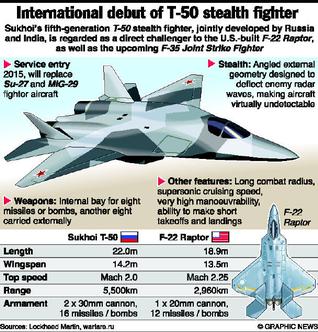
The T-50 resembles Russia’s best-selling Su-30 fighter jet but will have all its weapons hidden inside its body and wings to avoid radar detection and will fly at supersonic cruising speeds. The aircraft will also boast ultra manoeuvrability and high-technology avionics.
The Russian Air Force will begin testing the Perspective Frontline Aviation Complex, as the plane is called in Russia, in 2013 and will start inducting its mass-produced version from 2014, said the Russian Air Read more…
IBM develops first ‘brain chips’ capable of mimicking the process of human thought
 The challenge in training a computer to behave like a human brain has tested the limits of science for decades.
But researchers from IBM today said they have made a key step towards combining the two worlds.
The U.S. technology firm has built two prototype chips that it says process data more like how humans digest information than the chips that currently power PCs and supercomputers.
The chips represent a significant milestone in a six-year-long project that has involved 100 researchers and some $41million (£25million) in funding from the U.S. government’s Defense Advanced Research Projects Agency (Darpa). IBM has also committed an Read more…
Tiny Pocketbots Prepped for Combat
When the U.S. military first got serious about ground robots, it bought up a bunch of 42-pound machines called PackBots. The name implied that infantrymen would just throw the robots in their rucksacks. In reality, the things were too heavy for already-overloaded troops to carry around on the regular. The PackBot’s main Read more…
This U.S. Military Supercomputer Lab Just Bought A Bunch Of Chinese-Made Components

Image: UT Chattanooga
The U.S. lab that creates supercomputers to simulate tests flights of next-generation military aircraft and submarine warfare is closing a deal to buy a slew of Chinese components.
According to The Washington Times, the contract calls for wrapping U.S. made Symantec software around devices made by Chinese telecommunications conglomerate Huawei Technologies.
U.S. officials maintain Huawei has close ties with China’s military, but they own a 51 percent share of Symantec from a 2008 deal.
Four Republican Senators and one member of the House Select Committee on Intelligence are urging the Pentagon to re-think the arrangement and recognize the risks to national security.
“Given Huawei’s close ties to the [Chinese] government and its Read more…
New Chinese stealth jet raises question of Russian aid
 MOSCOW (Reuters) – Similarities between a new Chinese fighter jet and a prototype Russian plane have brought suggestions that Moscow may be quietly helping Beijing compete with the world’s military powers.
Experts say the fifth-generation J-20 fighter, which made its maiden flight in January during a visit of the U.S. defense secretary, could have its origins in the Mikoyan 1.44 stealth jet that never made it to the production line.
A highly placed source close to Russia’s defense industry said the similarities suggested Mikoyan technology had been passed into the hands of Chinese arms designers.
“It looks like they got access…to documents relating to the Mikoyan — the aircraft that the Ministry of Defense skipped over in its tender to create a stealth fighter,” he said, speaking on condition of anonymity.
He said it was not clear whether such a transfer of technology had been legal. Analysts say Russia’s assistance to the Chinese may Read more…
St. Joseph takes lunchtime high tech
Drake Aymond reaches out to use a palm scanner that relays information to the cafeteria computer at St. Joseph Catholic School. The new system provides a secure way to keep track of lunch balances, decreases the amount of time in lunch lines and provides security for each student’s account. / Jim Hudelson/The Times
Students at St. Joseph Catholic School are moving through the lunch line faster than ever thanks to biometric hand scanners.
The school, which houses more than 500 prekindergarten through eighth-grade students, this week began using new palm scanners in its cafeteria as a means for students to purchase lunch. The scanner creates an image of the student’s palm and relays that information to a database where the student’s account information is stored.
With the scan of a palm, the scanner is able to show medical and allergy information, as well as keep a running account balance that can notify parents when it becomes low.
Previously, the school used lunch identification numbers for students, but Principal Susan Belanger said the new technology makes lunchtime seamless.
“This technology not only expedites Read more…


![[Most Recent Quotes from www.kitco.com]](https://i0.wp.com/www.kitconet.com/charts/metals/gold/t24_au_en_usoz_2.gif)
![[Most Recent Quotes from www.kitco.com]](https://i0.wp.com/www.kitconet.com/charts/metals/silver/t24_ag_en_usoz_2.gif)

 crisisboom
 CRISISBOOM
You must be logged in to post a comment.