Archive
The Causes of Rising Food Prices
 Food prices are rising quickly around the world. Part of the problem is weather. The winter wheat crop in China has been poor. Australia has suffered floods, while Russia has undergone a drought. The earthquake and tsunami in Japan, no doubt, will hammer the very intensive agricultural production of the limited arable land on that archipelago. Weather-related agricultural problems, however, balance out fairly quickly. Mythical “global warming” aside, weather has ups and downs, and farmers, who are smart folks, take that into account. The Soviet Union, whose vassal state the Ukraine was once one of the best farmlands on earth, never managed to feed its people well, because a communist-controlled economy destroys Read more…
Currency Meltdown Coming
 By Greg Hunter’s USAWatchdog.com
The situation in Japan is getting worse, not better. There are shortages in food, fuel and warm dry shelter. To make matters exponentially worse, nuclear power plants there continue to burn out of control and emit high levels of radiation. Japan is a stark reminder of how fast a modern technologically advanced society can be brought to its knees by an unforeseen calamity.
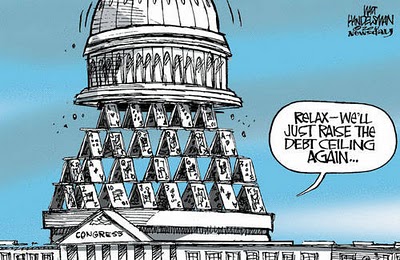
On the other side of the Pacific, the devastating pictures from that island nation are taking the attention away from our own, much more predictable, calamity coming from a tsunami of debt. As the U.S. and other world governments continue to print money to keep the banks and system solvent, a ball of debt is growing. It is on course to Read more…
Tsunami of Inflation to Hit U.S. with Japan Crisis
 The earthquake, tsunami, and nuclear disaster that hit Japan this past week and the destruction that it caused is nothing compared to the tsunami of inflation that will soon hit the U.S. as a result of this crisis. A tsunami of inflation in the U.S. will mean a complete collapse of our monetary system, which could lead to millions of deaths due to a lack of food and heat. 44 million Americans are now dependent on food stamps, but when the U.S. dollar becomes worthless as a result of hyperinflation, the government will no longer have the power to support these Americans and many of them will simply starve to death.
Japan’s citizens were smart enough to save up $885.9 billion in U.S. treasuries to spend in a situation like it finds itself in today. The U.S. has no such savings and is the world’s largest Read more…
Geologist Predicts Major N. America Earthquake Imminent (Video)
This is a very interesting interview with Jim Berkland who is an accredited geologist that worked with the U.S. Geological Survey and predicted the 1989 world series earthquake in San Francisco 4 days before its occurrence. Mr. Berkland explains the correlation regarding the super moon, equinoctial tide, strange animal deaths, and the current seismic window causing the earthquake catastrophes that we have witnessed in Chile, Sumatra, New Zealand, and currently Japan. My advice is if you are on the west coast and if you are able to-leave. I am not a fear monger but I do take precaution, especially with all of the accredited reports that are available all over the internet. Our heart and prayers are going out to all whom are affected by the quakes.
Japan’s nightmare gets even WORSE: All THREE damaged nuclear reactors now in ‘meltdown’ at tsunami-hit power station
The Japanese nuclear reactor hit by the tsunami went into ‘meltdown’ today, as officials admitted that fuel rods appear to be melting inside three damaged reactors.
There is a risk that molten nuclear fuel can melt through the reactor’s safety barriers and cause a serious radiation leak.
There have already been explosions inside two over-heating reactors at the Fukushima Dai-ichi nuclear plant, and the fuel rods inside a third were partially exposed as engineers desperately fight to keep them cool after the tsunami knocked out systems.
 ‘Meltdown’: The Fukushima Daiichi nuclear plant moments after Read more…
Shinmoedake volcano erupts in Japan
A volcano in southwestern Japan erupted Sunday after nearly two weeks of relative silence, sending ash and rocks up to four kilometres (two and a half miles) into the air, a local official says.
 It was not immediately clear if the eruption was a direct result of the massive 8.9-magnitude earthquake that rocked northern areas Friday, unleashing a fierce tsunami and sparking fears that more than 10,000 may have been killed.
The 1,421-metre (4,689-feet) Shinmoedake volcano in the Kirishima range saw its first major eruption for 52 years in January. There had not been any major activity at the site since March 1.
Authorities have maintained a volcano warning at a level of three out of five, restricting access to the entire mountain.
In April last year, the eruption of the Eyjafjoell volcano in Iceland dispersed a vast cloud of ash, triggering a huge shutdown of airspace that affected more than 100,000 flights and eight million passengers.
Japan may have hours to prevent nuclear meltdown
NEW YORK (Reuters) – Japanese officials may only have hours to cool reactors that have been disabled by Friday’s massive earthquake and tsunami or face a nuclear meltdown.
Tokyo Electric Power Co (TEPCO) (9501.T) is racing to cool down the reactor core after a highly unusual “station blackout” — the total loss of power necessary to keep water circulating through the plant to prevent overheating.
Daiichi Units 1, 2 and 3 reactors shut down automatically at 2:46 p.m. local time due to the earthquake. But about an hour later, the on-site diesel back-up generators also shut, leaving the reactors without Read more…
E. Asia, S. America under tsunami warning after Japan quake
03/11/2011 10:45
Biggest earthquake to hit Japan in 140 years triggers 10-meter tsunami, kills at least 6 people; 4 million homes without power; hotel collapses in city of Sendai, people feared buried in rubble; UN rescue teams on standby.
SINGAPORE – A tsunami warning has been issued for areas across East Asia and the western coast of South America following a huge earthquake that hit Japan on Friday, the Pacific Tsunami Warning Center said.
Among the countries for which a tsunami warning is in effect are: Read more…
Quake Shakes Northeast Japan

A hefty earthquake jolted northeastern Japan shortly before noon on Wednesday, providing an unwelcome reminder of just how prone to seismic activity the country is 2 weeks after the Christchurch disaster.
While the 7.2 magnitude quake was centered 160 kilometers off the coast and was about 14 kilometers underwater, according to the U.S. Geological Survey, it was felt all the way down to central Tokyo’s Otemachi business district – 416 kilometers to the south.
Though there weren’t immediate reports of damage, the Japan Meteorological Agency immediately issued a tsunami alert for parts of the northeastern coast of Japan, predicting modest waves of up to 50 centimeters.
Chile: fifth earthquake in three days

Shaky ground: A local resident hurries to abandon the waterfront after an earthquake in Constitucion, south from Santiago, on February 11, 2011. Picture: Diego Garcia Source: AFP
A MAGNITUDE 5.6 earthquake struck Chile – the third to hit within hours and the fifth tremor in three days.
The latest tremor hit 41 kilometres northwest of the central city of Concepcion at a depth of 17.7 kilometres. The quakes earlier in the day measured 6.0 and 5.8.
On Friday two quakes – measuring 6.3 and a 6.8 – rattled the region.
All the tremors have occurred in the same area heavily damaged by an 8.8 magnitude quake nearly a year ago.
That disaster resulted in more than 500 deaths and $30 billion in damage, and led to an inquiry over the lack of a timely tsunami warning.


![[Most Recent Quotes from www.kitco.com]](https://i0.wp.com/www.kitconet.com/charts/metals/gold/t24_au_en_usoz_2.gif)
![[Most Recent Quotes from www.kitco.com]](https://i0.wp.com/www.kitconet.com/charts/metals/silver/t24_ag_en_usoz_2.gif)

 crisisboom
 CRISISBOOM
You must be logged in to post a comment.