Archive
South Africa and China a match made in heaven
 Trade between China and South Africa is gaining momentum and for those companies who may have ignored this growing trade relationship in the past, are now forced to recognize the potential for doing business with China.
According to The China Inc meets SA Inc Business Forum, not only is there room for growth in trade between South Africa and China, but China is viewing the well-developed infrastructure South Africa provides as the key to unlocking the gateway into the rest of Africa.
In 2009, China surpassed the United States, to become South Africa’s largest export destination, whith trade between China and South Africa reached USD 16 billion in 2009.
With the signing of various cooperation deals in August 2010, by President Zuma during his State visit to China, this figure is expected to grow as China looks to export raw materials to fuel its booming economy.
The recent deals signed by Zuma focus on the mineral resources sector, railway development, construction industry as well as the mining sector and finally power transmission and nuclear power.
So for South Africa, doing business with China is good business my china. Far better than doing business with the US and Europe who are only looking for new markets for their goods without offering the same for our goods. This attitude by the developed world, the US in particular, is the reason the Doha negotiations are still deadlocked since 2001.
Its objective is to lower trade barriers around the world, which allows countries to increase trade globally. Talks have stalled over a divide on major issues, such as agriculture, industrial tariffs and non-tariff barriers, services, and trade remedies. The most significant differences are between developed nations led by the European Union (EU), the United States (USA), and Japan and the major developing countries led and represented mainly by Brazil, China, India, South Korea, and South Africa. There is also considerable contention against and between the EU and the USA over their maintenance of agricultural subsidies—seen to operate effectively as trade barriers.
To think that it was the US that first proposed the removal of agricultural subsidies in the first place. Developing countries were first to foolishly remove the subsidies to their detriment.
So more trade between developing countries make better sense as they trade on an equal footing and there is very little chance of blackmail or brinksmanship.
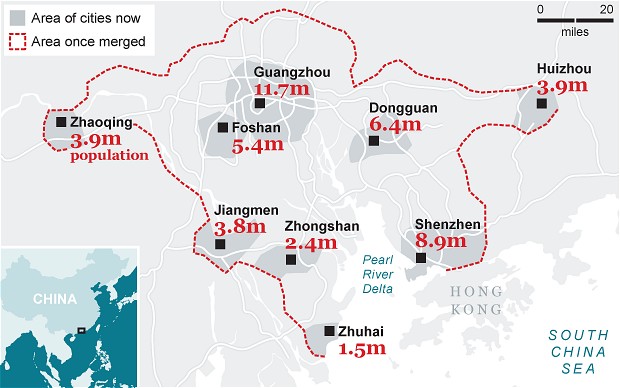
China Plans A New Mega City: Population, 42 Million
 A city the size of Switzerland? If China gets its way, yes.
Some ambitious apparatchiks in southern China want to combine 9 cities to create an urban area the size of New Jersey and Vermont combined.
The plan, announced in state media, would unite several existing cities in the prosperous Pearl River Delta region, including Guangzhou (12 million), Shenzhen (8.6 million), Dongguan (6.9 million) and six smaller cities. Together, these cities already account for about 10% of China’s economy, the Telegraph notes.
The Party’s planners hope improved transport links and better infrastructure be beneficial to the population and to greater economic efficiencies . Other areas in China are facing a similar gravitational pull to merge together, notably Beijing with its southern smaller twin Tianjin, already joined by a high speed train link.
Rich neighbors Hong Kong and Macau will not join the super sprawl, but it’s safe to assume that they’d like to have a say in larger regional themes, like pollution control.
The godzilla-like territory has yet to be named.
China Funneling Weapons to Afghanistan
Originally published on www.DarkGovernment.com
The Chinese are believed to be working with Afghan Taliban groups who are now in combat with NATO forces, prompting concerns that China might become the conduit for shoulder-fired anti-aircraft missiles, improved communications and additional small arms to the fundamentalist Muslim fighters.
 QW-1M / SA-18 Grouse Anti-Aircraft Weapon
A British military official contends that Chinese specialists have been seen training Taliban fighters in the use of infrared-guided surface-to-air missiles. This is supported by a May 13, 2008, classified U.S. State Department document released by WikiLeaks telling U.S. officials to confront Chinese officials about missile proliferation.
China is developing knock-offs of Russian-designed man-portable air defense missiles (manpads), including the QW-1 and later series models. The QW-1 Vanguard is an all-aspect, 35-lb. launch tube and missile that is reverse-engineered from the U.S. Stinger and the SA-16 Gimlet (9K310 Igla-1). China obtained SA-16s from Unita rebels in then-Zaire who had captured them from Angolan government forces. The 16g missiles have a slant range of 50,000 ft. The QW-1M is a variant that incorporates even more advanced SA-18 Grouse (9K38 Igla) technology. Read more…
China used downed U.S. fighter to develop first stealth jet
China was able to build its first stealth bomber using technology gleaned from a downed U.S. fighter, it has been claimed.
Beijing unveiled its state-of-the-art jet – the Chengdu J-20 – earlier this month.
Military officials say it is likely the Chinese were able to develop the stealth technology from parts of an American F-117 Nighthawk that was shot down over Serbia in 1999.
 Lift-off: China’s J-20 stealth plane has made a successful test flight. Military officials say it is likely the Chinese were able to develop the stealth technology from parts of an American F-117 Nighthawk that was shot down over Serbia in 1999
 It was during Nato’s aerial bombing of Serbia during the Kosovo war, that an anti-aircraft missile shot a Nighthawk (pictured). It was the first time one of the ‘invisible’ fighters had ever been hit
During Nato’s aerial bombing of the country during the Kosovo war, a Serbian anti-aircraft missile shot the Nighthawk. It was the first time one of the ‘invisible’ fighters had ever been hit.
The Pentagon believed a combination of clever tactics and luck had allowed a Soviet- Read more…
Gold is to China as paper currency is to US
Bill Bonner
 We’d still like to see a deep decline in the gold price. Too many people are getting onto gold. Most of them have no idea of what they are doing. Like readers of MONEY magazine, they’re buying the yellow metal as a speculation. Most likely they’re going to lose money. Almost everyone who speculates on gold loses money. Don’t ask us why. It’s just one of those Iron Laws of investing.
Gold goes up for 10 years straight. Speculators notice. They jump on board. And then the train runs off the tracks.
That’s just the way it works.
Besides, remember that this Great Correction is not over yet…not by a long shot. It has barely begun to correct the excesses of the Bubble Era. A quarter of all homeowners are said to be underwater on their mortgages – that still needs to be sorted out. And the whole financial industry – with the collusion of the Fed – is sitting on trillions of dollars’ worth of mortgage backed securities, pretending that they are good credits.
There are still major bankruptcies ahead…and deflation of assets prices. And in all the sturm and drang of it, the price of gold could go down too.
But if you’re acquiring gold, you have some powerful competition. As nations become rich and powerful, they accumulate gold. Those that are getting weak and poor give it up. Here’s The Financial Times with the latest news: Read more…
China’s coming fall
 Like the Soviet Union before it, much of China’s supposed boom is illusory — and just as likely to come crashing down
In 1975, while I was in Siberia on a two-month trip through the U.S.S.R., the illusion of the Soviet Union’s rise became self-evident. In the major cities, the downtowns seemed modern, comparable to what you might see in a North American city. But a 20-minute walk from the centre of downtown revealed another world — people filling water buckets at communal pumps at street corners. The U.S.S.R. could put a man in space and dazzle the world with scores of other accomplishments yet it could not satisfy the basic needs of its citizens. That economic system, though it would largely fool the West until its final collapse 15 years later, was bankrupt, and obviously so to anyone who saw the contradictions in Soviet society.
The Chinese economy today parallels that of the latter-day Soviet Union — immense accomplishments co-existing with immense failures. In some ways, China’s stability today is more precarious than was the Soviet Union’s before its fall. China’s poor are poorer than the Soviet Union’s poor, and they are much more numerous — about one billion in a country of 1.3 billion. Moreover, in the Soviet Union there was no sizeable middle class — just about everyone was poor and shared in the same hardships, avoiding resentments that might otherwise have arisen.
In China, the resentments are palpable. Many of the 300 million people who have risen out of poverty flaunt their new wealth, often egregiously so. This is especially so with the new class of rich, all but non-existent just a few years ago, which now includes some 500,000 millionaires and 200 billionaires. Worse, the gap between rich and poor has been increasing. Ominously, the bottom billion views as illegitimate the wealth of the top 300 million. Read more…
Chinese Silver Demand Surges Incredible Four Fold in Just One Year
Gold is flat and silver marginally lower despite dollar weakness this morning. Some market participants are blaming the precious metal sell off on speculation that China may take more monetary action to curb surging inflation. This is unlikely to be the reason for the sharp selloff, rather it looks like another paper driven sell off in the futures market by leveraged players on Wall Street with various motives.

The fact that silver is again in backwardation at the front end of the curve suggests that tightness in the physical bullion market continues and may even be deepening. Indeed, the massive increase in silver bullion demand from China (confirmed overnight – see below) suggests that silver’s bull market remains very much intact despite becoming overvalued in the short term towards the end of 2010.

Table Courtesy of Mitsui
Surging inflation in China, India, wider Asia and much of the world is of course positive for gold and silver as it will likely lead to an even greater appetite for the precious metals in order to protect against the ravages of inflation and the further depreciation of paper currencies. Read more…
China’s Inflation Problem Looms Large
Peter Schiff
 |
The global economy has become so unbalanced that even government ministers who would normally have trouble explaining supply or demand clearly recognize that something has to give. To a very large extent the distortions are caused by China’s long-standing policy of pegging its currency, the yuan, to the U.S. dollar. But as China’s economy gains strength, and the American economy weakens, the cost and difficulty of maintaining the peg become ever greater, and eventually outweigh the benefits that the policy supposedly delivers to China. In the first few weeks of 2011 fresh evidence has arisen that shows just how difficult it has become for Beijing.
Twenty years ago, China’s leaders decided to ditch the disaster of economic communism in favor of privatized, export-focused, industry. The plan largely worked. Over that time, China has arguably moved more people out of poverty in the shortest amount of time in the history of the planet. But somewhere along the way, China’s leaders became addicted to a game plan that outlived its usefulness.
In order to maintain the peg, China must continually buy dollars on the open market. But the weaker the dollar gets, the more dollars China must buy. And with the U.S. Federal Reserve pulling out all the stops to create inflation and push down the dollar, Beijing’s task becomes nearly impossible. Last week, it was announced that China’s foreign exchange reserves, the amount of foreign currency held at its central bank (mostly in U.S. dollars), increased by a record $199 billion in 4th quarter 2010, to reach $2.85 trillion. These reserves currently account for a staggering 49% of China’s annual GDP (if the same proportional amount were held by the U.S., our measly $46 billion in reserves would have to increase 163 times to $7.5 trillion).
In order to buy these dollars, the Chinese central bank must print its own currency. In essence, China is adopting the Fed’s expansionary monetary policy. In the U.S. the inflationary impact of such a strategy is mitigated by our ability to export paper dollars in exchange for inexpensive Chinese imports. Although prices are rising here, they are not rising nearly as much as they would if we had to spend all this newly printed money on domestically produced goods. The big problem for China is that, unlike the U.S., the newly printed yuan are not exported, but remain in China bidding up consumer prices. As a result, inflation is becoming China’s dominant political issue.
It was recently announced that in November China’s consumer price index rose 5.1% from the same time a year earlier, with food prices rising more than 10%. As unrest builds, the Chinese government has unleashed a series of policies to address the symptoms of the disease while ignoring its root cause.
China buys gold and the world follows
 “We are entering a period of strong seasonal growth in gold demand and Chinese New Year is a big part of that,” said Brien Lundin, editor of Gold Newsletter. “Physical demand has been supporting the gold prices on the downside even during the typical slack periods, and I expect that upcoming increase in demand will also support the price, but at higher levels.”
The Chinese New Year, also known as Lunar New Year, begins on Feb. 3 this year and ends with the Lantern Festival 15 days later.
“Chinese gold and silver demand has been phenomenal ahead of the New Year holiday,” said Adrian Ash, head of research at BullionVault.com, a leading online service for gold bullion trading and ownership, citing comments from dealers among others.
Shipments have been “heavy” and they began very early, in mid-December, he said. Read more…
Jim Rogers Says $200 Oil Will Lead Massive Commodity Surge
When it comes to state visits the devil is in the detail. It’s the nuances of the arrangements that allow you to calibrate just how important a relationship is. That’s why the world has been watching the visit of the Chinese President Hu Jintao with such attention. The state dinner at the White House – described as an “intimate” event – apparently signifies that Washington rates China as pretty much the most important nation, economically, on earth. But the visit has also prompted much speculation in the press about how long the Chinese economic miracle can last and whether it is about to come to a juddering halt. Jim Rogers, the legendary investor who co-founded the Quantum Fund with George Soros, has moved his family to Singapore and is making sure his two young daughters can speak Mandarin. He spoke to the Business Daily’s Justin Rowlatt.
Transcript is below
 Jim Rogers: The largest creditor nations in the world are in Asia now: China, Korea, Japan, Hong Kong. This is where the assets are. You know who the debtors are and where they are.
Justin Rowlatt: But listen, I mean the Chinese economy is still way behind the American economy is and it is about the third the size of the American economy.
Jim Rogers: Yes, of course. They had a disaster for 300 years, but about 30 years ago, they woke up, they changed their minds and they said we got to try something new. They unleashed entrepreneurship and capitalism again, and they have been astonishing for 30 years. It takes a while to go from a disaster to rival the Americans, but they are on their way.
Justin Rowlatt: Do you really believe the Chinese boom can continue, because lots of people are saying there are all sorts of asset price bubbles that are going to trip the Chinese up in the coming years?
Jim Rogers: Well, the only asset bubble I see potentially in China is in urban coastal real estate, but real estate is not nearly the entire Chinese economy as it was in America and the U.K. Sure, they will have setbacks.
Justin, in the 19th Century, America had a horrible civil war. We had 15 depressions with a ‘D.’ We had very few human rights. We had massacres in the streets regularly. We had very little rule of law. You could buy and sell – you can still buy and sell congressmen in America, but in those days they were cheap. America had horrible problems, but they came out of that and had a pretty good 20th Century. Read more…


![[Most Recent Quotes from www.kitco.com]](https://i0.wp.com/www.kitconet.com/charts/metals/gold/t24_au_en_usoz_2.gif)
![[Most Recent Quotes from www.kitco.com]](https://i0.wp.com/www.kitconet.com/charts/metals/silver/t24_ag_en_usoz_2.gif)

 crisisboom
 CRISISBOOM
You must be logged in to post a comment.