Archive
Air travelers may have been exposed to measles
 WASHINGTON (AP) — Public health officials are warning travelers and workers present at four U.S. airports on two recent days that they may have been exposed to measles from a traveler arriving from London.
Authorities said Saturday that a New Mexico woman later confirmed to have measles arrived at Washington Dulles International Airport late in the afternoon of Feb. 20. Two days later, the measles-infected traveler departed from BWI Thurgood Marshall Airport near Baltimore on an evening flight to Denver, Colo., and then on to Albuquerque, N.M.
The traveler became sick and was subsequently diagnosed with measles in New Mexico, said Tom Skinner, a spokesman for the Atlanta-based Centers for Disease Control and Prevention. He said Saturday night that authorities in those states are trying to notify Read more…
Tree-killing disease found in Florida
The Associated Press
 MIAMI — The Florida Department of Agriculture and Consumer Services has positively identified the presence of a destructive disease that affects avocado trees and other trees in the laurel family.
State and federal agriculture experts say laurel wilt disease has been detected on three swamp bay trees in Miami Dade County.
The fungal disease is spread by the redbay ambrosia beetle.
If the disease spreads, it could potentially harm Florida’s avocado industry, which represents nearly $13 million to the local economy, with more than 6,773 production acres in Miami-Dade County, with some acreage in Collier County.
AP IMPACT: Past medical testing on humans revealed

In this June 25, 1945 picture, army doctors expose patients to malaria-carrying mosquitoes in the malaria ward at Stateville Penitentiary in Crest Hill, Ill. Around the time of World War II, prisoners were enlisted to help the war effort by participating in studies that could help the troops. A series of malaria studies at Stateville Penitentiary in Illinois and two other penitentiaries were designed to test antimalarial drugs that could help soldiers fighting in the Pacific. Shocking as it may seem, government doctors once thought it was fine to experiment on disabled people and prison inmates.
By MIKE STOBBE,
ATLANTA – Shocking as it may seem, U.S. government doctors once thought it was fine to experiment on disabled people and prison inmates. Such experiments included giving hepatitis to mental patients in Connecticut, squirting a pandemic flu virus up the noses of prisoners in Maryland, and injecting cancer cells into chronically ill people at a New York hospital.
Much of this horrific history is 40 to 80 years old, but it is the backdrop for a meeting in Washington this week by a presidential bioethics commission. The meeting was triggered by the government’s apology last fall for federal doctors infecting prisoners and mental patients in Guatemala with syphilis 65 years ago.
U.S. officials also acknowledged there had been dozens of similar experiments in the United States — studies that often involved making healthy people sick.
An exhaustive review by The Associated Press of medical journal reports and decades-old press clippings found more than 40 such studies. At best, these were a search for lifesaving treatments; at worst, some amounted to curiosity-satisfying experiments that hurt people but provided no useful results.
Inevitably, they will be compared to the well-known Tuskegee syphilis study. In that episode, U.S. health officials tracked 600 black men in Alabama who already had syphilis but didn’t give them adequate treatment even after penicillin became available.
These studies were worse in at least one respect — they violated the Read more…
Poultry farmers on bird flu alert
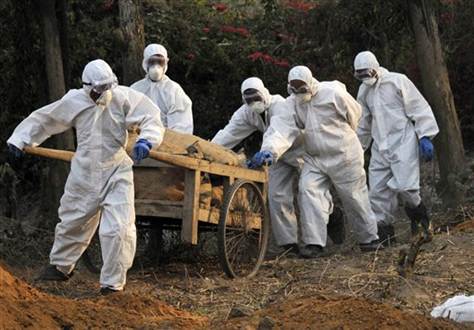
“We have asked poultry farmers to report any unusual and large-scale deaths so as to take the necessary measures to confirm if there is any outbreak of bird flu here,” said Dr Y Thirupathaiah, additional director, planning, directorate of animal husbandry.
In 2006, bird flu fear led to losses worth crores of rupees in the state as poultry birds had to be culled in large numbers and eggs were also destroyed.
In case of any signs of bird flu in the state, the serum samples will have to be Read more…
Global warming could increase diseases originating from water sources

WASHINGTON (AFP) – Climate change could increase exposure to water-borne diseases originating in oceans, lakes and coastal ecosystems, and the impact could be felt within 10 years, US scientists told a conference in Washington on Saturday.
Several studies have shown that shifts brought about by climate change make ocean and freshwater environments more susceptible to toxic algae blooms and allow harmful microbes and bacteria to proliferate, researchers from the National Oceanic and Atmospheric Administration said.
In one study, NOAA scientists modeled future ocean and weather patterns to predict the effect on blooms of Alexandrium catenella, or the toxic “red tide,” which can accumulate in shellfish and cause symptoms, including paralysis, and can sometimes be deadly to humans who eat the Read more…
Biodefense Scientists Fight Lassa Fever
 Scientists are at work in Sierra Leone studying the rat-carried Lassa fever with the aim of developing a speedy and uncomplicated process for diagnosing the virus in the event of a bioterrorism attack, Reuters reported yesterday (see GSN, Nov. 23, 2010).
A laboratory in Sierra Leone’s southeast is conducting U.S.-funded research on Lassa fever, which is classified as a “category A” pathogen, a designation given to biological agents such as botulism and anthrax that can produce significant health threats.
The disease is found in a particular species of rat that is widespread in sub-Saharan Africa and regularly consumed for Read more…
US study links pesticides to Parkinson’s disease

The pesticides, paraquat and rotenone, are not approved for house and garden use. Previous research on animals has linked paraquat to Parkinson’s disease, so it is restricted to use by certified applicators.
Rotenone is approved only for use in killing invasive fish species.
“Rotenone directly inhibits the function of the mitochondria, the structure responsible for making energy in the cell,” said study co-author Freya Kamel, a researcher at the National Institute of Environmental Health Sciences.
“Paraquat increases production of certain oxygen derivatives that may harm cellular structures. People who used these pesticides or others with a similar mechanism of action were more likely to develop Parkinson’s disease.”
The study examined 110 people with Parkinson’s disease and 358 people who served as a control group from the Farming and Movement Evaluation (FAME) Study.
FAME is part of a larger Agricultural Health Study looking at the health of approximately 90,000 licensed pesticide applicators and their spouses.
The study appears in the journal Environmental Health Perspectives.
S. Korea confirms 2 more bird flu outbreaks
 SEOUL, Feb. 13 (Yonhap) — South Korea on Sunday confirmed two additional bird flu outbreaks in areas near Seoul despite nationwide efforts to stem the spread of the disease.
The farm ministry said the new cases were reported at a medium-sized duck farm and a small poultry farm that raises chickens and ducks, which reported symptoms earlier in the week.
All 8,400 birds on the two farms in Hwaseong south of Seoul and Dongducheon north of the capital have been culled and buried, with other bird farms within a 3-kilometer radius being checked for infections.
The outbreaks are the Read more…
North Korea confirms large-scale foot-and-mouth disease outbreak
PYONGYANG: North Korean state media on Friday acknowledged for the first time that foot-and-mouth disease has broken out in the Asian country, affecting eight provinces.

KCNA said the most seriously affected areas are Pyongyang, North Hwanghae Province and Kangwon Province. Other areas which have been affected are North and South Phyongan Provinces and Jagang Province, although the other three affected provinces were not identified.
“Type O Foot-and-mouth diseases broke out on cooperative farms, diary farms and pig farms in those areas, doing harm to domestic animals,” KCNA said. “More than 10 000 heads of draught oxen, milch cows and pigs have so far been infected with the diseases and thousands of them died.”
The state broadcaster said a national emergency veterinary and anti-epizootic committee has since been established. “An emergency anti-epidemic campaign was Read more…
CDC: Deadly Superbug “C-Diff” Spreading

CDC officals say Clostridium Difficile is killing more people each year.
Reporting Kate Merrill
DENNIS (CBS) – Three months after having knee replacement surgery, Kathleen Powers of Dennis is finally feeling well enough to do something as simple as make herself a cup of tea.
Her slow recovery has nothing to do with her knee. An infection she picked up either in the hospital or in the rehab facility ravaged her digestive system. “You feel like all of your life’s energy is being sucked out of you,” she said.
Tests confirmed Kathleen had C-Diff which is short for Clostridium Difficile. It’s a bacterium that attacks your intestines.
“You feel like you’re not going to get better and you feel like you’re dying,” she said.
According to the Centers for Disease Control, C-Diff kills thousands of people every year and that number is growing.
“It’s between three and six-fold more common than Read more…


![[Most Recent Quotes from www.kitco.com]](https://i0.wp.com/www.kitconet.com/charts/metals/gold/t24_au_en_usoz_2.gif)
![[Most Recent Quotes from www.kitco.com]](https://i0.wp.com/www.kitconet.com/charts/metals/silver/t24_ag_en_usoz_2.gif)

 crisisboom
 CRISISBOOM
You must be logged in to post a comment.