Archive
Africa battles worst drought in 60 years, aid agencies warn
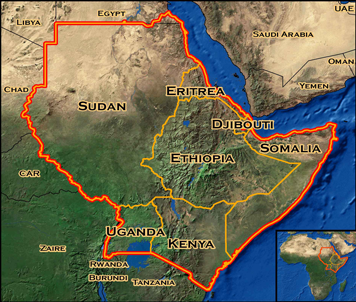 With the UN warning that both East and the Horn of Africa have been hit by the worst drought in 60 years, international aid agencies have warned of an alarming gap in the food pipeline to reach those most in need.
More than 10 million people are thought to be affected across the East African region. The UN says that large swathes of central Kenya and Somalia are now in the “emergency” category, one phase before what is officially classified as famine.
The crisis is most acute in Somalia, Ethiopia and; central and northern Kenya. Refugees are now arriving at the Somali camps in northern Kenya, at a rate of 1,200 every day.
Aid agencies told the UK-based Independent on Sunday, of the terrible plight of Read more…
Drought conditions taking toll on Texas lakes
 The boat ramps at Lake Medina just seem to go on and on. What used to be only a few feet to the water are now hundreds of feet and getting further every day. While Medina is by far the lowest of the area lakes, it isn’t alone in its shrinking shoreline.
Medina Lake is down almost 30 feet, Canyon Lake is down 5 feet, Lake Buchanan is down 14 feet; even Lake Travis is down 34 feet.
The summer drought has depleted these reservoirs one by one, with areas of shoreline exposed for the sun for the first time in two years.
Across the state, the combined totals of Texas’s reservoirs are down to 71.8 percent, a decline of almost five percent since May 22, with lake levels dropping a combine 2,700,000 feet. Read more…
European drought raises fears of food riots

The cracked river-bed near the village of Ancenis, in western France, where severe water restrictions have been impressed. Picture: AFP Source: AFP
BERNARD Maquis’s cattle would normally be grazing in the lush green pastures of the Limousin region, in central France, at this time of year.
Instead, they are eating hay intended for the winter after months of drought have turned the fields yellow.
He is wondering whether it might be better to sell his cows at a reduced price rather than find himself without fodder by the end of the autumn. “I’m starting to sleep badly,” he said.
Mr Maquis is not alone. With northern Europe facing its worst drought since 1976, politicians in the West are expecting protests Read more…
Drought continues to tighten its grip on Georgia

UNDATED – The drought continues to push deeper into north Georgia while making it difficult for south Georgia farmers to plant two key crops.
A new report shows roughly 77 percent of the state’s cotton crop and 80 percent of the peanut crop have been planted.
The driest conditions in the state continue to be two pockets in southwest and southeast Georgia.
Meanwhile, the U.S. Drought Monitor says the drought has now pushed as far north as southern Habersham County, south Dawson and south Forsyth, extending westward to the Alabama line near Carrollton and LaGrange. Gainesville and all of Hall County are now considered in a drought. Conditions in all of these areas are considered “abnormally” dry.
A swath of counties just Read more…
China drought ignites global grain supply concerns
 A prolonged drought in China could hit grains output in key growing regions, further squeezing global supplies and putting upward pressure on prices, but plentiful domestic wheat stocks will act as a cushion and keep import volumes low.
Analysts are closely watching the weather in China, warning any further supply shocks in the grain markets would fuel a further rally in U.S. corn and wheat futures, already stoked by harsh crop weather in the United States and Europe.
“Parts of China have been too dry and if we did see crop failures in that part of the world they are going to look to the global market for supplies,” said Luke Mathews, a commodity strategist with Commonwealth Bank of Australia in Sydney.
“They are going to be looking to North America and Europe and there is significant amount of concern whether those particular countries will be able to satisfy those needs.”
Chicago Board of Trade corn has climbed 80 percent since the start of May last year, while wheat has risen around 50 percent. Last week alone corn and wheat jumped more than 10 percent on expectations of a global squeeze in supplies.
CROP CONCERNS & TIGHT GLOBAL SUPPLIES
Timely corn seeding is crucial for optimal yields needed to replenish U.S. supplies that are projected at the lowest level in 15 years amid strong demand from livestock feeders, ethanol makers and exporters.
About 80 percent of the U.S. corn crop has been planted, according to the U.S. Agriculture Department, but showers this week are expected to bring the final corn seedings to Read more…
China’s Yangtze river closed to ships by severe drought
The Yangtze river, the longest waterway in Asia and China’s most important shipping route, has been closed by the worst drought in 50 years that has left cargo ships stranded and 400,000 people without drinking water.

Water-levels have sunk as low as 10ft in the main thoroughfare of the 3,900-mile long river that stretches from the glaciers of the Tibetan plateau to the coastal city of Shanghai.
The Yangtze river basin is home to one-third of China’s population and is responsible for 40 per cent of the country’s economic growth.
Emergency teams have been sent to the river’s middle reaches around Wuhan in the central province of Hubei, to rescue two ships Read more…
Climate Record Suggesting Severe Tropical Droughts as Northern Temperatures Rise
 Laguna Pumacocha in the Peruvian Andes. |
A 2,300-year climate record Universityof Pittsburgh researchers recovered from an Andes Mountains lake reveals that as temperatures in the Northern Hemisphere rise, the planet’s densely populated tropical regions will most likely experience severe water shortages as the crucial summer monsoons become drier. The Pitt team found that equatorial regions of South America already are receiving less rainfall than at any point in the past millennium.
The researchers report in the Proceedings of the National Academy of Sciences (PNAS) that a nearly 6-foot-long sediment core from Laguna Pumacocha in Peru contains the most detailed geochemical record of tropical climate fluctuations yet uncovered. The core shows pronounced dry and wet phases of the South American summer monsoons and corresponds with existing geological data of precipitation changes in the surrounding regions.
Paired with these sources, the sediment record illustrated that rainfall during the South American summer monsoon has dropped sharply since 1900-exhibiting the greatest shift in precipitation since around Read more…
Grains Wilt in Dry Europe as England Posts Its Hottest April in 352 Years
Dry, warm weather in Europe may reduce global wheat stockpiles already expected to fall 7.6 percent in the year that ends on May 31, the biggest decline since 2007. Photographer: Simon Dawson/Bloomberg
Dry weather in France and Germany and England’s hottest April in at least 352 years are threatening crops across the European Union, producer of a fifth of the world’s wheat.
About 20 percent of average rain fell in the U.K. in April after a dry March, further reducing soil moisture, the Home- Grown Cereals Authority, an industry group, said in an e-mailed report. European wheat and rapeseed crops are “in jeopardy” after an “incredibly dry” April, according to agricultural weather forecaster Martell Crop Projections.
Dry, warm weather in Europe may reduce global wheat stockpiles already expected to fall 7.6 percent in the year that ends on May 31, the biggest decline since 2007. Food prices reached a record in February, driving 44 million people into poverty, and wheat consumption may rise to an all-time high this year. The world “cannot afford” for Europe’s crop to be diminished, Abdolreza Abbassian, a senior economist at the United Nations’ Food and Agriculture Organization, said last month.
“The world needs a bumper crop in all grains from the U.S. and from Europe and from Canada or we are in trouble,” Dennis Gartman, an economist and author of The Gartman Letter, said today by e-mail. “The winter wheat crop here is in trouble, and the spring wheat crop in the Dakotas and the Canadian prairies may be very badly delayed and therefore in Read more…
Texas Drought worst since 1895
 The drought in Texas, during March, was the worst since 1895.
That is about the time my parents were born 120 years ago.
I never thought it could be worse than the drought of the 1950s, but it is. Drive out into grazing country where mesquite aren’t too thick and all you can see is dry, cracked soil with an occasional fire ant or a gopher mound in the sandier soil.
Comparing the current drought with the seven-year drought in the 1950s, old-timers say the current drought sapped the soil of moisture faster than it did in the 1950s.
It just stopped raining last July, and pasture after pasture was hit by wildfires.
Right now, there is no potential to produce hay, harvest wheat or plant cotton or grain sorghum this May. Unless there is a week of rain fairly soon there is no hope for agriculture this year.
The Texas Ag Extension Service says that, despite a few recent showers in some areas, the cotton growing in Texas and Oklahoma is still in a drought. Any crop planted in southern Texas earlier in the year that got up out of the ground is now being sand blasted by hot, dry winds.
Wildfires have burned at least 1.5 million acres in the state since Jan. 1.
In addition to grazing losses, ranchers are facing rangeland stock water tanks that are dry or nearly dry. Streams are not flowing and lakes and big tanks are turning to deep mud.
Europe is facing the worst drought in century

Traditional Easter fairs in the east and the north of the Netherlands have been cancelled because of the risk of fires posed by the extraordinarily dry weather affecting northern Europe. In the eastern half of the country, one of Europe’s biggest traders, outdoor family barbecues, smoking and camp fires are a strict no-no.
In the Swiss canton of Zurich, officials began moving trout this week from the river Toess before their habitat dried up. This year threatens to bring “one of the most significant droughts since 1864,” the year when records began in Switzerland. The drought in western Switzerland over the last 12 months is as severe as those recorded in 1884 and 1921. Several cantons have also imposed bans on lighting fire in and close to forests. A grass shortage could also lead to a Read more…


![[Most Recent Quotes from www.kitco.com]](https://i0.wp.com/www.kitconet.com/charts/metals/gold/t24_au_en_usoz_2.gif)
![[Most Recent Quotes from www.kitco.com]](https://i0.wp.com/www.kitconet.com/charts/metals/silver/t24_ag_en_usoz_2.gif)

 crisisboom
 CRISISBOOM
You must be logged in to post a comment.