Archive
U.S. West Coast Erosion Spiked In Winter 2009-10, Previewing Likely Future As Climate Changes
Knowing that the U.S. West Coast was battered during the winter before last by a climatic pattern expected more often in the future, scientists have now pieced together a San Diego-to-Seattle assessment of the damage wrought by that winter’s extreme waves and higher-than-usual water levels. Getting a better understanding of how the 2009–10 conditions tore away and reshaped shorelines will help coastal experts better predict future changes that may be in store for the Pacific coast, the researchers say.

Credit: Patrick Barnard, USGS

Mexico City is sinking! More gigantic earthcracks in Valley of Mexico

Excelsior was reporting about the crack which appeared on 13 July in Santa Maria Huejoculco in Chalco, State Mexico. The earthcrack has now reached 1500 meters long. Just after survey work was detected in Santa Maria Huejoculco yet another gap of about four km which reaches La Candelaria Tlapala, was found in the community of Miraflores, in Chalco. This event began back 2009 in a small area of this region but since that time, it has grown and opened to devour everything around it. The continued sinking of some parts of Read more…
2011: Headed for Record Arctic Melt?
 July 11, 2011: Arctic sea ice, seen by satellite. Credit: NASA.
This year could be well on its way toward earning a dubious spot in the record books.
Arctic sea ice has melted away with astonishing speed in the first half of July, at an average rate of about 46,000 square miles (120,000 square kilometers) per day, according to the National Snow and Ice Data Center (NSIDC) in Boulder, Colo.
That’s equivalent to an area roughly the size of Pennsylvania melting into the sea every 24 hours.
“That’s relatively fast,” said Julienne Stroeve, a research scientist at the NSIDC.
Already, sea ice extent — how far ice extends across the ocean — this year is below the extent for the same time in 2007, a year which, in September, saw the lowest sea ice coverage ever recorded.
As of July 17 this year, sea ice covered 2.92 million square miles (7.56 million square kilometers) of the frigid Arctic Ocean. That may sound like a lot, but it’s 865,000 square miles (2.24 million square kilometers) below the 1979 to 2000 average.
However, Stroeve said, much of what Read more…
Gigantic Crack Opens Up In Mexico

HERE The crack appeared on 13 July in Santa Maria Huejoculco in Chalco, State Mexico, land has now reached the thousand 500 meters long and the authorities have not taken preventive measures, warned James Espinoza Hilario, responsible for planning Social of the project Sierra Nevada of the Autonomous Metropolitan University.
In addition, after survey work was detected in Santa Maria Huejoculco get another gap of about four km which reaches La Candelaria Tlapala, in the community of Miraflores, in Chalco, explained Professor in interview with Martín Espinosa, for group picture Multimedia.
These failures is part of a family of cracks that exist in the region and threaten to spread across the entire area east of the Valley of Mexico, result in the over-exploitation of water table and the proliferation of housing.
This event began back 2009 in a small area of this region but since it has grown and opened wide up eating up everything around it . Read more…
CERN ‘gags’ physicists about role of cosmic rays in climate change
theextinctionprotocol.wordpress
 July 20, 2011 – DENMARK – The chief of the world’s leading physics lab at CERN in Geneva has prohibited scientists from drawing conclusions from a major experiment. The CLOUD (“Cosmics Leaving Outdoor Droplets”) experiment examines the role that energetic particles from deep space play in cloud formation. CLOUD uses CERN’s proton synchrotron to examine nucleation. CERN Director General Rolf-Dieter Heuer told Welt Online that the scientists should refrain from drawing conclusions from the latest experiment. “I have asked the colleagues to present the results clearly, but not to Read more…
Rapid Greenland Glacial Melt Shown By ESA Satellite
Some of the last images from ESA’s ERS-2 satellite have revealed rapidly changing glacial features in Greenland. In its final days, the veteran satellite gave us frequent views of the Kangerdlugssuaq glacier and its advancing ice stream.

Before it retired on 6 July, ESA’s ERS-2 Earth observation satellite entered an orbit to capture radar images of the same area on the ground every three days, rather than its previous 35-day cycle.
Images of the Kangerdlugssuaq glacier in eastern Greenland taken from March to May 2011 show that the ice stream was Read more…
Global temperatures were seventh warmest on record for June
The globe experienced the seventh warmest June since record keeping began in 1880. The Arctic sea ice extent was the second smallest extent for June on record.
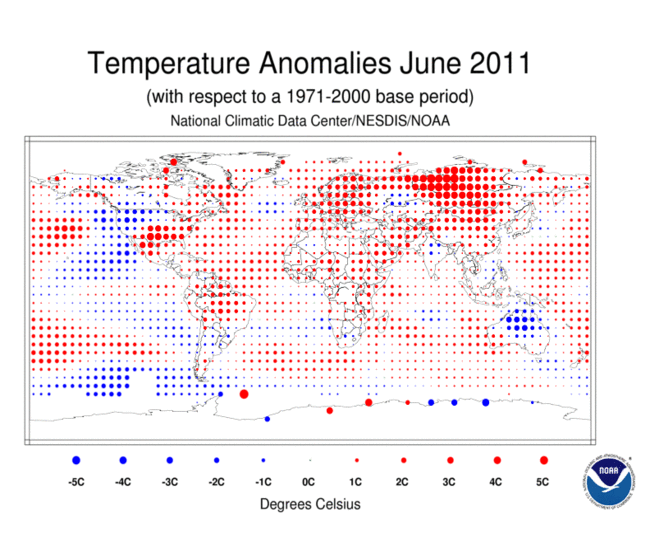 The monthly analysis from NOAA’s National Climatic Data Center is part of the suite of climate services NOAA provides government, business and community leaders so they can make informed decisions.
Global Temperature Highlights: June
- The combined global land and ocean average surface temperature for June 2011 was the seventh warmest on record at 60.94 F (16.08 C), which is 1.04 F (0.58 C) above the 20th century average of 59.9 F (15.5 C). The margin of error associated with this temperature is +/- 0.13 F (0.07 C).
- Separately, the global land surface temperature was 1.60 F (0.89 C) above the 20th century average of 55.9 F (13.3 C), which was the fourth warmest June on record. The margin of error is +/- 0.23 F (0.13 C). Warmer-than-average conditions occurred across most of Russia, Europe, and China, the Middle East, eastern Canada, Mexico, and the southern United States. Cooler-than-average regions included the northern and western United States, part of western Canada, and most of Australia.
- The June global ocean surface temperature was 0.85 F (0.47 C) above the 20th century average of 61.5 F (16.4 C), making it the Read more…
Reservoirs Can Trigger Earthquakes Say Chinese Geologists Studying Complex Interaction Of Earth And Water
This figure is a presentation of viscous stress and Reynolds stress at multiple micro-spatial scales under ultra-high temperature and pressure conditions.

Credit: ©Science China Press
The extended Coulomb failure stress (ECFS) criteria and anisotropic porosity and permeability tensor at micro/meso/macro scale under ultra‑high temperature and pressure (UTP) conditions were developed employing the flow driven pore‑network crack (FDPNC) model under multiple temporal–spatial scales and the hybrid hypersingular integral equation‑lattice Boltzmann method (HHIE‑LBM). The correlation of the Zipingpu reservoir and Longmenshan slip was then analyzed and the fluid–solid coupled three‑dimensional facture mechanism of the reservoir and earthquake fault was explored.
Describing the correlation of a reservoir and Read more…
Rising Oceans – Too Late to Turn the Tide?
(Click to enlarge) If sea levels rose to where they were during the Last Interglacial Period, large parts of the Gulf of Mexico would be under water (red areas), including half of Florida and several Caribbean islands. (Photo illustration by Jeremy Weiss)
Melting ice sheets contributed much more to rising sea levels than thermal expansion of warming ocean waters during the Last Interglacial Period, a UA-led team of researchers has found. The results further suggest that ocean levels continue to rise long after warming of the atmosphere has leveled off.
Thermal expansion of seawater contributed only slightly to rising sea levels compared to melting ice sheets during the Last Interglacial Period, a University of Arizona-led team of researchers has found.
The study combined paleoclimate records with computer simulations of Read more…
Melting glaciers store up trouble

by Julia Slater, swissinfo.ch
As the alpine glaciers shrink they will affect the flow of Europe’s biggest rivers, impacting areas of the economy ranging from shipping to power generation.
Glaciologist Matthias Huss of Fribourg University has discovered that right down to the sea, the Danube, Rhine, Rhone and Po contain a larger proportion of water from glaciers than previously thought.
For example, more than a quarter of the water that flows from the Rhone into the Mediterranean in August has its origin in alpine glaciers. At its mouth in the Netherlands seven percent of the water in the Rhine is Read more…


![[Most Recent Quotes from www.kitco.com]](https://i0.wp.com/www.kitconet.com/charts/metals/gold/t24_au_en_usoz_2.gif)
![[Most Recent Quotes from www.kitco.com]](https://i0.wp.com/www.kitconet.com/charts/metals/silver/t24_ag_en_usoz_2.gif)

 crisisboom
 CRISISBOOM
You must be logged in to post a comment.