Archive
Everett, Washington Fissure
Wind and waves growing across globe: study

Photo by Todd Binger
(PhysOrg.com) — Oceanic wind speeds and wave heights have increased significantly over the last quarter of a century according to a major new study undertaken by ANU Vice-Chancellor Professor Ian Young.
Large-Scale Assessment Of The Arctic Ocean: Significant Increase In Freshwater Content Since 1990s
The freshwater content of the upper Arctic Ocean has increased by about 20 percent since the 1990s. This corresponds to a rise of approx. 8,400 cubic kilometres and has the same magnitude as the volume of freshwater annually exported on average from this marine region in liquid or frozen form. This result is published by researchers of the Alfred Wegener Institute in the journal Deep-Sea Research. The freshwater content in the layer of the Arctic Ocean near the surface controls whether heat from the ocean is emitted into the atmosphere or to ice. In addition, it has an impact on global ocean circulation.
Differences in the mean salinity of the Arctic Ocean above the 34 isohaline between 2006 to 2008 and 1992 to 1999.

Negative values are shown in yellow, green, and blue and stand for an increase of freshwater.
Image: Benjamin Rabe, Alfred Wegener Institute Read more…
First North Pole Ozone Hole Forming?

Spawned by strangely cold temperatures, “beautiful” clouds helped strip the Arctic atmosphere of most of its protective ozone this winter, new research shows.
The resulting zone of low-ozone air could drift as far south as New York, according to experts who warn of increased skin-cancer risk.
The stratosphere’s global blanket of ozone—about 12 miles (20 kilometers) above Earth—blocks most of the sun‘s high-frequency ultraviolet (UV) rays from hitting Earth’s surface, largely preventing sunburn and skin cancer.
But a continuing high-altitude freeze over the Arctic may have already reduced ozone to half its normal concentrations—and “an end is not in sight,” said research leader Markus Rex, a physicist for the Alfred Wegener Institute for Polar and Marine Research in Bremerhaven, Germany.
Preliminary data from 30 ozone-monitoring stations throughout the Arctic show the Read more…
Magnetic Monster: Geomagnetic Field Reveals Increasing Danger of ‘Continent Killing’ Quakes
The earth’s history is one of violence.
 Image: ‘Doomsday’
|
(CHICAGO) – Russian geophysicist Pogrebnikov concurs with his colleagues at Harvard and Stanford: the earth may be in for a hell of a time.
Imagine events just short of doomsday and you’ll have a small glimpse of the global catastrophes that may lie just ahead.
Some scientists have seen this future—and the future is damn scary.
The former geologist Jim Berkland also “sees the future” on a regular basis, at least as far as earthquakes are concerned. He watches the geomagnetic field by watching aberrations in animals: odd actions, bizarre events, eerie mass deaths.
And the world’s animals are self-destructing in swarms, hordes, flocks.
The magnetite embedded in many animal’s brains make them sensitive to changes in the magnetic field. When that field is disrupted, some animals go mad. They get lost. Whales beach themselves. Birds desperately soar in confused flight and crash into each other, the ground and buildings.
Sometimes they just fall from the sky and die.
Berkland, a former USGS scientist has an 80 percent success rate predicting significant Read more…
GLOBAL Earthquake OVERVIEW – March 20, 2011 – Areas of concern, USA, EU, ASIA..(Video)
High seismic activity will last 10 years – seismologist
 The magnitude-9.0 earthquake in Japan was one of the major events in the natural cycle of the planet’s seismic activity, Evgeny Rogozhin, deputy director of the Institute of Physics of the Earth of the Russian Academy of Sciences told RT.
RT: You have made some controversial predictions in terms of future earthquakes. What exactly are they and what are they based on?
Evgeny Rogozhin: I think that there is no direct connection between the earthquake in Japan and earthquakes that could happen on our territory. But this latest is one of the major events in the chain of earthquakes that recently happened on the planet. You all remember the earthquake on Sumatra in 2004. It was a major earthquake – magnitude 9.5. It was huge. Major loss of life, tsunami, etc. Then there were a number of other earthquakes – in India, where people also died, in China with the magnitude 8 and finally, in Chile last year – 8.8. And now this earthquake in Japan with a magnitude unheard of before in this country – 9.
As you can see the process is taking place in different places on Earth. What does our country look like in this respect? In the last 15 years or so we’ve had about 15 major earthquakes in Read more…
Earth’s Core Provides Climate Insights

Summary: By studying the molten core of the planet Earth, scientists have uncovered new evidence that humans play a dominant role in changing Earth's climate. The study could have important implicaitons in understanding the future of life on our planet.
The latest evidence of the dominant role humans play in changing Earth’s climate comes not from observations of Earth’s ocean, atmosphere or land surface, but from deep within its molten core.
Scientists have long known that the length of an Earth day – the time it takes for Earth to make one full rotation – fluctuates around a 24-hour average. Over the course of a year, the length of a day varies by about 1 millisecond, getting longer in the winter and shorter in the summer. These seasonal changes in Earth’s length of day are driven by exchanges of energy between the solid Earth and fluid motions of Earth’s atmosphere (blowing winds and changes in atmospheric pressure) and its ocean. Scientists can measure these small changes in Earth’s rotation using astronomical observations and very precise geodetic techniques.
But the length of an Earth day also fluctuates over much longer timescales, such as interannual (two to 10 years), decadal (approximately 10 years), or those lasting multiple decades or even longer. A dominant longer timescale mode that ranges from 65 to 80 years was observed to change the length of day by approximately 4 milliseconds at the beginning of the Read more…
Nuclear nightmare: Japanese reactor meltdown could propel ‘death cloud’ to US West Coast
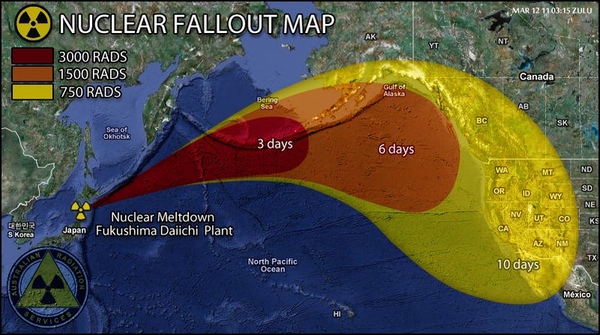
Some Japanese officials have admitted that Tokyo Electric’s Fukushima Dai-Ichi atomic reactor No. 1 may experience a total meltdown. That disaster would be followed by the release of a deadly radioactive death cloud that would drift over the Pacific and poison the people of the U.S. West Coast.
A worried Nuclear and Industrial Safety Agency spokesman Yuji Kakizaki warned:“If the fuel rods are melting and this continues, a reactor meltdown is possible,” Kakizaki said.
A core meltdown of the nuclear pile occurs from an intense build-up of heat Read more…
Japan Quake Shifts Earth Axis: Though Slight, Days Will Be Shortened In Centuries

The Montreal Gazette
By Carmen Chai, Postmedia News
Initial results out of Italy’s National Institute of Geophysics and Volcanology show that the 8.9-magnitude earthquake that rattled Japan Friday shifted the earth’s rotation axis by about 25 centimetres.
INGV’s report, which came hours after the devastating incident, is equivalent to “very, very tiny” changes that won’t be seen for centuries, though, Canadian geologists say.
Only after centuries would a second be lost as each day is shortened by a millionth of a second, according to University of Toronto geology professor Andrew Miall.
“Ten inches sounds like Read more…


![[Most Recent Quotes from www.kitco.com]](https://i0.wp.com/www.kitconet.com/charts/metals/gold/t24_au_en_usoz_2.gif)
![[Most Recent Quotes from www.kitco.com]](https://i0.wp.com/www.kitconet.com/charts/metals/silver/t24_ag_en_usoz_2.gif)

 crisisboom
 CRISISBOOM
You must be logged in to post a comment.