Archive
Food Riot Fears Strike Japan
 The government lies and cover-ups are coming to a head, and residents of Japan are now scrambling to acquire non-radiated rice and other foods.
Via Alexander Higgins:
Fears of food riots strike Japan after rice trading is halted due to a 40% price spike triggered by massive hoarding of the remaining radiation free rice supply.
It is time to start paying very close attention the events unfolding in Japan as the nation teeters on the verge of food riots which may serve as an example of what other nations in a similar situation would face.
As we approach the 5 month marker since the onset of the Fukushima nuclear disaster, Japan has repeatedly assured the public that the nation’s food supply was safe from radiation. Japan has given those reassurances despite warnings from experts that the nuclear fallout has already surpassed Read more…
Japan tsunami broke huge icebergs off Antarctica

The massive March 11 Japan earthquake and its ensuing tsunami were so powerful that they broke off huge icebergs thousands of miles away in Antarctica, according to a new study.
The calving of icebergs (where a huge chunk of ice breaks off from a glacier or ice shelf) from the Sulzberger Ice Shelf in Antarctica was linked to the tsunami, which originated with the magnitude 9.0 earthquake off the coast of the Japanese island of Honshu, by satellite observations of the Antarctic coast immediately after the earthquake.
Icebergs have been reported to calve following earthquakes before, including after the magnitude 6.3 earthquake that struck Christchurch, New Zealand, on Feb 22. But the new finding marks the first direct observation of such a connection between tsunamis and iceberg calving.
Japan’s Big Earthquake Rattled The Ionosphere
The giant 11 March 2011 magnitude 9 Tohoku earthquake not only shook the Earth and caused devastating tsunamis but also rattled the ionosphere, according to a new study.
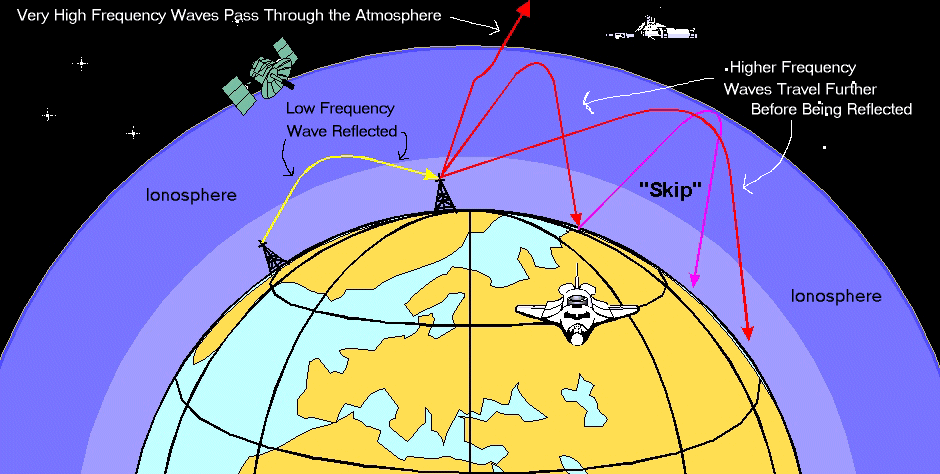 Image: NASA
The ionosphere is a part of the upper atmosphere, comprising portions of the mesosphere, thermosphere and exosphere, distinguished because it is ionized by solar radiation. It plays an important part in atmospheric electricity and forms the inner edge of the magnetosphere. It has practical importance because, among other functions, it influences radio propagation to distant places on the Earth. Read more…
Japan should have nuclear weapons: Tokyo Governor
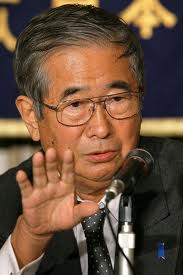 TOKYO – Tokyo Governor Shintaro Ishihara has criticised Japanese Prime Minister Naoto Kan’s vow to reduce dependency on atomic energy after the Fukushima disaster, saying instead the country should deepen its nuclear embrace to include weapons.
“Japan should absolutely possess nuclear weapons,” Mr Ishihara said in a July 15 interview at his office citing China and North Korea as potential threats.
“I don’t think we can easily do away with atomic power. Nuclear energy is inexpensive if managed well,” he also said.
Mr Ishihara has built a political career by taking on consensus views on everything from Japan’s pacifist constitution to economic ties with the United States, with a record of success with voters that’s withstood controversial remarks that have forced public apologies.
The 78-year-old Governor expressed regret in March after calling the earthquake and tsunami disaster “divine punishment” for the “egoism” of Japnese society. He was re-elected in April to a fourth four-year term governing Japan’s biggest and richest city. Bloomberg
1 BILLION BECQUERELS PER HOUR Emission of Radioactive Materials from Fukushima I Nuke Plant at the End of June
That’s an amazing reduction from the maximum emission of 2,000 terabecquerels per hour on March 15, it is actually one-2 millionth of the maximum, says TEPCO in the Reference No. 2 of the progress report on the “roadmap” to God knows where.
Is this number, 1 billion becquerels per hour emission, good? TEPCO’s Matsumoto, in the press conference on July 19, avoided the judgment, and said he didn’t know, but it was one-2 millionth of what it had been on March 15.
On closer reading of the document, though, I noticed one strange thing about this emission number. TEPCO is talking about the radiation emission measured in cesium (cesium-134 and -137), not in iodine equivalence.
To come up with the iodine-131 equivalence, you have to multiply cesium-134 Read more…
Typhoon Ma-on approaches Japan
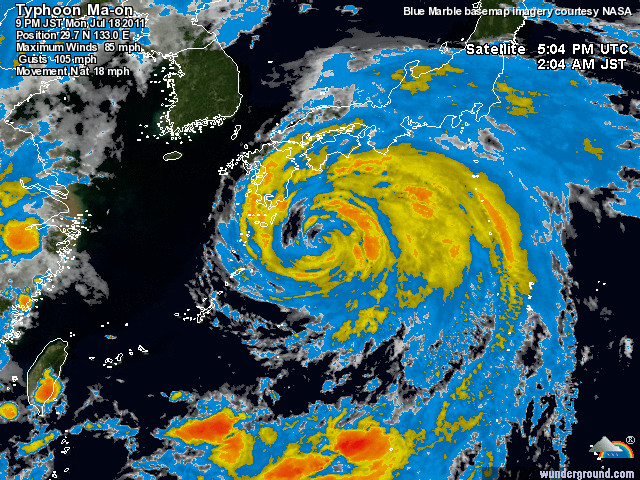
Typhoon Ma-on is threatening the Japanese island of Shikoku. According to forecasters, the typhoon is likely to make landfall on Wakayama Prefecture (Honshu Island) early on July 20th. Later on Wednesday, July 20th or early on Thursday, July 21st, the typhoon, weakened by that time into a category-one storm, is expected to hit the south of Kanto Plain and Tokyo-Yokohama metropolitan area. Consequently, heavy downpours and strong winds are forecast while flash floods and landslides remain possible. Power cuts, telecommunication and water outages are possible in affected areas. Transport disruptions are also expected as the typhoon could force the closure of several airports including Osaka International airport, Tokyo International Airport (Haneda) and Narita International Airport. Ferry and train services (including the high-speed trains Shinkansen) are likely to be disrupted in southern and central Honshu.
Typhoon Ma-on will generate heavy Read more…
Straw Fed To Japanese Found To Be Radioactive
 MINAMISOMA, JAPAN (BNO NEWS) — Japan’s nuclear crisis has spread to its cattle as high levels of radioactive cesium were detected at a farm in Fukushima, officials said Monday.
The radioactive cesium was found in straw fed to cattle at a farm in Minamisoma, Fukushima Prefecture with an average of 75,000 becquerels of the radioactive isotope per kilogramme (2.25 pounds), which is about 56 times the allowable limit, Kyodo news agency reported.
According to officials, the contaminated straw was stored in an exposed area of the farm without roofs during the March 11 earthquake and tsunami that caused a series of explosions that crippled the Fukushima Daiichi nuclear power plant. Furthermore, the farm is located in one of the high-risk areas of the region, and officials suspect the straw could be the radioactive source of contaminated beef that had been detected in meat shipped from that area.
The contaminated meat of eleven cows was detected in Tokyo, where the meat was shipped for processing. However, at the time of the shipment, the Read more…
Contaminated Fluid Spills From Japanese Nuclear Plant
 Roughly 15 tons of radiation-tainted fluid has escaped into the earth from a container at Japan’s Fukushima Daiichi nuclear power plant, the nation’s Nuclear and Industrial Safety Agency said on Tuesday (see GSN, June 27).
Plant operator Tokyo Electric Power indicated it was looking into the source of a container rupture, which was discovered on Tuesday and then patched, Reuters reported.
Plant personnel have battled to prevent radioactive contaminants from escaping the six-reactor Fukushima facility following a March 11 earthquake and tsunami that left more than 20,000 people dead or missing in Japan. Radiation releases on a level not seen since the 1986 Chernobyl disaster have already forced the evacuation of about 80,000 residents from a 12-mile ring around the facility.
Separately, workers on Tuesday resumed operation of equipment deployed recently at the site for treating contaminated liquid, Tokyo Electric Power representative Junichi Matsumoto said.
The firm has pumped water into the facility on an ongoing basis in an effort to cool components, resulting in Read more…
Japan’s Stealth Fighter Gambit
Tokyo seems poised to spend billions developing the country’s first homegrown stealth warplane. But is the Shinshin really meant for military service?


![[Most Recent Quotes from www.kitco.com]](https://i0.wp.com/www.kitconet.com/charts/metals/gold/t24_au_en_usoz_2.gif)
![[Most Recent Quotes from www.kitco.com]](https://i0.wp.com/www.kitconet.com/charts/metals/silver/t24_ag_en_usoz_2.gif)

 crisisboom
 CRISISBOOM
You must be logged in to post a comment.