Archive
NASA: Huge Solar Flare Jamming Radio And Satellite Signals, Could Affect Electric Grid, Bright Auroras Expected
According to NASA, a large solar eruption triggered a giant geomagnetic storm that has disturbed radio communications and could disrupt electrical power grids, radio and satellite communication in the next days
The calm before the storm. Three CMEs are enroute, all a part of the Radio Blackout events on February 13, 14, and 15 (UTC). The last of the three seems to be the fastest and may catch both of the forerunners about mid to late day tomorrow, February 17. Watch this space for updates on the impending — G2, possibly periods of G3 — geomagnetic storming.
Watch Today’s Space Weather for the most recent activity.
This is a composite image of the Sun at the moment of the X2.2 flare. Image courtesy of SDO
(NASA)

Credit: NASA/SDO
A strong wave of charged plasma particles emanating from the Jupiter-sized sun spot, the most powerful seen in four years, has already disrupted radio communication in southern China.
Solar Activity Forecast: Read more…
FIRST X-CLASS FLARE OF THE NEW SOLAR CYCLE:
Sunspot 1158 has unleashed the strongest solar flare in more than four years. The eruption, which peaked at 0156 UT on Feb. 15th, registered X2 on the Richter scale of solar flares. NASA’s Solar Dynamics Observatory recorded an intense flash of extreme ultraviolet radiation, circled below:
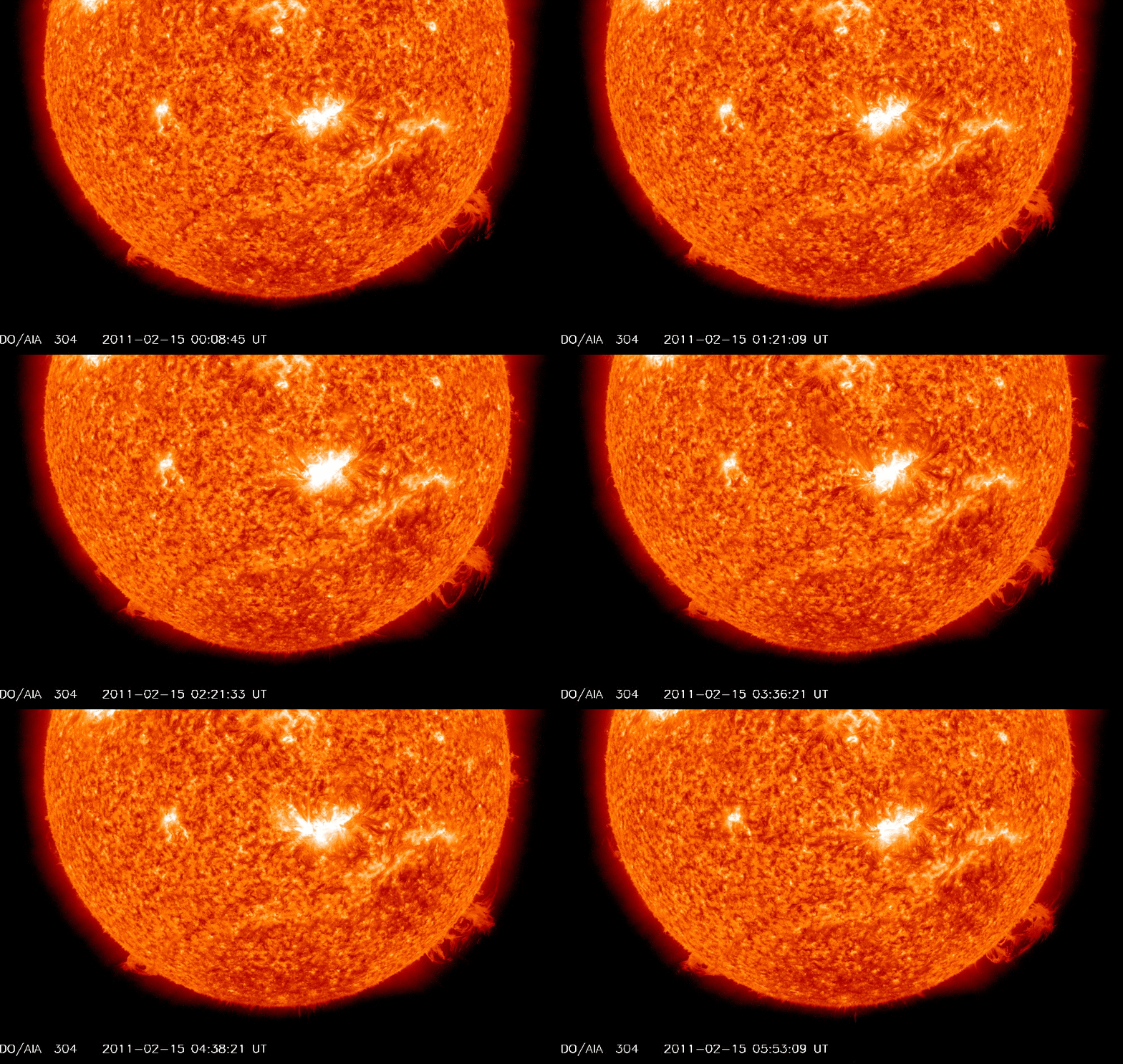
movie formats: 5 MB gif, 1.3 MB iPad, 0.6 MB iPhone
X-flares are the strongest type of solar flare, and this is the first such eruption of new Solar Cycle 24. In addition to flashing Earth with UV radiation, the explosion also hurled a coronal mass ejection (CME) in our direction. The expanding cloud may be seen in this movie from NASA’s STEREO-B spacecraft. Geomagnetic storms are possible when Read more…
Astronomers spot ‘planet’ in Oort Cloud, but are they mistaking Tyche for her sister?

If you grew up thinking there were nine planets and were shocked when Pluto was demoted five years ago, get ready for another surprise. There may be nine after all, and Jupiter may not be the largest.
The hunt is on for a gas giant up to four times the mass of Jupiter thought to be lurking in the outer Oort Cloud, the most remote region of the solar system. The orbit of Tyche, as it is provisionally called, would be 15,000 times farther from the Sun than the Earth’s, and 375 times farther than Pluto’s, which is why it hasn’t been seen so far.
But now scientists believe the proof of its existence has already been gathered by a NASA space telescope, Wise, and is just waiting to be analyzed.
The first tranche of data is to be released in April, and astrophysicists John Matese and Daniel Whitmire from the University of Louisiana at Lafayette think it will reveal Read more…
Spacecraft to be controlled by artificial intelligence
 It is a concept that had fatal consequences for the astronauts in the science fiction movie 2001: A Space Odyssey after their spaceship’s artificially intelligent computer reasoned it had to kill them in order to continue the mission.
Yet despite this warning from Arthur C Clarke and director Stanley Kubrick, The European Space Agency now hopes to use real-life artificial intelligence to control future spacecraft.
British engineers, supported by ESA, are developing control systems that can be used in satellites, robotic exploration vehicles and spacecraft capable of controlling themselves.
The space vehicles will be able to learn, identify problems, adapt during missions, carry out repairs and take their own decisions about how best to carry out a task.
Details of the research have emerged as ESA prepares to launch the second of its Read more…
Target Earth: Near Earth Asteroids Swarming the February Skies

Photo by Steve E. Farmer Jr.
February 12, another newly discovered hazardous asteroid (PHA) was announced. As most other NEO’s in the past, this one safely passed by Earth…this time.
Potentially Hazardous Asteroid 2011 CU46 was announced on February 12, 2011. This hazardous asteroid did not drift by Earth at only a few thousand miles as in the case of Near Earth Object 2011 CQ1; 2011 CU46 safely passed by at a distance of a little more than 316,000 miles – which is still considered a “near miss” in astronomical terms. PHA 2011 CU46 has a diameter of 20m – 50m; and this particular object would likely cause a massive fireball and surface damage if it were to impact Earth in a populated area.
Potentially Hazardous Asteroids & Near Earth Objects
As defined by NASA, A Potentially Hazardous Asteroid (PHA) is based on parameters that measure the asteroid’s potential to make threatening close approaches to the Earth. An asteroid which comes within an orbital intersection distance of 0.05 AU with Earths orbit and is of a diameter of 110m – 240m, is normally identified as a potentially hazardous object. Other factors are also included.
Since the February 4 announcement of NEO 2011 CQ1, over forty more Near Earth Objects have been discovered, identified, and catalogued.
Apophis Likely to Miss, What about PHA 2011 AG5?
PHA 2011 AG5 was discovered by Mt. Lemmon Survey on January 8, 2011. After more than one-hundred extra observations of this Potentially Hazardous Asteroid were collected by both amateur and professional astronomers, orbital elements were calculated and it was determined that 2011 AG5 could possibly impact Earth in the year 2052. More observations and research is needed to refine the orbit of this asteroid.


2011 AG5 is very similar to the famous asteroid Apophis which could possibly impact the Earth in the year 2036. Apophis is a little larger in diameter that 2011 AG5 and is expected to pass by Earth twice as close as 2011 AG5. Both of these minor planets are large enough to cause substantial damage to a major city on Earth if impact were to occur, but with any luck these minor planets will spare Earth and safely pass us by.
Preparing for Asteroid Impact
It’s only a matter of time before the announcement comes that Earth will obtain an impact from a minor planet large enough to cause wide-spread damage. It is this reason why more studies be performed on minor planets – to help further improve our understandings on these objects in hopes to give us a better defense option when that announcement comes. We have the technology to detect these hazardous objects and certain programs are working on methods to deflect or destroy asteroids. With any luck, they will design a fail-proof method to eliminate the potential risk from these objects impacting Earth.
Evidence of a False Solar Flare Cover Story for GPS system failure
 A solar flare cover story was used to explain worldwide GPS satellite system failure, Dec 2006. A GPS failure actually caused by a shift of the earth’s axis which misaligned the entire system…
NGDC (a division of NOAA) has stated that a solar flare of epic proportions occurred on Dec 5 & 6, 2006 and knocked down the world GPS satellite system as shown in this article on their website (Dec 5th 2006 at 10:18 UT X9 solar flare.)
Yet, neither the solar flare or the GPS failure were mentioned until April 2007 according to this April 4, 2007 news release by NOAA (GPS significantly impacted by powerful solar radio burst.)
It is virtually impossible to believe that not one of the space agencies, observatories, astronomers, astrophysicists, meteorologists or other scientists mentioned a word about this supposed “historic” solar flare for 4 months. It is inconceivable to believe that Read more…
China’s hostile space capabilities worry US: official
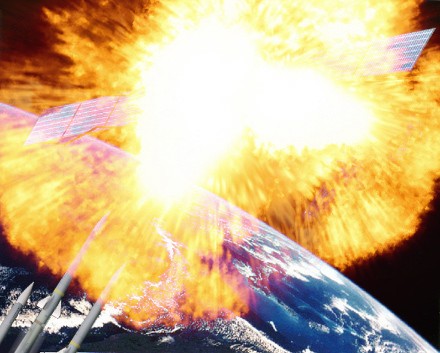 WASHINGTON (AFP) – China is developing “counterspace” weapons that could shoot down satellites or jam signals, a Pentagon official said Friday as the United States unveiled a 10-year strategy for security in space.
“The investment China is putting into counterspace capabilities is a matter of concern to us,” deputy secretary of defense for space policy Gregory Schulte told reporters as the defense and intelligence communities released their 10-year National Security Space Strategy (NSSS).
The NSSS marks a huge shift from past practice, charting a 10-year path in space to make the United States “more resilient” and able to defend its assets in a dramatically more crowded, competitive, challenging and sometimes hostile environment, Schulte said.
“Space is no longer the preserve of the US and the Soviet Union, at the time in which we could operate with impunity,” Schulte said.
“There are more competitors, more countries that are launching satellites… and we increasingly have to Read more…
Astronomy: “The Taurid Stream: A Cosmic Trail With Destruction In Its Wake”
by Nick Nuttall

According to astronomers such as Dr. Victor Clube, of Oxford University’s Department of Astrophysics, the coming and goings of the Taurid stream should be a source of concern to politicians, planners and anyone who cherishes life on Earth. A ”catastrophist”, Dr. Clube is one of many astronomers who are convinced that Read more…
WikiLeaks: US and China in military standoff over space missiles
The United States threatened to take military action against China during a secret “star wars” arms race within the past few years, according to leaked documents obtained by The Daily Telegraph
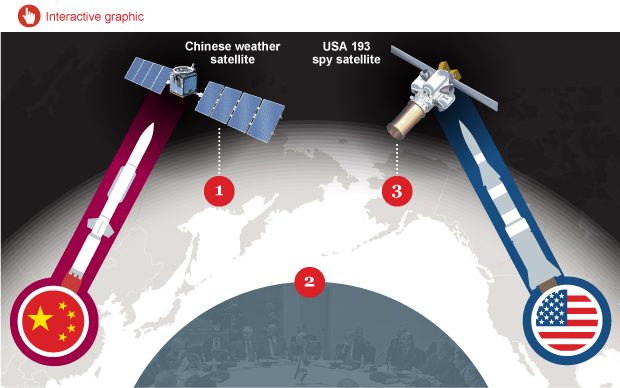
The two nuclear superpowers both shot down their own satellites using sophisticated missiles in separate show of strength, the files suggest.
The American Government was so incensed by Chinese actions in space that it privately warned Beijing it would face military action if it did not desist.
The Chinese carried out further tests as recently as last year, however, leading to further protests from Hillary Clinton, the US Secretary of State, secret documents show.
Beijing justified its actions by accusing the Americans of developing an “offensive” laser weapon system that would have the capability of destroying missiles before they left enemy territory.
The disclosures are contained in the latest documents obtained by the Wikileaks website, which have been released to The Telegraph. They detail the private fears of Read more…
Russia Working on Mysterious Space Plane of Its Own

It’s official: the space race is on again.
54 years after the Soviet Union launched its Sputnik I satellite, sparking the original space race — and 20 years after the USSR’s collapse left America as the sole space superpower — the Russians are back on track. The Kremlin’s military space chief Oleg Ostapenko just announced that Russia is developing a small, maneuverable, reusable space plane to match the U.S. Air Force’s mysterious X-37B Orbital Test Vehicle.
Russian industry has already outlined the craft’s design, Ostapenko said. “As to whether we will use it, only time will tell,” he added coyly.
But it seems unlikely Russia would forgo the opportunity to Read more…


![[Most Recent Quotes from www.kitco.com]](https://i0.wp.com/www.kitconet.com/charts/metals/gold/t24_au_en_usoz_2.gif)
![[Most Recent Quotes from www.kitco.com]](https://i0.wp.com/www.kitconet.com/charts/metals/silver/t24_ag_en_usoz_2.gif)

 crisisboom
 CRISISBOOM

You must be logged in to post a comment.