Archive
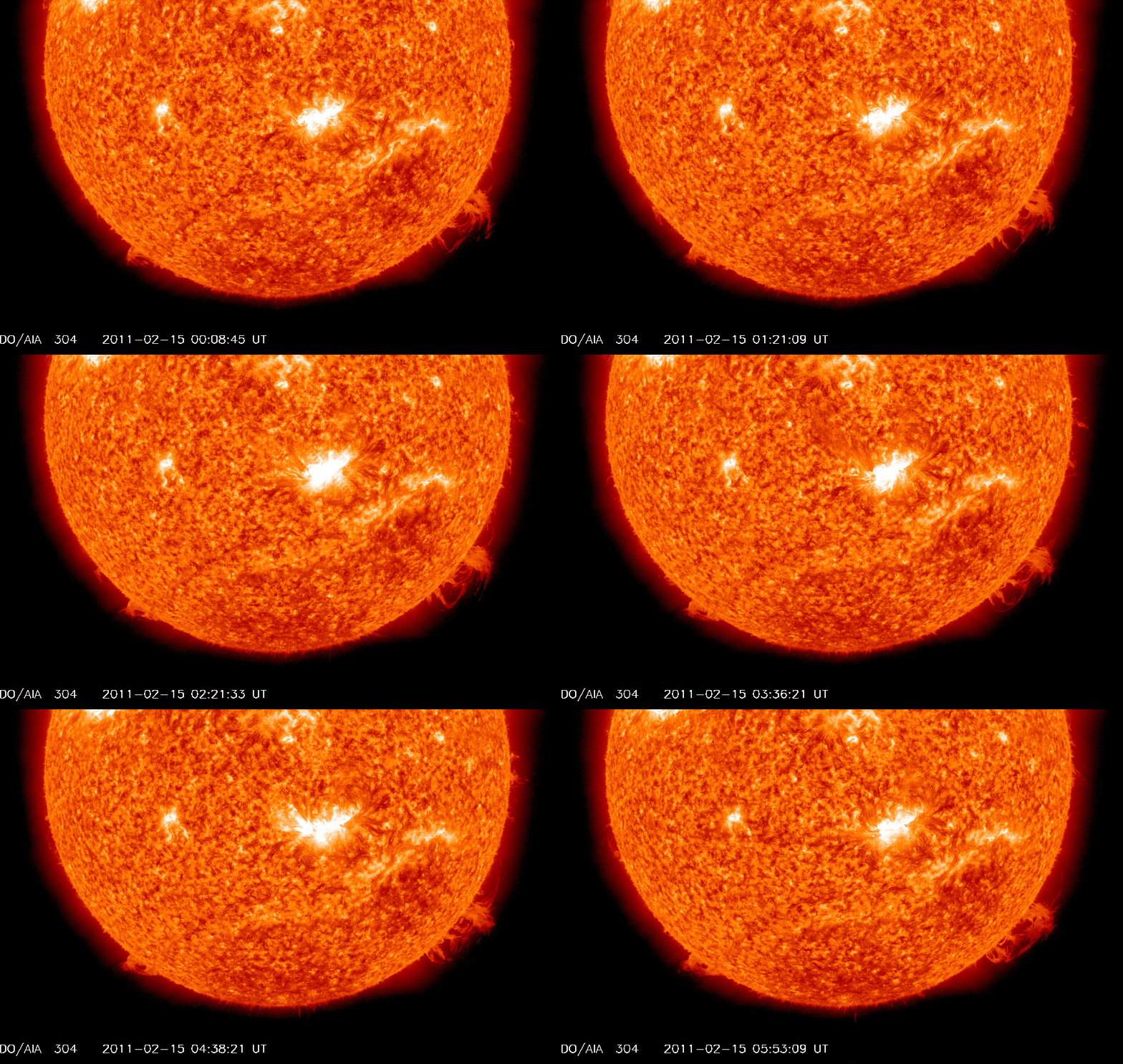
Sun Emitting Solar Flare
Look at the size of that solar flare! Lots of activity on the way folks.

Get ready for a ‘global Katrina’: Biggest ever solar storm could cause power cuts which last for MONTHS

- Earth is overdue a solar storm as the sun enters its most active period.
The world is overdue a ferocious ‘space storm’ that could knock out communications satellites, ground aircraft and trigger blackouts – causing hundreds of billions of pounds of damage, scientists say.
Astronomers today warned that mankind is now more vulnerable to a major solar storm than at any time in history – and that the planet should prepare for a global Katrina-style disaster.
A massive eruption of the sun would save waves of radiation and charged particles to Earth, damaging the satellite systems used for synchronizing computers, airline navigation and phone networks.
Modern Society Threatened by Solar Storms

NASA/SDO/AIA
The Earth just dodged a solar bullet. But it won’t be the last. Experts say a geomagnetic storm, sparked by a massive solar eruption similar to the one that flared toward the Earth on Tuesday, is bound to strike again, and the next one could wreak more havoc than the world has ever seen.
Modern society is increasingly vulnerable to space weather because of our dependence on satellite systems for synchronizing computers, navigational systems, telecommunications networks and other electronic devices.
A potent solar storm could disrupt these technologies, scorch satellites, crash stock markets and cause months-long power outages, experts said Saturday at the Read more…
Giant Stealth Planet May Explain Rain of Comets from Solar System’s Edge

Our sun may have a companion that disturbs comets from the edge of the solar system — a giant planet with up to four times the mass of Jupiter, researchers suggest.
A NASA space telescope launched last year may soon detect such a stealth companion to our sun, if it actually exists, in the distant icy realm of the comet-birthing Oort cloud, which surrounds our solar system with billions of icy objects.
The potential jumbo Jupiter would likely be a world so frigid it is difficult to spot, researchers said. It could be found up to 30,000 astronomical units from the sun. One AU is the distance between the Earth and the sun, about 93 million miles (150 million km).
Most systems with stars like our sun — so-called class G stars — possess companions. Only one-third are single-star systems like our solar system.
Not a nemesis
Scientists have already proposed that a hidden star, which they call “Nemesis,” might lurk a light-year or so away from our sun. They suggest that during its orbit, this red dwarf or brown dwarf star would regularly enter the Oort cloud, jostling the orbits of many comets there and causing some to fall toward Earth. That would provide an explanation for what seems to be a cycle of mass extinctions here.
Still, other astronomers recently found that if Nemesis did exist, its orbit could not be nearly as stable as claimed.
Now researchers point to evidence that our sun might have a different sort of companion.
To avoid confusion with the Nemesis model, astrophysicists John Matese and Daniel Whitmire at the University of Louisiana at Lafayette dub their conjectured object “Tyche” — the good sister of the goddess Nemesis in Greek mythology, and a name proposed by scientists working on NASA’s Wide-Field Infrared Survey Explorer (WISE) space telescope.
It is the WISE observatory that, using its all-seeing infrared eye, stands the best chance of having spotted Tyche, if this companion to the sun exists at all, the researchers said. [WISE telescope’s amazing images]
Matese and Whitmire detailed their research Nov. 17 online edition of the journal Icarus.
Comet-flinging sun companion
The researchers noted that most comets that fly into the inner solar system seem to come from the outer region of the Oort cloud. Their calculations suggest the gravitational influence of a planet one to four times the mass of Jupiter in this area might be responsible.
Two centuries of observations have indicated an anomaly that suggests the existence of Tyche, Matese said. “The probability that it could be caused by a statistical fluke has remained very small,” he added.
The pull of Tyche might also explain why the dwarf planet Sedna has such an unusually elongated orbit, the researchers added.
If Tyche existed, it would probably be very cold, roughly minus 100 degrees F (-73 degrees C), they said, which could explain why it has escaped detection for so long — its coldness means that it would not radiate any heat scientists could easily spot, and its distance from any star means it would not reflect much light.
“Most planetary scientists would not be surprised if the largest undiscovered companion was Neptune-sized or smaller, but a Jupiter-mass object would be a surprise,” Matese told SPACE.com. “If the conjecture is indeed true, the important implications would relate to how it got there — touching on the early solar environment — and how it might have affected the subsequent distributions of comets and, to a lesser extent, the known planets.”
Is Tyche really out there?
The fact of Tyche’s existence is questionable, since the pattern seen in the outer Oort cloud is not seen in the inner Oort.
“Conventional wisdom says that the patterns should tend to correlate, and they don’t,” Matese said.
If the WISE team was lucky, it caught evidence for the Tyche solar companion twice before the space observatory’s original mission ended in October. That could be enough to corroborate the object’s existence within a few months as researchers analyze WISE’s data.
But if WISE detected signs of Tyche only once (or not at all), researchers would have to wait years for other telescopes to confirm or deny the potential solar companion’s existence, Matese said.
Strange Particles Coming Out Of The Sun
BeePee: YouTube user TATANKAWOWAHA sent me the initial picture of this strange anomaly happening on the sun and I followed up with the current image…
Something is coming out of the sun! A few months back some scientists were doing some math and they use radioactive material decay rates to generate random numbers (complicated) and they noticed that what was never supposed to change was changing with outbursts from the suns core… Its changing matter that we as humans have, we have 8 types that is being effected by this new particle and it will/is changing the entire human DNA structure! And no media coverage about it!
NASA: Huge Solar Flare Jamming Radio And Satellite Signals, Could Affect Electric Grid, Bright Auroras Expected
According to NASA, a large solar eruption triggered a giant geomagnetic storm that has disturbed radio communications and could disrupt electrical power grids, radio and satellite communication in the next days
The calm before the storm. Three CMEs are enroute, all a part of the Radio Blackout events on February 13, 14, and 15 (UTC). The last of the three seems to be the fastest and may catch both of the forerunners about mid to late day tomorrow, February 17. Watch this space for updates on the impending — G2, possibly periods of G3 — geomagnetic storming.
Watch Today’s Space Weather for the most recent activity.
This is a composite image of the Sun at the moment of the X2.2 flare. Image courtesy of SDO
(NASA)

Credit: NASA/SDO
A strong wave of charged plasma particles emanating from the Jupiter-sized sun spot, the most powerful seen in four years, has already disrupted radio communication in southern China.
Solar Activity Forecast: Read more…
Solar Flare Causes Problems for China’s Radio Communications
A solar flare—the strongest one in four years—messed with China’s communications in the southern portion of the country over the past several days, according to media reports.
The recent, massive solar flare that was emitted by the sun on Tuesday caused a Read more…
FIRST X-CLASS FLARE OF THE NEW SOLAR CYCLE:
Sunspot 1158 has unleashed the strongest solar flare in more than four years. The eruption, which peaked at 0156 UT on Feb. 15th, registered X2 on the Richter scale of solar flares. NASA’s Solar Dynamics Observatory recorded an intense flash of extreme ultraviolet radiation, circled below:
movie formats: 5 MB gif, 1.3 MB iPad, 0.6 MB iPhone
X-flares are the strongest type of solar flare, and this is the first such eruption of new Solar Cycle 24. In addition to flashing Earth with UV radiation, the explosion also hurled a coronal mass ejection (CME) in our direction. The expanding cloud may be seen in this movie from NASA’s STEREO-B spacecraft. Geomagnetic storms are possible when Read more…
M CLASS Solar Flare Headed Toward Earth
Sunspot 1158 has just unleashed the strongest solar flare of the year, an M6.6-category blast @ 1738 UT on Feb. 13th and it is heading straight for Earth.
The eruption appears to have launched a coronal mass ejection (CME) toward Earth. It also produced a loud blast of radio emissions heard in shortwave receivers around the dayside of our planet. Amateur radio astronomer Thomas Ashcraft recorded these sounds. Stay tuned for updates!
Solar activity increased sharply over the weekend with the eruption of an M6.6-class solar flare from behemoth sunspot 1158. The blast produced a strong burst of radio waves heard in the loudspeakers of shortwave receivers around the dayside of our planet, and it appears to have hurled a faint coronal mass ejection toward Earth.
Sunspot 1158 is growing rapidly (48 hour movie) and crackling with M-class solar flares. The active region is now more than 100,000 km wide with at least a dozen Earth-sized dark cores scattered beneath its unstable magnetic canopy. Earth-directed eruptions are likely in the hours ahead.
The remains of old sunspot complex 1147-1149 are rotating over the eastern limb today. Although the region is in an advanced state of decay, it’s not dead yet. During the late hours of Feb. 11th, a plasma bullet came rocketing out of the region’s unstable core. Watch the movie–but don’t blink, because it’s fast.

Movie formats: 21 MB Quicktime, 1.3 MB mpeg, 0.5 MB iPad. Credit: SDO


![[Most Recent Quotes from www.kitco.com]](https://i0.wp.com/www.kitconet.com/charts/metals/gold/t24_au_en_usoz_2.gif)
![[Most Recent Quotes from www.kitco.com]](https://i0.wp.com/www.kitconet.com/charts/metals/silver/t24_ag_en_usoz_2.gif)

 crisisboom
 CRISISBOOM

You must be logged in to post a comment.