Archive
Huge coronal hole on Sun turning towards Earth
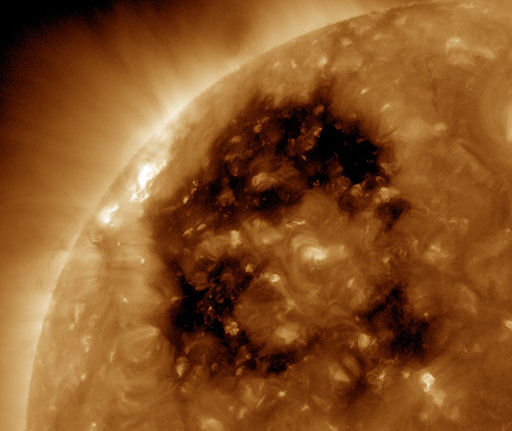
CORONAL HOLE: A dark croissant-shaped hole has opened up in the sun’s atmosphere, and it is spewing a stream of solar wind into space. NASA’s Solar Dynamics Observatory took this picture of the vast opening during the early hours of Jan. 30th. Researchers call this a “coronal hole.” Solar rotation is turning the coronal hole toward Earth. The stream of solar wind pouring from it will swing around and hit our planet in early February, possibly sparking polar magnetic storms. High-latitude sky watchers should be alert for auroras between Feb. 2nd and 4th. The coronal blast from the Sun storm’s arrival on Earth will coincide with a massive snow storm that will sweep across North America. –Space Weather
Blast from the Sun
 |
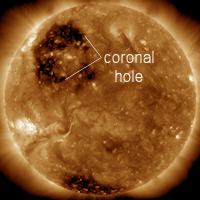
| This still from SDO caught the action in freeze-frame splendor when the Sun popped off two events at once (Jan. 28, 2011). A filament on the left side became unstable and erupted, while an M-1 flare (mid-sized) and a coronal mass ejection on the right blasted into space. NASA/SDO/GSFC |
The sun unleashed two powerful solar eruptions today (Jan. 28) in a spectacular double blast caught on camera by a NASA spacecraft.
The twin solar storms occurred in concert and marked an impressive start for the 2011 space weatherseason.
A video recorded by NASA’s Solar Dynamics Observatory shows the two sun storms erupting from opposite sides of the star. Neither of the events posed a space weather threat to Earth or its satellites, NASA officials said. Read more…
Massive Filament Eruption Jan 24th
Massive Filament Eruption on the solar corona as spotted on the SDO website yesterday and subsequent solar tsunami effects show a powerful event .
“Suicide” Comet Storm Hits Sun—Bigger Sun-Kisser Coming?

The sun-kissing comet Ikeya-Seki, as it appeared in the dawn sky in 1965.
Photograph by Victor R. Boswell, Jr., National Geographic
Andrew Fazekas
Published January 17, 2011
A recent storm of small comets that pelted the sun could herald the coming a much bigger icy visitor, astronomers say.
Since its launch in 1995, NASA’s Solar and Heliospheric Observatory, or SOHO, orbiter has captured pictures of 2,000 comets as they’ve flown past the sun.
Most of these comets are so-called sungrazers, relatively tiny comets whose orbits bring them so near the sun that they are often vaporized within hours of discovery. (See a picture of a sungrazer spied in October.)
The sun-watching telescope usually picks up one sungrazer every few days. But between December 13 and 22, SOHO saw more than two dozen sungrazers appear and disintegrate.
Seeing “25 comets in just ten days, that’s unprecedented,” Karl Battams, of the United States Naval Research Laboratory in Washington, D.C., said in a statement. “It was crazy!”
According to Battams and colleagues, the comet swarm could be forerunner fragments from a much larger parent comet that may be headed along a similar path. And such a large icy body coming so near the sun would result in a spectacular sky show.
Sun-Kissing Comet “Granddaddy” on the Way? Read more…
The sun rises two days early in Greenland, sparking fears that climate change is accelerating
The sun over Greenland has risen two days early, baffling scientists and sparking fears that Arctic icecaps are melting faster than previously thought.
Experts say the sun should have risen over the Arctic nation’s most westerly town, Ilulissat, yesterday, ending a month-and-a-half of winter darkness.
But for the first time in history light began creeping over the horizon at around 1pm on Tuesday – 48 hours ahead of the usual date of 13 January.
The mysterious sunrise has confused scientists, although it is believed the most likely explanation is that it is down to the lower height of melting icecaps allowing the sun’s light to penetrate through earlier.
 Climate change? The sun rose in Ilulissat, Greenland, two days early on Tuesday, ending a month-and-a-half of winter darkness. One theory is that melting ice caps have lowered the horizon allowing the sun to shine Read more…
The Deadly Sun
Often we think of the deadly nature with the sun as one of fire and heat but the opposite can be true as well. If the sun doesn’t produce enough heat we on earth can can freeze – there is massive evidence of this in our geological record. Also think of how cold the planets in our own solar system get the further away from the sun they are. 
Whilst scientists in some fields in recent decades want to play down the effects of the sun on the earth’s climate our climate history shows it plays a huge role. The sun typically has an 11 year cycle of sunspot activity which can extend and become quieter or contract and become more busy. History tells us when it is low in sunspots (typically a long cycle) then the world cools. At the moment Solar Cycle 24 is extending and losing it’s sunspots.
According to the Laymans Sunspot Count the sun today is again balnk of any sunspots. As we extend into solar cycle 24 we can get more of an idea of the anticipated peak of the cycle as it typically follows a curve when the sunspot number is smoothed (averaged). Looking at the graph of the sun from Layman’s Sunspot count website we see;
What we are witnessing in Solar Cycle 24 is a sunspot cycle that could peak as low as 30 – 35. It is currently tracking below Solar Cycle 5 which was part of a cold period on earth that correlated with the Dalton Minimum. We also find the sunspots are reducing in Read more…
Nasa warns solar flares from ‘huge space storm’ will cause devastation

Solar Maximum is happening now between 2011 and 2013 as part of Solar Cycle 24. My question is, why is this not being reported in the major newspapers and news outlets in the United States?
National power grids could overheat and air travel severely disrupted while electronic items, navigation devices and major satellites could stop working after the Sun reaches its maximum power in a few years.
Senior space agency scientists believe the Earth will be hit with unprecedented levels of magnetic energy from solar flares after the Sun wakes “from a deep slumber” sometime around 2013, The Daily Telegraph can disclose.
In a new warning, Nasa said the super storm would hit like “a bolt of lightning” and could cause catastrophic consequences for the world’s health, emergency services and national security unless precautions are taken.
Scientists believe it could damage everything from emergency services’ systems, hospital equipment, banking systems and air traffic control devices, through to “everyday” items such as home computers, iPods and Sat Navs.
Due to humans’ heavy reliance on electronic devices, which are sensitive to magnetic energy, the storm could leave a multi-billion pound damage bill and “potentially devastating” problems for governments.
“We know it is coming but we don’t know how bad it is going to be,” Dr Richard Fisher, the director of Nasa’s Heliophysics division, said in an interview with The Daily Telegraph.
“It will disrupt communication devices such as satellites and car navigations, air travel, the banking system, our computers, everything that is electronic. It will cause major problems for Read more…
Solar Wind to Reach Earth In Few Days, Spark Auroral Activity
A dark coronal hole at the Sun center was captured in extreme ultraviolet light by National Aeronautics and Space Administration’s (NASA) solar dynamics observatory on Jan. 10.

NASA
A dark coronoal hole at the Sun center was captured in extreme ultraviolet light by National Aeronautics and Space Administration’s (NASA) solar dynamics observatory. As the Sun continues to rotate, the high speed solar wind particles blowing from this hole will likely reach Earth in a few days and may spark some auroral activity.
Coronal holes are areas of the Sun’s surface that are the source of open magnetic field lines that head way out into space. They are also the source regions of the fast solar wind, which is characterized by a relatively steady speed of about 800 kilometers per second.
As the Sun continues to rotate, the high speed solar wind particles blowing from this hole will likely reach Earth in a few days and may spark some auroral activity, according to NASA.
Here, the solar dynamics observatory detected a giant solar filament that became unstable and erupted from the far side of the Sun. A filament is a large, bright feature extending outward from the Sun’s surface, often in a loop shape. Some filaments break apart and give rise to coronal mass ejections.
Prediction: Read more…


![[Most Recent Quotes from www.kitco.com]](https://i0.wp.com/www.kitconet.com/charts/metals/gold/t24_au_en_usoz_2.gif)
![[Most Recent Quotes from www.kitco.com]](https://i0.wp.com/www.kitconet.com/charts/metals/silver/t24_ag_en_usoz_2.gif)

 crisisboom
 CRISISBOOM

You must be logged in to post a comment.