Archive
IMF says weaker dollar would help global growth

AFP – The International Monetary Fund called for a weaker dollar to help the United States reduce its deficits with the rest of the world and rebalance the global economy, in a report released Wednesday.
In the report prepared for a Group of 20 finance chiefs meeting last week, the IMF said that its calculations showed the dollar remains “on the strong side” of medium-term fundamentals, while the euro and the Japanese yen were “broadly in line” and several Asian currencies, including China, were undervalued.
To address global imbalances, the G20 should allow the dollar to Read more…
Population, Food, Oil … Collision?

World population and growth
Factoring the net birth minus death rate in the world each year, the annual increase to world population is about 75 million people. The current world population is about 6,900,000,000, or 6.9 billion.
Annually, we add to the planet the equivalent population of any of the following scenarios,
- New York City (9 of them!)
- Los Angeles (20 of them!)
- Chicago (27 of them!)
- San Francisco (94 of them!)
- Boston (117 of them!)
- Unites States of America (25 percent of the country!)
When you think about it, this is a startling number. And that’s in just one Read more…
Rising world food prices may soon hit Africa hard, but could be a future boon
 Damaged rice is seen in a paddy field destroyed by flood- waters near a village in Manmunai West in Batticaloa district, about 199 miles east of Colombo, Sri Lanka, on Jan. 26. The floods inundated rice paddies, and according to the UN Food and Agriculture Organization, at least 15.5 percent of the main annual rice harvest could be lost.
Andrew Caballero-Reynolds/Reuters
Johannesburg, South Africa
Global food prices reached a historic high last month, a fact that may cause even the most comfortable of Americans to cinch in their belts and cut back on spending.
But what about the world’s poor?
“Global food prices are rising to dangerous levels and threaten tens of millions of poor people around the world,” World Bank Group President Robert Zoellick said Tuesday as he announced the bank’s findings that about 44 million people in developing countries have been pushed into poverty since Read more…
World On Fire – Mapping Last Week’s 88 Global Protests
from ZeroHedge.com
Feeling like the entire world is on the verge of a global revolution? It’s understandable. According to the attached interactive map, based on Google News data, in the past week, there have been 88 reported instances of protest somewhere in the world. How much of this is due to snow, and how much is due to Bernanke’s increasingly more genocidal policies (has anyone done a tally of how many people have died in various riots, protests and revolutions since the beginning of the year – perhaps it is time) is unknown and irrelevant.

The Middle East and Then the World
Tony Cartalucci
Activist Post
February 19, 2011
 Beginning in North Africa, now unfolding in the Middle East and Iran, and soon to spread to Eastern Europe and Asia, the globalist fueled color revolutions are attempting to profoundly transform entire regions of the planet in one sweeping move. It is an ambitious gambit, perhaps even one born of desperation, with the globalists’ depravity and betrayal on full display to the world with no opportunity to turn back now.
To understand the globalists’ reasoning behind such a bold move, it helps to understand their ultimate end game and the obstacles standing between them and their achieving it.
The End Game
The end game of course is a world spanning system of global governance. This is a system controlled by Anglo-American financiers and their network of global institutions ensuring the world’s Read more…
Global systemic crisis / World geopolitical breakup – End of 2011: Fall of the “Petro-dollar wall”
– Public announcement GEAB N°52 (February 16, 2011) –

The Fed is Wrong About Commodity Prices
Author: David Weinstein
I imagine he has to say it, but Bernanke is wrong when he says US monetary policy has nothing to do with international commodity prices. At the height of the Egyptian crisis, which was partly driven by rising food prices, Bernanke couldn’t say, “Oh yea, US policy economic policy is part of the problem in Egypt.” This attitude, however, is both prevalent and respected, and it’s largely wrong.
First of all, commodities as a group are not commoditized – they are not all the same. For instance, the amount of gold in the world is largely fixed relative to annual gold production. Along with its historical position as a store a value, Gold’s consistent volume about ground is a primary reason for its currency-like quality; i.e. almost entirely driven by overall liquidity. Corn production, on the other hand can vary greatly from year to year given the amount of land devoted to it and the weather. Oil is somewhere in the middle because production can vary, but the worlds known reserves are relatively fixed. The resulting differences in price volatility have been studied ad nauseam and are most simply articulated by the so-called ‘cob-web model’ (see chart below).
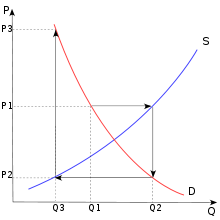
Very simply put: Read more…
World Bank: Food prices at “dangerous levels”
 Global food prices have hit “dangerous levels” that could contribute to political instability, push millions of people into poverty and raise the cost of groceries, according to a new report from the World Bank.
The bank released a report Tuesday that said global food prices have jumped 29 percent in the past year, and are just 3 percent below the all-time peak hit in 2008. Bank President Robert Zoellick said the rising prices have hit people hardest in the developing world because they spend as much as half their income on food.
“Food prices are the key and major challenge facing many developing countries today,” Zoellick said. The World Bank estimates higher prices for corn, wheat and oil have pushed 44 million people into extreme poverty since Read more…
Climate phenomenon La Nina to blame for global extreme weather events

Cyclone Yasi over Australia in February 2011. Image credit: NASA
(PhysOrg.com) — Recent extreme weather events as far as Australia and Africa are being fueled by a climate phenomenon known as La Nina — or “the girl” in Spanish. La Nina has also played a minor role in the recent cold weather in the Northeast U.S.
The term La Niña refers to a period of cooler-than-average sea-surface temperatures in the Equatorial Pacific Ocean that occurs as part of natural climate variability. This situation is roughly the opposite of what happens during El Niño (“the boy”) events, when surface waters in this region are warmer than normal. Because the Pacific is the largest ocean on the planet, any significant changes in average conditions there can have consequences for temperature, rainfall and vegetation in distant places.
Scientists at the International Research Institute for Climate and Society (IRI), part of Columbia’s Earth Institute, expect moderate-to-strong La Niña conditions to continue in the tropical Pacific, potentially causing additional shifts in rainfall patterns across Read more…
Einstein was right – honey bee collapse threatens global food security
The bee crisis has been treated as a niche concern until now, but as the UN’s index of food prices hits an all time-high, it is becoming urgent to know whether the plight of the honey bee risks further exhausting our food security.


![[Most Recent Quotes from www.kitco.com]](https://i0.wp.com/www.kitconet.com/charts/metals/gold/t24_au_en_usoz_2.gif)
![[Most Recent Quotes from www.kitco.com]](https://i0.wp.com/www.kitconet.com/charts/metals/silver/t24_ag_en_usoz_2.gif)

 crisisboom
 CRISISBOOM

You must be logged in to post a comment.