Archive
CONFIRMED ! Comet Elenin on SOHO .. 200,000+km WIDE coma (1/6th size of the sun)
Is the Solar System Warming? Inner and Outer
SO WHAT MAKES YOU THINK THAT THE SOLAR SYSTEM IS WARMING? Read more…
Evidence Found for Undiscovered Comet That May Threaten Earth
 |
| This February eta Draconid was filmed by Peter Jenniskens with one of the low-light-level video cameras of the Cameras for Allsky Meteor Surveillance (CAMS) station in Mountain View, California, at 07:59:24 UT on February 4, 2011. CREDIT: All Sky Cameras/Peter Jenniskens |
A surprise meteor shower spotted in February was likely caused by cosmic “bread crumbs” dropped by an undiscovered comet that could potentially pose a threat to Earth, astronomers announced today (July 27).
The tiny meteoroids that streaked through Earth’s atmosphere for a few hours on Feb. 4 represent a previously unknown meteor shower, researchers said. The “shooting stars” arrived from the direction of the star Eta Draconis, so the shower is called the February Eta Draconids, or FEDs for short.
The bits of debris appear to have been shed by a long-period comet. Long-period comets whiz by the sun very infrequently, so it’s tough to Read more…
Cosmic Turnaround As Earth Tracks Trojan Asteroid

Astronomers have discovered the first known “Trojan” asteroid orbiting the sun along with Earth.
The 300-metre-wide (1,000 ft) asteroid is located approximately 50 million miles (80 million kilometres) from earth and was discovered by astronomers studying observations taken by NASA’s Wide-field Infrared Survey Explorer (WISE) mission.
The asteroid’s orbit is well-defined and for at least the next 100 years, it will not come closer to Earth than 15 million miles (24 million kilometres).
The findings will be published in the July 28 issue of the journal Nature.
Trojans are asteroids that share an orbit with a planet near stable points in front of or behind the planet. Because they constantly lead or follow in the same orbit as the planet, they never can collide with it. In our solar system, Trojans also share orbits with Neptune, Mars and Jupiter. Two of Saturn’s moons share orbits with Trojans.
Scientists had predicted Earth should have Trojans, but they have been difficult to find because Read more…
Farthest, Largest Water Mass In Universe Discovered

Hubble Telescope Finds Adorably Tiny Fourth Moon Orbiting Pluto

Peering at Pluto in preparations for a satellite visit in 2015, the Hubble Space Telescope has spotted a fourth moon orbiting the dwarf planet. The wee moon doesn’t even have a name yet — it’s called P4 for now — and its estimated diameter is between 8 and 21 miles.
That’s right, Hubble spotted something the size of a city from a distance of more than 3 billion miles away.
Pluto’s new moon is smaller than the dwarf planet’s other companions; the big one, Charon, is 648 miles across, and the other moons, Nix and Hydra, are in the range of 20 to 70 miles in diameter, according to NASA. Hubble discovered those moons back in 2005.
P4 is located between the orbits of Nix and Hydra. Hubble’s Wide Field Camera 3 ultraviolet visible instrument, which was installed on the telescope’s final servicing missiontwo years ago, first picked it up on June 28, and then confirmed it in follow-up pictures taken July 3 and July 18. It may appear as a faint smudge in images from 2006, NASA reports, but no one noticed because it was too obscured. This recent set of Read more…
Bastille Day Solar Storm: Anatomy of a Gargantuan Sun Tempest

The "Bastille Day" solar flare as seen by SOHO's EIT instrument in the 195 Å emission line. CREDIT: NASA
One of the most violent sun storms in recorded history erupted 11 years ago today (July 14).
The event was called the Bastille Day Solar Storm, and it registered as an X-class flare, the highest designation possible. (One storm since then, in October 2003, was even more powerful.)
Ever wonder just how a solar storm brews? So do scientists. Here’s a rundown of what happened on July 14, 2000, one of the sun’s most violent days:
A sunspot was born. This occurred when magnetic field lines became tangled by the  churning and shifting of plasma bubbles on the sun’s surface. These twisted magnetic field lines formed a sunspot — an active region that appeared darker than the surrounding area. [Infographic: Anatomy of Solar Storms & Flares]
As the magnetic field lines became more and more twisted, magnetic potential energy built up, similar to how a roller coaster car at the top of the track builds up gravitational potential energy, which is then converted to the kinetic energy of motion as the car zooms downward.

CREDIT: NASA/TRACE
When the magnetic potential energy of the sun finally hit a certain point, it snapped, releasing that energy in the form of heat, light and the motion of particles. Plasma on the sun was heated up to 20 million or 30 million degrees Kelvin (36 million to 54 million degrees Fahrenheit). Plasma particles were accelerated along giant loops that traced magnetic field lines down through successive layers of the sun’s atmosphere.
These loops connected to form large ribbons of superheated plasma.
At the same time, some plasma particles from the sun’s atmosphere were accelerated away from the surface, out into space. Such a release of material is called a coronal mass ejection. Many of these protons and electrons made their way to Earth, where they disrupted satellites and blocked radio communications.
Though scientists understand many aspects of the storm’s process, there are still some pressing questions. One of the biggest is: What sparked the storm in the first place? [Hell Unleashed: Sun Spits Fire in Close-Up]
“The holy grail, which is not solved yet, is, what is the actual trigger mechanism that causes this buildup of energy to be released?” said Phil Chamberlin, a solar scientist at NASA’s Goddard Space Flight Center in Greenbelt, Md.
However, the Bastille Day solar storm did go a long way toward helping scientists piece together a general theory of how eruptions on the sun occur.
“This theory is all based on observations from the Bastille Day flare,” Chamberlin told SPACE.com.
That knowledge will come in especially handy in the coming years, as the sun ramps up toward a peak in its 11-year cycle of activity. Near the end of 2013, we are likely to see storms that rival, or even surpass, the Bastille Day event.
Comet’s Death by Sun Photographed for First Time
 |
| The Solar Dynamics Observatory AIA imager (observing in extreme ultraviolet light) actually spotted a sun-grazing comet as it disintegrated over about a 15 minute period (July 6, 2011), something never observed before. The angle of the comet’s orbit brought it across the front half of the Sun. Given the intense heat and radiation, the comet simply evaporated away completely. The comet was probably a member of the Kreutz sun-grazer family. CREDIT: NASA/SDO/AIA |
The death of a comet that plunged into the sun was captured on camera this month for the first time in history, scientists say.
The comet met its fiery demise on July 6 when it zoomed in from behind the sun and melted into oblivion as it crashed into the star. It was NASA’s Solar Dynamics Observatory (SDO), a satellite orbiting Earth that studies the sun, which witnessed the comet’s death-blow.
One of the SDO spacecraft’s high-definition imagers “actually spotted a sun-grazing comet as it disintegrated over about a 15 minute period (July 6, 2011), something never observed Read more…
Behemoth sunspots evolve
The SDO team has just prepared a beautiful movie of the explosion that produced the CME.
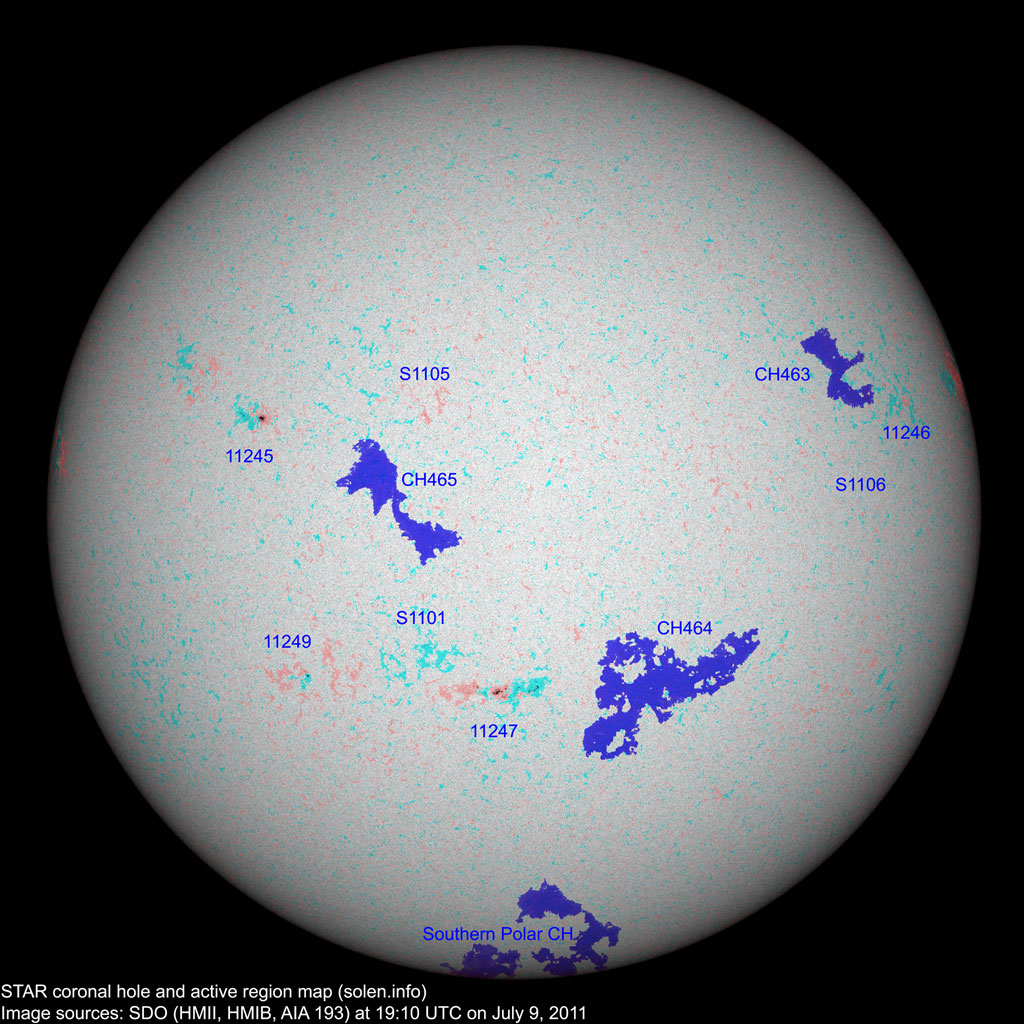
Sunspot group 1247 is expanding rapidly and in an interesting way. The active region is organizing itself as a linear Read more…
Elenin 7/7/11 Saturn Megastorm
io9.com
 Check out the most intense Saturn storm that the Cassini spacecraft has ever recorded. You can see it overtaking its own tail as it zooms around Saturn’s Northern hemisphere. (The tail is the blue clouds to the South and West.)
The storm started months ago, and is still active today. The storm’s surface area is eight times the surface area of our own planet. And at its most intense, the storm has generated more than 10 lightning flashes per second. It covers 500 times the area of the largest of the Southern hemisphere storms Cassini has observed — there were several storms in the Southern region scientists dubbed “storm alley,” but the hemispheres flipped around August 2009, when the Northern hemisphere began experiencing spring.
Says Georg Fischer, the lead author of a paper about this new storm:
This storm is thrilling because it shows how shifting seasons and solar illumination can dramatically stir up the weather on Saturn. We have been observing storms on Saturn for almost seven years, so tracking a storm so different from the others has put us at the edge of our seats. Read more…


![[Most Recent Quotes from www.kitco.com]](https://i0.wp.com/www.kitconet.com/charts/metals/gold/t24_au_en_usoz_2.gif)
![[Most Recent Quotes from www.kitco.com]](https://i0.wp.com/www.kitconet.com/charts/metals/silver/t24_ag_en_usoz_2.gif)

 crisisboom
 CRISISBOOM
You must be logged in to post a comment.