Archive
UK nightclub uses biometrics to control entry

The Underground, a nightclub in Dundee, Scotland, recently installed biometric fingerprint scanners for first time visitors to prove they are of age to enter. For subsequent visits, customers of the nightclub are identified by scanning their fingerprint.
The club is run by G1 Group PLC, who introduced the Scannet ID Scan system after a successful trial period in its Glasgow club. Scannet ID Scan is used to verify that identification presented is real.
Fingerprints gathered, together with photo-based profiles, are stored in computers in the club. Having this technology makes it easier for the management to identify troublemakers, and scan foreign passports and driving licenses before allow entry to the club.
A spokeswoman from G1 Group said : “The system recognizes most international passports and driving licenses, meaning we can Read more…
Eye movement biometrics
phys.org
 A biometric security system based on how a user moves their eyes is being developed by technologists in Finland. Writing in the International Journal of Biometrics, the team explains how a person’s saccades, their tiny, but rapid, involuntary eye movements, can be measured using a video camera. The pattern of saccades is as unique as an iris or fingerprint scan but easier to record and so could provide an alternative secure biometric identification technology. Martti Juhola of the University of Tampere and colleagues point out that fingerprint and face recognition are perhaps the most usual biometric means to verify identity for secure access to buildings and computer resources and even at international borders. Other techniques such as iris scanning are also occasionally used in some circumstances. The most obvious disadvantage of such biometrics is that they might be forged through the use of an Read more…
Feds to consider biometrics for permanent residents to combat fraud
Photograph by: Postmedia News , National Post
OTTAWA — Immigration Minister Jason Kenney says he supports extending biometric ID requirements to permanent residents and would consider amending his current omnibus immigration bill to make it happen.
“I think in principle, we should be doing everything we reasonably can to identify visitors or immigrants and ensure they don’t represent a threat to Canada’s safety, so biometrics is the best technical tool at our disposal and I think in principle, that it should be applied to not just temporary but also permanent residents,” Kenney said Thursday after testifying before a Commons committee reviewing Bill C-31, the Protecting Canada’s Immigration Act.
After hinting at it during the meeting, he confirmed the government was “considering” amending the bill to ensure Read more…
Biometrics: Those Tell-Tale Signs That Say Who You Are
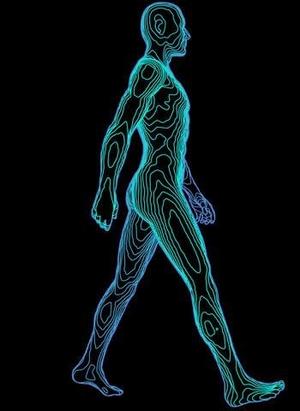 ScienceDaily (Apr. 23, 2012) — Forget about fingerprints or iris recognition; the way you walk or move your hands, even your pulse, can be analysed for unique characteristics. EU-funded researchers are looking at ways this new technology could protect your security and make identity checking less obtrusive and more accurate.
You might think that PIN codes and fingerprints are pretty secure identity systems, but they are in fact simple to hack. The criminal community has found it too easy to steal PIN numbers just using cameras, card copiers or the point of a knife at the cash point. And James Bond famously tricked an adversary to believing his false identity by wearing ‘fake fingerprints’.
The use of biometric identification — using the unique properties and characteristics of an individual to help identify them — continues to grow in popularity. Modern electronic passport checks use face recognition, and iris scanning has also been tested in some airports.
Recognising the growing market fo Read more…
Computer Can Pick You Out From Your Eyes In A Crowd: ‘Needle in Haystack’ Search Capability
nanopatentsandinnovations.blogspot
Identifying people by acquiring pictures of their eyes is becoming easier, according to a new report* from the National Institute of Standards and Technology (NIST). NIST researchers evaluated the performance of iris recognition software from 11 different organizations and found that some techniques produced very rapid results—though this speed was often at the cost of accuracy.

Credit: Talbott/NIST
Robocop becomes reality with Spain’s Ex-Sight

ALICANTE–The cyborg facial recognition of Robocop becomes a reality as Spain’s Ex-Sight technology equips police officers with the ability to scan 100,000 faces per second. They can then cross these images with whose in a database and, in moments, identify suspects.
The first widespread implementation of this technology is with the Brazilian police getting ready for the next World Cup and the 2016 Summer Olympics. ”The military police have a database of suspicious people they connect with our software, and our software runs inside the control center in every stadium,” says Elazar Lozano Vidal, of Ex-Sight Spain. There are cameras at each entrance of the sports stadiums. “The police have also cameras in the glasses, one of the lens is a screen and (the other) has a camera in the glass.”
Lozano says these Ex-Eye facial recognition glasses are used to scan every person that goes in front of these cameras, up to 100,000 faces a second, and that one well-situated police officer is enough to detect a crowd on a street.
The officer “moves his face and with the glasses detects a lot of people, and Read more…
Japanese ATMs to Use Palm Readers in Place of Cash Cards
A Japanese bank will introduce ATMs that use palm scanners in place of cash cards, it said Wednesday.

on an ATM (Credit: Fujitsu)
Ogaki Kyoristu Bank said the new machines will allow customers to withdraw or deposit cash and check their balances by placing their hand on a scanner and entering their birthday plus a pin number. The ATMs will initially be installed at 10 banks, as well as a drive-through ATM and two mobile banks, from September.
Ogaiki announced the new ATMs with the slogan “You are your cash card.”
One reason the bank decided to use the new technology was the massive earthquake and tsunami that ravaged the country’s northeast coast last year, it said. Many who escaped the tsunami lost their homes, personal possessions and all forms of identification, and so were unable to access their bank accounts until weeks or months later.
Finger and palm scanners are currently used by many large Japanese banks along with cash cards as an additional safety feature, but Ogaki said it will be the first bank in the country to do away with cards Read more…
NYPD Forces Retina Scan on Occupy Wall Street Activists
 It remains unclear whether there is compelling state interest in forcing retina scans on peaceful protesters exercising their right to free speech in a public place, but that’s just what the New York Police Department is doing to the Occupy Wall Street activists.
Over 90 Occupy Wall Street protesters were arrested Saturday afternoon, and some were arraigned yesterday in Manhattan Criminal Court, but not before learning that the cost of their bail would spike exponentially — or that the opportunity to post bail would be denied arbitrarily – if protesters did not submit to retina scans.
Activists and lawyers alike were surprised yesterday to learn that Read more…
Nigeria: ‘Biometric Data Will Control Crime in FCT’
 This will be the excuse that many governments around the world will use. Gather biometrics from everyone for their own safety and to be monitored while reducing crime…
The FCT Police Commissioner, Michael Zuokumor, yesterday said that capturing cab driver’s biometric data in the territory will tremendously reduce crime.
Zuokumor stated this in Abuja, during the official flag-off of the biometric data capturing of FCT cab drivers, an event organised by Painted Abuja Taxi Nigeria Limited (PAT).
He said the FCT Police Command in partnership with cab drivers in the territory have been able to reduce the incidences of car snatching and ‘one chance operators’ to the barest minimum in recent time.
“The command is developing strategies that will ensure that the issue of car snatching becomes a thing of the past in Abuja within the next three to six months,” he said.
Earlier in his remark, Chairman of Painted Abuja Taxi Nigeria Limited, Alhaji Shugaba Yar’Adua, said the essence of capturing cab drivers biometric data is to tackle the incidence of ‘one chance operators’ in order to guarantee the safety and security of commuters.
He said that the exercise will enable the government monitor the activities of taxi drivers in the territory and urged all cab drivers to key into the scheme.
Yar ‘Adua disclosed that Painted Abuja Taxi Ltd has signed an MoU with FCT Transportation Secretariat to provide them with 300,000 new vehicles in order to remove all rickety commercial vehicles from Abuja road.
He said the FCT Transport Secretariat has equally promised to create taxi racks in all the six area councils, where cab drivers can conveniently carry out their activities.
On his part, Representative of FCT Transport Secretary, Alhaji Mohammed Tukur, urged cab operators in the territory to strictly follow the rules and regulations laid down for their operations for smooth transport operation.
US-VISIT: Biometrics Are Here to Stay
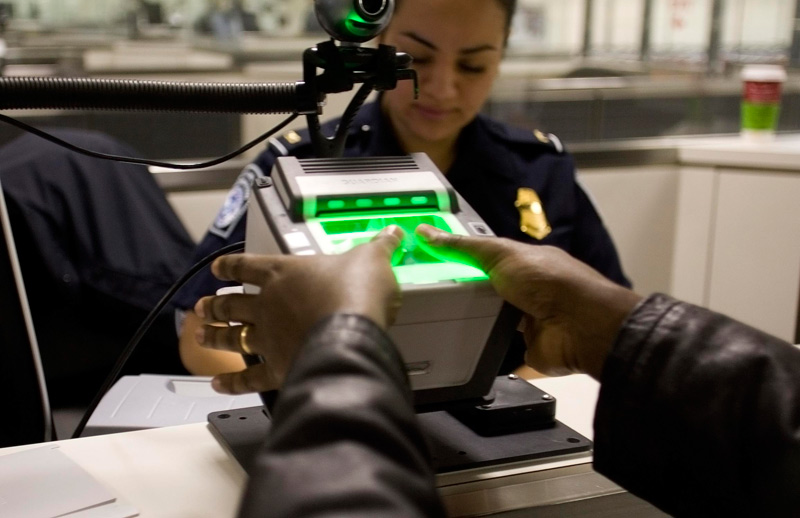
A traveler arriving at Washington Dulles International Airport uses a scanner that records images of all 10 fingerprints. U.S. Customs and Border Protection photo
In its everyday operations, the term “biometrics” still has a fairly simple meaning for the federal border protection workforce: It means fingerprints and photographs. The immigration and border management system used by the Department of Homeland Security – the United States Visitor and Immigrant Status Indicator Technology (US-VISIT) program – collects digital fingerprints and photographs from everyone between the ages of 14 and 79 who attempts to enter the United States, and checks these images against a database of known or suspected criminals, terrorists, and illegal immigrants.
US-VISIT is a component of – or more accurately, it is a system that will soon make use of – the largest fingerprint repository and biometric-matching system in the world, DHS’s Automated Biometric Identification System, or IDENT. By the end of 2012, according to US-VISIT Director Bob Mocny, the program will become fully integrated with this fingerprint database, enabling real-time “rapid response” capability – instead of checking against the current US-VISIT watch list of about 6 million identities, the fingerprints of incoming travelers will be


![[Most Recent Quotes from www.kitco.com]](https://i0.wp.com/www.kitconet.com/charts/metals/gold/t24_au_en_usoz_2.gif)
![[Most Recent Quotes from www.kitco.com]](https://i0.wp.com/www.kitconet.com/charts/metals/silver/t24_ag_en_usoz_2.gif)

 crisisboom
 CRISISBOOM
You must be logged in to post a comment.