Archive
Middle East Meltdown Could Mean Oil at $300 a Barrel, Pump Prices of $9.57 a Gallon
moneymorning.com [Editor’s Note: U.S. oil prices yesterday (Tuesday) hit their highest levels since September 2008 as investors reacted to fears that Middle East tumult would spread from Libya to such key Organization of Petroleum Exporting Countries (OPEC) as Iran and Saudi Arabia. But never fear: Even if the Middle East melts down and oil prices soar, there are moves you can make to hedge away your risk. We have two suggestions for you here.] By Martin Hutchinson, Contributing Editor, Money Morning The unrest in the Middle East oil patch is roiling the global oil markets on an almost daily basis.  The events in Egypt, Libya, Saudi Arabia, Oman and other countries are also forcing us to ask that long-dreaded question: What happens if the countries throughout the Middle East region fall to radical governments? The answer is both stunning and surprising. In an absolute worst-case scenario – if the entire Middle East falls under radical control – we could be looking at $300-a-barrel oil and pump prices of $9.57 a gallon. Definitely a stunner. Here’s the surprise: Even such a worst-case outcome would Read more…
Kuwait is the Spear Pointing at the Heart of Saudi Arabia
 Despite the reassurances and promises of change and trinkets for the masses, the front page news continues to reflect that Bahrain is the most dangerous situation for the Kingdom of Saudi Arabia. The reasoning is that the Shi’a will spread their unrest into the Eastern Provinces along the rich oil producing regions of the nation and interrupt the flow of oil operations and embolden the Iranian regime to create mischief against their historic foe. In my opinion, this is a reach as the spear pointing towards the heart of the Kingdom is in Kuwait, a nation which has escaped the mainstream media’s attention up until this point in time.
The reason Bahrain is so key can best be summed up by the United States military interests in the region based there. Unfortunately for the media, the true story is the same one people realized in 1990 when Iraq invaded Kuwait. Kuwait is the key to destroying the stranglehold the Saudi royal family has held on the Persian Gulf and the revolutionary movements of the region have understood this for twenty years now. When the Iraqi regime was crushed by the U.S. this decade the focus shifted from expelling the various monarchies in the Gulf region to using terror to expel the American “occupiers” as our nation was so labeled. When the strategy of state sponsored and funded terrorism failed, the revolutionaries and Read more…
Why the World Must Watch Europe
Beyond the EU Debt Crisis
The continent’s financial crisis gave rise to bailouts, infighting and demands for sweeping financial reform. Could there still be a bright future over the horizon for the European Union?

Amid the shift in global superpowers, two names come up as heavyweight world championship opponents: China and the United States.
The constant media exposure and speculation could be likened to a pay-per-view boxing matchup.
In one corner: the world’s largest energy consumer—with a 1.3-billion-strong population—endlessly stockpiling natural resources—and holding nearly $900 billion in United States’ debt.
In the other: longtime democratic world champion—largest economy—and leader in manufacturing.
China is the clear favorite, but the U.S. is still in the running. On its way down from unmatched superpower, it is still a formidable opponent, with its manufacturing sector out-producing China by 40 percent.
Yet America is weighed down by a $14 trillion federal debt and rampant Read more…
The Chinese government started stockpiling food 3 years ago: What has the US government been doing beside spending money we don’t have?
 I wrote this three years ago, when the Chinese were reportedly stockpiling food in their cities. The world economic and political situation has worsened. With rising food prices, massive unemployment, union protests and government debt driving states to the brink of shut down and bankruptcy, the situation has worsened–and we owe the Chinese more than ever. ED.
by Monica Davis
Rumor has it that the Chinese government is advising its cities to start stockpiling food and fuel. The government news agency reports that the central government has told the largest cities to stockpile at least two weeks of food, until the world economic turmoil caused by the banking industry’s foreclosure woes slows down. Lots of luck on that.
With China’s exposure in the twitchy American financial markets, it is no wonder that the Chinese are getting nervous. They have a lot at stake in the American economy, as do many foreign investors, past and present.
In a historical analysis of foreign investment in the United States, one writer notes that: Read more…
Need Versus Greed

NEW YORK – India’s great moral leader Mohandas Gandhi famously said that there is enough on Earth for everybody’s need, but not enough for everybody’s greed. Today, Gandhi’s insight is being put to the test as never before.
The world is hitting global limits in its use of resources. We are feeling the shocks each day in catastrophic floods, droughts, and storms – and in the resulting surge in prices in the marketplace. Our fate now depends on whether we cooperate or fall victim to self-defeating greed.
The limits to the global economy are new, resulting from the unprecedented size of the world’s population and the unprecedented spread of economic growth to nearly the entire world. There are now seven billion people on the planet, compared to just three billion a half-century ago. Today, average per capita income is $10,000, with the rich world averaging around $40,000 and the developing world around $4,000. That means that the world economy is now producing around $70 trillion in total annual output, compared to around $10 trillion in 1960.
China’s economy is growing at around 10% annually. India’s is growing at Read more…
China tamps down Middle East-inspired protests before they can gain momentum

The Chinese government met protesters with a show of force Sunday. In Shanghai, police converged whenever a group of more than a dozen people seemed to be forming. (Peter Parks)
BEIJING – Police and security officials displayed a show of force here and in other Chinese cities Sunday, trying to snuff out any hint of protests modeled on the uprisings in the Middle East and North Africa. In Shanghai, several hundred people trying to gather were dispersed with a water truck.
Premier Wen Jiabao, meanwhile, used a morning Internet chat to promise to purge senior officials who are corrupt and to rein in inflation and rising home prices, directly addressing some of the most common grievances of ordinary Chinese.
Since a January uprising in Tunisia spurred similar anti-government protests across the Arab world, threatening long-entrenched authoritarian regimes, China’s Communist rulers have reacted nervously, with both defensive and aggressive tactics.
Officials have used state-run media outlets to dismiss any comparisons of those regimes with China. At the same time, they have stepped up public comments on the need to address “social conflict” and to tackle problems such as the growing income disparity between the rich and poor. They also have Read more…
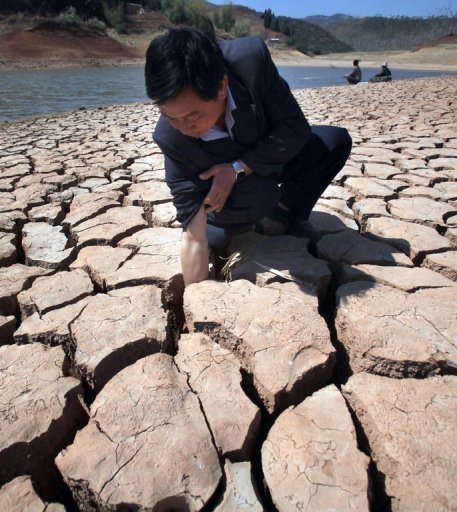
China’s droughts nears worst in 200 years, adding pressure to world food prices
The recent unrest in the Middle East, which has been attributed, in part, to high food prices, gives us a warning of the type of global unrest that might result in future years if the climate continues to warm as expected. A hotter climate means more severe droughts will occur. We can expect an increasing number of unprecedented heat waves and droughts like the 2010 Russian drought in coming decades. This will significantly increase the odds of a world food emergency far worse than the 2007 – 2008 global food crisis. When we also consider the world’s expanding population and the possibility that peak oil will make fertilizers and agriculture much more expensive, we have the potential for a perfect storm of events aligning in the near future, with droughts made significantly worse by climate change contributing to events that will cause disruption of the global economy, intense political turmoil, and war. Read more…
After the ecstasy of revolution, the Bankers quietly begin carving up Egypt and North Africa
By Richard Eastman
21st Century Wire
Feb 25, 2011
The European Bank for Reconstruction and Development (EBRD) is ready to lend one billion EUROS a year to Egypt for reconstruction and “free-market reform”- even as Egypt’s Minister of Finance Samir Radwan has gone begging to the City of London bankers and the British Ministry of Trade and Investment for relief on debt payments that are about to throw Egypt into bankruptcy.
All this, as Egypt has been such a good boy with regards to privatization and austerity, measures which awarded Egypt its celebrated 7 percent growth rate- mostly in investments that will end up in international hands as ventures fail to pay out with ever diminishing Egyptian domestic purchasing power.
FRESH CYCLES OF DEBT
First EBRD will lend at interest and build what they want backed by Egyptian collateral and the value of the projects themselves. Then when it turns out they can’t make the debt payments because of all the interest we have sucked from them, we take over all of the assets we have developed. That’s freedom and EBRD is really going to give it to them. After all EBRD is experienced at this. In 1991 the EBRD was organized to financially lead Russia and Eastern Europe in their transition from paternalistic socialism to sustainable free-market economies open to international Read more…
Limited Nuclear War Could Deplete Ozone Layer, Increasing Radiation
By Chris Schneidmiller
 WASHINGTON — A nuclear conflict involving as few as 100 weapons could produce long-term damage to the ozone layer, enabling higher than “extreme” levels of ultraviolet radiation to reach the Earth’s surface, new research indicates (see GSN, March 16, 2010).
(Feb. 24) – A 1971 French nuclear test at Mururoa Atoll. The ozone layer could sustain lasting harm from a nuclear exchange involving as few as 100 weapons, allowing increased levels of ultraviolet radiation to reach the Earth’s surface, according to new research (Getty Images).
Increased levels of UV radiation from the sun could persist for years, possibly with a drastic impact on humans and the environment, even thousands of miles from the area of the nuclear conflict.
“A regional nuclear exchange of 100 15-kiloton weapons … would produce unprecedented low-ozone columns over populated areas in conjunction with the coldest surface temperatures experienced in the last 1,000 years, and would likely result in a global nuclear famine,” according to a presentation delivered on Friday at a major science conference in Washington.
Today, there are five recognized nuclear powers — China, France, Russia, the United Kingdom and the United States. India, Israel and Pakistan are all known or widely assumed to hold nuclear weapons, while North Korea has a Read more…


![[Most Recent Quotes from www.kitco.com]](https://i0.wp.com/www.kitconet.com/charts/metals/gold/t24_au_en_usoz_2.gif)
![[Most Recent Quotes from www.kitco.com]](https://i0.wp.com/www.kitconet.com/charts/metals/silver/t24_ag_en_usoz_2.gif)

 crisisboom
 CRISISBOOM
You must be logged in to post a comment.