Archive
Russia- Japan: The Kuril Islands conflict and Russia’s defense arsenal in the Far East
Alexandr Grashenkov
Global Research
 Russia to boost Kuril defense to ward off war Russia’s unresolved conflict with Japan over the Kuril Islands, which has been simmering since WWII, may reach a boiling point now that Russian authorities are set to go ahead with their plan to build up the disputed territory’s defense potential.
The Food Bubble is About to Burst
We’re fast draining the fresh water resources our farms rely on, warns Lester Brown, president of the Earth Policy Institute
What is a food bubble?
 That’s when food production is inflated through the unsustainable use of water and land. It’s the water bubble we need to worry about now. The World Bank says that 15 per cent of Indians (175 million people) are fed by grain produced through over-pumping – when water is pumped out of aquifers faster than they can be replenished. In China, the figure could be 130 million.
Has this bubble already burst anywhere?
Saudi Arabia made itself self-sufficient in wheat by using water from a fossil aquifer, which doesn’t refill. It has harvested close to 3 million tonnes a year, but in Read more…
China gains chokehold over U.S. defense
WorldNetDaily
An alarming new report says the United States is choosing to rely on China for the rare earth metals that are critical for the production of America’s strategic defense weapons, giving the communist nation a chokehold on the ability of the U.S. to defend itself, according to Joseph Farah’s G2 Bulletin.
While the U.S. has the world’s second-largest reserves of the substances, instead of facilitating production, it has left China to take over the market – it controls some 97 percent of the global sales of these elements, according to the report.
The American Security Project, in fact, says the U.S. is “completely reliant on China” for rare earth metals for the production of the nation’s most critical weapons systems.
“Rare earth metals are essential for the United States’ military and economic well-being,” the report said. “Yet, the U.S. has been particularly lax when it comes to securing the supply of these metals.
“The U.S. has gone from the world’s top producer and supplier of rare earths to Read more…
North Korea confirms large-scale foot-and-mouth disease outbreak
PYONGYANG: North Korean state media on Friday acknowledged for the first time that foot-and-mouth disease has broken out in the Asian country, affecting eight provinces.

KCNA said the most seriously affected areas are Pyongyang, North Hwanghae Province and Kangwon Province. Other areas which have been affected are North and South Phyongan Provinces and Jagang Province, although the other three affected provinces were not identified.
“Type O Foot-and-mouth diseases broke out on cooperative farms, diary farms and pig farms in those areas, doing harm to domestic animals,” KCNA said. “More than 10 000 heads of draught oxen, milch cows and pigs have so far been infected with the diseases and thousands of them died.”
The state broadcaster said a national emergency veterinary and anti-epizootic committee has since been established. “An emergency anti-epidemic campaign was Read more…
China spends $1 billion to tackle drought
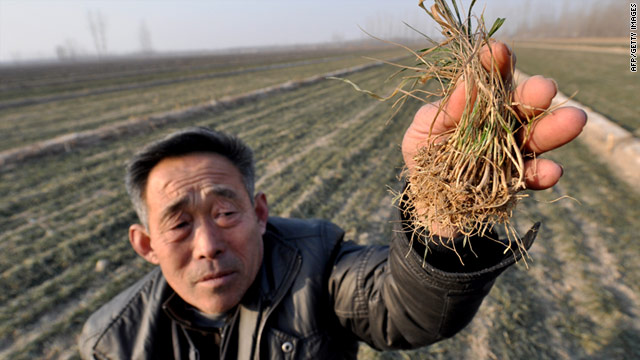
Beijing (CNN) — China’s government will invest $1 billion to combat a three month drought crippling the country’s north.
The worst drought in six decades threatens to ruin China’s winter harvest, the world’s largest producer of wheat.
To combat it, China’s government plans to spend around 6.7 billion yuan ($1.02 billion) to divert water to affected areas and irrigation facilities according to the state news agency, Xinhua.
Some 2.57 million people and 2.79 million livestock are suffering from drinking water shortages, Xinhua said.
The main affected provinces include Shandong, Jiangsu, Henan, Hebei and Shanxi, which together account for about 60% of the wheat planted this winter.
The United Nation’s Food and Agriculture Organization (FAO) issued an alert Tuesday, warning of severe wheat shortages, saying “the ongoing drought is potentially a serious problem.”
According to the FAO the drought is now affecting an area of around 5.16 million hectares, representing two-thirds of China’s wheat production.
Meanwhile the country’s capital Beijing got it first snowfall in more than three months overnight on Wednesday. But the precipitation is unlikely to end the area’s drought, reported Xinhua.
The precipitation followed cloud seeding by the municipal artificial weather intervention office, the agency said.
What does China want from Zimbabwe?
Zimbabwe has claimed that China is ready to pour $10 billion (£6.2 billion) into its ailing economy. If the figure is true, what might Beijing want in return?


By Malcolm Moore, Shanghai 8:13AM GMT 10 Feb 2011
When Yang Jiechi arrives in Harare on Thursday, for the first visit by a Chinese Foreign minister in a decade, he is almost certain to be bearing gifts.
After almost three years in which China has publicly shied away from Zimbabwe, there are signs that Beijing has its eyes, once again, on the country’s rich mineral reserves.
Since the deadly elections in 2008, which forced Robert Mugabe, Zimbabwe’s president, to form a “unity” government with his opponent Morgan Tsvangirai, relations have cooled while Chinese officials hedged their bets over the country’s leadership and squirmed in the fierce glare of international condemnation.
“China gets embarrassed when embarrassing details become public,” said Philip Barclay, a former British diplomat in Harare and the author of Zimbabwe, Years of Hope and Despair.
“And the Chinese weapons shipment which arrived in 2008, just at the time when violence broke out around the Zimbabwean elections, was very embarrassing. They really did not like that,” he added.
On Thursday, however, Mr Yang is likely to start negotiations over a significant injection of Chinese investment.
According to Tapiwa Mashakada, the Zimbabwean Economic planning minister, Mr Yang may be carrying with him as much as $10 billion of investment from Beijing.
“We have met with officials from China Development Bank and they have said they are willing to invest up to $10 billion,” he said, at a business conference in Harare earlier this month.
“The Chinese are looking into mining development, that is exploration and exploitation, agriculture, infrastructure development and information communication technology,” added Mr Mashakada, a member of Mr Tsvangirai’s Movement for Democratic Change party.
Previous rumors suggested, however, that the money on the table is actually a $3 billion loan from China’s Export-Import (Exim) Bank. Both sums dwarf previous Chinese investments in Zimbabwe, and Mr Mashakada’s claim represents more than twice the value of Zimbabwe’s entire economy last year, and more than all other Chinese direct investments in Africa in 2009 put together.
“It is a pie-in-the-sky figure,” said Mr Barclay. “It is much larger than previous Chinese investments and when they do invest money, the Chinese expect concrete benefits, usually closely linked to concessions,” he added.
More likely are targeted deals, perhaps for Zimbabwe’s platinum and zinc mines. Zimbabwe has the second-largest reserves of platinum in the world after South Africa.
Details of the Exim bank deal reported in Zimbabwe’s respected “Independent” newspaper cite documents proposing a “master-loan facility” aimed at resuscitating Zimbabwe’s struggling economy after years of hyperinflation and disastrous government policies.
In return, China reportedly wants control over platinum deposits currently owned by the Zimbabwean government in the Selous and Northfields concession covering 68 square miles and valued at between $30 billion to $40 billion.
More controversially, China may also have its eyes on the Marange diamond fields in Chiadzwa. In late 2008 the Zimbabwean military is alleged to have seized control of the fields, shooting illegal miners from helicopter gunships.
Currently, a small proportion of the diamonds from this vast mine are certified by the Kimberley Process to avoid being tagged as “blood” diamonds, but a much greater quantity is thought to be bought up by dubious traders with profits flowing to Mr Mugabe’s Zanu-PF.
China already mines one alluvial diamond concession at Chiadzwa in partnership with the government under the banner of Anjin Investments. There have also been rumors that China may be involved in further illegal mining activities, but they have never been confirmed.
In addition, some Chinese investment could flow into agriculture. China imports a significant quantity of tobacco from Zimbabwe, and may have one eye on a future source of food for its growing middle class.
Around 5,000 Chinese workers live in Zimbabwe, and the two countries have a relationship stretching back to the founding of Robert Mugabe’s Zanu-PF, whose Marxist revolution was partly funded by Beijing. Over the years, China has found it easy to do business with a country that was run along similar lines, with Zanu-PF’s politburo making unilateral decisions.
It is not clear if dealing with the unity government and Mr Tsvangirai’s MDC party will be to Beijing’s taste, but for Zimbabwe there seems little option.
“The MDC will send China warm and fuzzy messages too,” said Mr Barclay. “Although the investment from China is not a particularly good fit, the Chinese are the only investors out there. There was a small delegation from Germany in 2010, but they backed off.”
Chinese weapons fall into hands of insurgents

Insurgents in Afghanistan and Iraq have obtained Chinese-made weapons
Chinese-made weapons have fallen into the hands of insurgents fighting Coalition forces in Iraq and Afghanistan because of China’s failure to enforce export controls on arms to Iran, the leaked cables show.
By Gordon Rayner
US diplomats also feared that Chinese companies were selling materials to Iran that could be used to build nuclear missiles and other weapons of mass destruction.
Chinese-made guns, as well as rocket-propelled grenades and surface-to-air missiles containing Chinese-made components, have all been used against Coalition forces or civilian targets in Iraq, the US claims, while other weapons have been obtained by militants in Afghanistan.
The US was so concerned about Chinese arms and components being sold to Iran that in September 2008 the State Department launched a major diplomatic offensive to put pressure on Beijing.
It decided to share intelligence with eight “key allies” including Spain and Italy to “persuade China to enforce its export control laws more effectively” and to “aggressively implement” UN Security Council resolutions on the sale of arms and weapons materials.
Ambassadors were told to encourage the foreign governments to point out to the Chinese that arms sales to Iran “could ultimately damage China’s reputation and its bilateral relationship with” each of the countries.
The What? And Why? Of Rare Earth Metals
Over the past few months, there’s been a buzz surrounding rare earth metals. These are metals such as europium, lanthanum, neodymium and 14 others found in small concentrations attached to other metals and resource deposits. They’re actually not that rare, just expensive and difficult to pull out of the ground.
These naturally occurring elements are essential in everything from wind turbines to lasers to iPads.
Rare earths are a conundrum for the environmentally conscious—they hold the key to green energies but create toxic waste when being separated away from other elements. “Just one wind turbine generating 3 megawatts of electricity requires 600 kilograms of rare earths for its magnets,” a source told the United Kingdom’s Guardian newspaper.
 Electric and hybrid cars can contain more than twice as much rare earth metals as a standard car. This image from the NY Times breaks down how these metals make up critical elements of a Prius.
Currently, China controls 97 percent of the world’s production of rare earth metals. In October 2010, the country cut exports of the metals by 70 percent, disrupting manufacturing in Japan, Europe and the U.S., and sending the prices of these metals up 40 percent.
China currently controls production but the country only has 37 percent of Read more…
China police stop spread of Egypt news: activist
 BEIJING — Police in southwest China have barred activists from distributing leaflets about anti-government protests in Egypt and Tunisia, deeming the news too sensitive, one dissident said Wednesday.
Activists in Guizhou province tried to hand out information about the demonstrations over the weekend, but police told them this was an “unusual period” and gave them 3,000 yuan ($450) to stop, Chen Xi told AFP.
The police paid the money to compensate for losses incurred from the printing costs, and when the activists tried to distribute more information in Guiyang city on Monday, police again barred them from doing so, Chen said.
“We do this (hand out leaflets) all the time but the Read more…
Russian volcano activity causes global concern
Now the world has something else to grip about when it comes to Russia – the weather.
A string of volcanoes on Russia’s eastern seaboard of Kamchatka have been unusually active for the last six months. The dust they threw up diverted winds in the Arctic, pushing cold air over Europe and North America and causing the unusually cold winter this year, say scientists.
The volcanoes (160 in total, of which 29 are active) are still on the go and could create more problems this year, depressing harvests around the world just as global food prices soar and Read more…


![[Most Recent Quotes from www.kitco.com]](https://i0.wp.com/www.kitconet.com/charts/metals/gold/t24_au_en_usoz_2.gif)
![[Most Recent Quotes from www.kitco.com]](https://i0.wp.com/www.kitconet.com/charts/metals/silver/t24_ag_en_usoz_2.gif)

 crisisboom
 CRISISBOOM
You must be logged in to post a comment.