Archive
In U.S., Salmonella Is On the Rise While E. Coli Retreats
 TUESDAY, June 7 (HealthDay News) — As a deadly new strain of E. coli in Europe makes headlines, U.S. health officials announced Tuesday that salmonella, not E. coli, remains the biggest foodborne health threat to Americans.

In fact, while rates of several types of foodborne illness — including E. coli — have been falling over the past 15 years, there’s been no progress against salmonella infections, according to the U.S. Centers for Disease Control and Prevention.
While infections from Shiga toxin-producing E. coli O157 (the strain of most concern in the United States) have dropped almost in half and the rates of six other foodborne infections have been cut 23 percent, salmonella infections have risen 10 percent, the agency said.
“There are about 50 million people each year who become sick from food in the U.S. That’s about one in six Americans,” CDC director Dr. Thomas R. Frieden said during a noon press conference Tuesday.
In addition, about 128,000 people are Read more…
E.coli outbreak in Europe caused by new toxic strain
An employee of Czech center of national reference laboratories prepares samples of vegetables for molecular testing on EHEC bacteria (bacterium Escherichia coli.) in Brno June 1, 2011.
Credit: Reuters/David W Cerny
By Tan Ee Lyn
HONG KONG | Thu Jun 2, 2011 8:13am EDT
HONG KONG (Reuters) – The E. coli epidemic in Europe is caused by a new, highly infectious and toxic strain of bacteria that carries genes giving it resistance to a few classes of antibiotics, Chinese scientists who analyzed the organism said.
The scientists at the Beijing Genomics Institute, who are collaborating with Germany’s University Medical Center Hamburg-Eppendorf, completed sequencing the genome of the bacterium in three days after receiving its DNA samples.
“This E. coli is a new strain of bacteria that is highly infectious and toxic,” said the scientists at the Beijing Genomics Institute in Shenzhen city in southern China.
They said in a press release on Thursday the bacterium was closely related to Read more…
New concerns over Lyme disease
 Ted Simons can’t remember the content of a recent phone conversation. When he reads, an activity he has always enjoyed, he has trouble understanding and retaining what he’s read.
Yet Simons, a performer and composer of music, can still play the piano and remember thousands of songs. The 78-year-old Westport resident and his wife Jean don’t know exactly what’s wrong with him.
Tests have shown it’s unlikely he has Alzheimer’s disease, though he shows signs of dementia. The couple have tried various therapies, but nothing has worked for long. In talking to doctors, the Simons have developed a possible, unexpected cause for Ted’s confusion and memory problems: Lyme disease.
The illness, spread by tick bites, can affect different organ systems, including Read more…
EU ministers scramble to deal with cucumber crisis
 EU agricultural ministers Monday struggled to come to terms with a deadly bacteria outbreak suspected of stemming from contaminated cucumbers that has already killed 12 in Germany.
“One problem with Spanish cucumbers, and all of Europe is trembling,” Belgium’s minister Sabine Laruelle said on the sidelines of an informal meeting in Debrecen, eastern Hungary.
At least 12 people have died in Germany following an outbreak of enterohaemorrhagic E. coli (EHEC) found on imported cucumbers.
And several hundred more are being treated in hospitals for the highly virulent strain of bacteria, which can result in full-blown haemolytic uraemic syndrome (HUS), a disease that causes bloody diarrhoea and serious liver damage and which can result in death.
Around Europe, other cases — real or suspected — have been reported in Denmark, Sweden, Britain, the Netherlands, Austria, France and Switzerland, all of them apparently stemming from Germany.
Dutch agriculture minister Henk Bleker said Read more…
Another woman dies of mysterious virus in s Korea
 Seoul (ANTARA News/Xinhua-OANA) – A pregnant woman has died of pneumonia related to an unidentified virus, nearly 15 days after the same cause brought about the first fatality in South Korea, local media reported Thursday.
The 36-year-old woman died early Thursday morning, about one month after being admitted to the intensive care unit of a large hospital in Seoul, according to the Korea Center for Disaster Control and Prevention (KCDC), Seoul`s Yonhap news agency reported.
She initially showed cold-like symptoms but later was diagnosed with pulmonary fibrosis. The victim was among eight patients who checked into the intensive care unit of the hospital for infection with the unknown virus.
Seven of the eight patients have recently given birth or are expecting, prompting widespread fears among the country`s pregnant women.
The KCDC has been focusing on verifying the origin of the virus by studying the specimen taken from the patient and conducting genetic analysis on it.
Antibiotics In Animal Feed Encourage Emergence Of Superbugs – FDA Sued By Health And Consumer Organizations
medicalnewstoday
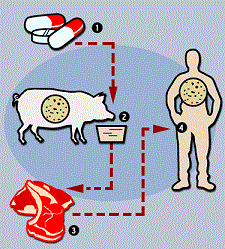 If the FDA concluded in 1977 that adding low-dose antibiotics used in human medicine to animal feed raised the risk of antibiotic-resistant bacteria, why has it still done nothing about it? A suit filed by some health and consumer organizations says the FDA has not met its legal responsibility to protect public health – the practice of routinely adding low-dose antibiotics to animal feed has to stop, and the FDA has the authority to make it so.
Peter Lehner, Natural Resources Defense Council (NRDC) executive director, said:
“More than a generation has passed since FDA first recognized the potential human health consequences of feeding large quantities of antibiotics to healthy animals.
Accumulating evidence shows that antibiotics are becoming less effective, while our grocery store meat is increasingly laden with drug-resistant bacteria. The FDA needs to put the American people first by ensuring that antibiotics continue to serve their primary purpose – saving human lives by combating disease.”
70% of all US antibiotic consumption is used up in adding low-doses to animal feed to make up for unsanitary living conditions and promote faster growth, according to NRDC. This practice has been steadily growing over the last six decades, despite the every-growing threat to humans of superbugs.
The antibiotic doses used in feed or water for turkeys, cows, pigs and chickens are too low to treat diseases – however, they are low enough for a significant number of bacteria to survive and build Read more…
Anti-locust programme in Central Asia and Caucasus

19 May 2011, Rome – FAO will assist ten countries in Central Asia and the Caucasus to save up to 25 million hectares of cultivated farmland from a locust crisis. Locusts are a serious threat for agriculture, food security and livelihoods in both regions including adjacent areas of northern Afghanistan and the southern Russian Federation.
A five-year programme to develop national capacities and launch regional cooperation is about to start thanks to assistance from the United States of America. Support from other donors is expected soon.
Ten countries at risk
In all, ten countries are at risk: Afghanistan, Armenia, Azerbaijan, Georgia, Kazakhstan, Kyrgyzstan, Russian Federation, Tajikistan, Turkmenistan and Uzbekistan. There are three locust pests in the Read more…
Bedbugs with ‘superbug’ germ found
 We’ve all heard the expression “don’t let the bed bugs bite.” Well that’s exactly what they do, and a new study shows some of them may be carrying a staph infection superbug.
First of all the study is very small and preliminary. Canadian scientists found drug-resistant staph bacteria in bedbugs at a hospital in British Columbia. Experts say while the bugs cause a lot of discomfort they have not been known to spread disease. Just the word bedbug gives a lot of people the willies.
The small pests were nearly wiped out 70 years ago, but they are once again a growing problem.
Karen Christie is an infection preventionist with ProMedica. She says, “In the state of Ohio, we’ve seen a real increase and part of the reason for that is they are resistant to some of the pesticides that are used to treat and kill bedbugs.”
The Centers for Disease Control released a study on the potential bedbug superbug this week. Doctors at a Vancouver hospital did research after seeing a spike in bedbugs and staph infections from a neighborhood near the hospital. Five bed bugs were crushed and analyzed. Methicillin resistant staphylococcus aureus or MRSA was found on three of the bugs. MRSA is resistant to several Read more…
Mice plague hits biblical proportions across New South Wales farms

Mice are at plague proportions in the NSW Riverina area. Source: The Daily Telegraph Source: Supplied
DROUGHTS, locusts and floods – now a mouse plague threatens to cripple winter crops.
With an estimated 8000 mice per hectare, farmers are fighting a losing war against the pint-sized enemy, which eats seedlings as quickly as they can be planted and chews through new crops.
Describing the vermin as “intelligent and crafty”, NSW Riverina farmer John Pattison said their natural predators had disappeared after recent weather events, allowing them to multiply at a fast rate.
Not seen in such numbers for 15 years, they hide underground and grab the seed as it germinates.
Primary Industries Minister Katrina Hodgkinson said she would move swiftly to increase the production of poison to meet demand.
The worst affected areas are Hillston, Wentworth, Warren, Parkes and Griffith, with mouse activity and damage also reported in other areas across the Central West, Darling, Lachlan, Hume and Riverina.
Riverina firefighters have blamed mice for chewing through wire and starting a fire which almost killed a dairy farmer. Six people have also tested positive for a rare disease carried by mice.
Bat disease could allow insects to destroy crops

A deadly disease to bats could become a major financial headache for agriculture, costing Ohio farmers as much as $1.7 billion a year.
A new study is the first to tie a dollar value to the millions of crop-damaging insects that bats routinely devour each year. Now, the night-flying hunters face the threat of a fungal disease that kills most of the bats it infects.
White-nose syndrome, named for the fungus that spreads over bats while they hibernate, has killed at least 1 million bats in 15 states and Canada since it was discovered in New York in 2006.
On March 30, Ohio officials announced that they found the disease among bats hibernating in an abandoned limestone mine in the Wayne National Forest. They fear it will march through Ohio as it has Read more…


![[Most Recent Quotes from www.kitco.com]](https://i0.wp.com/www.kitconet.com/charts/metals/gold/t24_au_en_usoz_2.gif)
![[Most Recent Quotes from www.kitco.com]](https://i0.wp.com/www.kitconet.com/charts/metals/silver/t24_ag_en_usoz_2.gif)

 crisisboom
 CRISISBOOM
You must be logged in to post a comment.