Archive
Chinese President Hu Disses the Dollar; Says U.S. System is a ‘Product of the Past’

“The current international currency system is the product of the past,” Hu noted in answers to questions submitted to his foreign ministry office by The Wall Street Journal and the Washington Post.
BEIJING—Chinese President Hu Jintao emphasized the need for cooperation with the U.S. in areas from new energy to space ahead of his visit to Washington this week, but he called the present U.S. dollar-dominated currency system a “product of the past” and highlighted moves to turn the yuan into a global currency.
“We both stand to gain from a sound China-U.S. relationship, and lose from confrontation,” Hu said in written answers to questions from The Wall Street Journal and the Washington Post.
Hu acknowledged “some differences and sensitive issues between us,” but his tone was generally compromising, and he avoided specific mention of some of the controversial issues that have dogged relations with the U.S. over the past year or so—including U.S. arms sales to Taiwan that led to a freeze in military relations between the world’s sole superpower and its rising Asian rival. Read more…
Obama’s Push for China Currency Changes Could Cost U.S. Consumers
 When President Obama meets with Chinese President Hu Jintao this week, one of the top items on the agenda will be resolving a dispute over how China sets the value of its currency. If Obama gets his way, it could spur U.S. exports, but it could also mean higher prices for American consumers.
For over a decade, China has held down the value of its currency, the Yuan, in relation to the dollar. That helps keep the cost of the goods Americans buy from China low and the price of American goods sold in China high. The cheap Chinese currency has helped open a wide trade imbalance between the two countries. In 2010, China’s trade advantage with the U.S. was more than $252 billion.
The Obama administration has made stopping China’s currency manipulation a central focus of the president’s push to increase American exports.
“China still closely manages the level of its exchange rate and restricts the ability of capital to move in and out of the country,” Treasury Secretary Timothy Geithner said is a speech last week. “As the [International Monetary Fund] has said consistently, these policies have the effect of keeping the Chinese currency substantially undervalued.”
On the surface, it’s a positive for Read more…
Could the U.S. central bank go broke?
Reuters
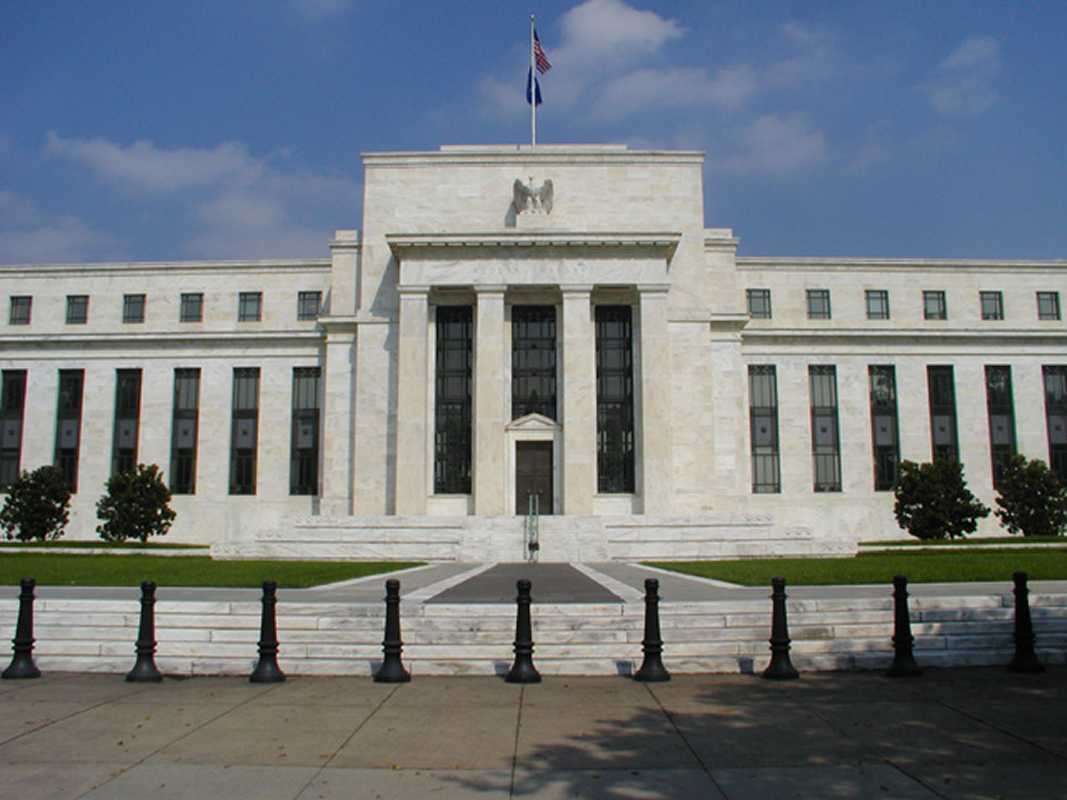 The U.S. Federal Reserve’s journey to the outer limits of monetary policy is raising concerns about how hard it will be to withdraw trillions of dollars in stimulus from the banking system when the time is right.
While that day seems distant now, some economists and market analysts have even begun pondering the unthinkable: could the vaunted Fed, the world’s most powerful central bank, become insolvent?
Almost by definition, the answer is no.
As the monetary authority, the central bank is the master of the printing press. It can literally conjure up money at will, and arguably did exactly that when it bought about $2 trillion of mortgage-backed securities and U.S. Treasuries to push down borrowing costs and boost the economy.
The Fed’s unorthodox steps helped it generate record profits in 2010, allowing it to send $78.4 billion to the U.S. Treasury Department. But its swollen balance sheet leaves the central bank unusually exposed to possible credit losses that could create a major headache at a time of increasing political encroachment on the Fed’s independence. Read more…
Food Shortages Will Become A Global Crisis: 7 Reasons

Food inflation is here and it’s here to stay. We can see it getting worse every time we buy groceries. Basic food commodities like wheat, corn, soybeans, and rice have been skyrocketing since July, 2010 to record highs. These sustained price increases are only expected to continue as food production shortfalls really begin to take their toll this year and beyond.
This summer Russia banned exports of wheat to ensure their nation’s supply, which sparked complaints of protectionism. The U.S. agriculture community is already talking about rationing corn over ethanol mandates versus supply concerns. We’ve seen nothing yet in terms of food protectionism.
Global food shortages have forced emergency meetings at the U.N. Food and Agriculture Organization where they claim “urgent action” is needed. They point to extreme weather as the main contributing factor to the growing food shortages. However, commodity speculation has also been targeted as one of the culprits.
It seems that the crisis would also present the perfect opportunity and the justification for the large GMO food companies to force their products into skeptical markets like in Europe and Japan, as recently leaked cables suggest. One thing is for sure; food shortages will likely continue to get worse and eventually become a full-scale global food crisis.
Here are seven reasons why food shortages are here to stay on a worldwide scale:
1. Extreme Weather: Extreme weather has been a major problem for global food; from summer droughts and heat waves that devastated Russia’s wheat crop to the ongoing catastrophes from ‘biblical flooding’ in Australia and Pakistan. And it doesn’t end there. An extreme winter cold snap and snow has struck the whole of Europe and the United States. Staple crops are failing in all of these regions making an already fragile harvest in 2010 even more critical into 2011. Based on the recent past, extreme weather conditions are only likely to continue and perhaps worsen in the coming years.
2. Bee Colony Collapse: The Guardian reported this week on the USDA’s study on bee colony decline in the United States: “The abundance of four common species of bumblebee in the US has dropped by 96% in just the past few decades.” It is generally understood that bees pollinate around 90% of the world’s commercial crops. Obviously, if these numbers are remotely close to accurate, then our natural food supply is in serious trouble. Luckily for us, the GMO giants have seeds that don’t require open pollination to bear fruit.

3. Collapsing Dollar: Commodity speculation has resulted in massive food inflation that is already creating crisis levels in poor regions in the world. Food commodity prices have soared to record highs mainly because they trade in the ever-weakening dollar. Traders will point to the circumstances described in this article to justify their gambles, but also that food represents a tangible investment in an era of worthless paper. Because the debt problems in the United States are only getting worse, and nations such as China and Russia are dropping the dollar as their trade vehicle, the dollar will continue to weaken, further driving all commodity prices higher.
4. Regulatory Crackdown: Even before the FDA was given broad new powers to regulate food in the recent Food Safety Modernization Act, small farms were being raided and regulated out of business. Now, the new food bill essentially puts food safety under the direction of the Department of Homeland Security where the food cartel uses the government to further consolidate their control over the industry. Militant police action is taken against farmers suspected of falling short on quality regulations. It is the power to intimidate innocent small farmers out of the business.
 5. Rising oil prices: In 2008, record oil prices that topped $147 per barrel drove food prices to new highs. Rice tripled in 6 months during the surge of oil prices, along with other food commodities. The price of oil affects food on multiple levels; from plowing fields, fertilizers and pesticides, to harvesting and hauling. Flash forward to 2011: many experts are predicting that oil may reach upwards of $150-$200 per barrel in the months ahead. As oil closed out 2010 at its 2-year highs of $95/bbl, it is likely on pace to continue climbing. Again, a weakening dollar will also play its part in driving oil prices, and consequently, food prices to crisis levels.
6. Increased Soil Pollution: Geo-engineering has been taking place on a grand scale in the United States for decades now. Previously known in conspiracy circles as ‘chemtrailing,’ the government has now admitted to these experiments claiming they are plan “B” to combat global warming. The patents involved in this spraying are heavy in aluminum. This mass aluminum contamination is killing plants and trees and making the soil sterile to most crops. In an astonishing coincidence, GMO companies have patented aluminum-resistant seeds to save the day.
The equation is actually quite simple: food is a relatively inelastic commodity in terms of demand. In other words, people need to eat no matter how bad the economy gets. Thus, demand can be basically measured by the size of the population. Therefore, as demand remains steady while the 7 supply pressures outlined above continue to worsen, food prices will have only one place to go — up, up, and up.
As international agencies scramble to find “solutions,” their energy may be just as well spent on questioning if this famine scenario is being purposely manipulated for profits. Regardless, the average person would be very wise to stock up on food staples as an investment, and frankly to survive the worsening food crisis
Alex Jones and Porter Stansberry
National Debt $200 Trillion Dollars
Dr. Laurence Kotlikoff economics professor at Boston University, discusses the national debt and unfunded liabilities – Aug. 11, 2010
Using CBO data, Kotlikoff says the real national debt is $202 trillion.
Compare the official deficit numbers for July – $165 billion – with the numbers for all of 2002 – where $165 billion covered the deficit for the entire fiscal year.
—
Excerpt:
The Congressional Budget Office whose Long-Term Budget Outlook, released in June, shows an even larger problem.
‘Unofficial’ Liabilities
Based on the CBO’s data, I calculate a fiscal gap of $202 trillion, which is more than 15 times the official debt. This gargantuan discrepancy between our “official” debt and our actual net indebtedness isn’t surprising. It reflects what economists call the labeling problem. Congress has been very careful over the years to label most of its liabilities “unofficial” to keep them off the books and far in the future.
2010 in Review-Commodities affected by World Events
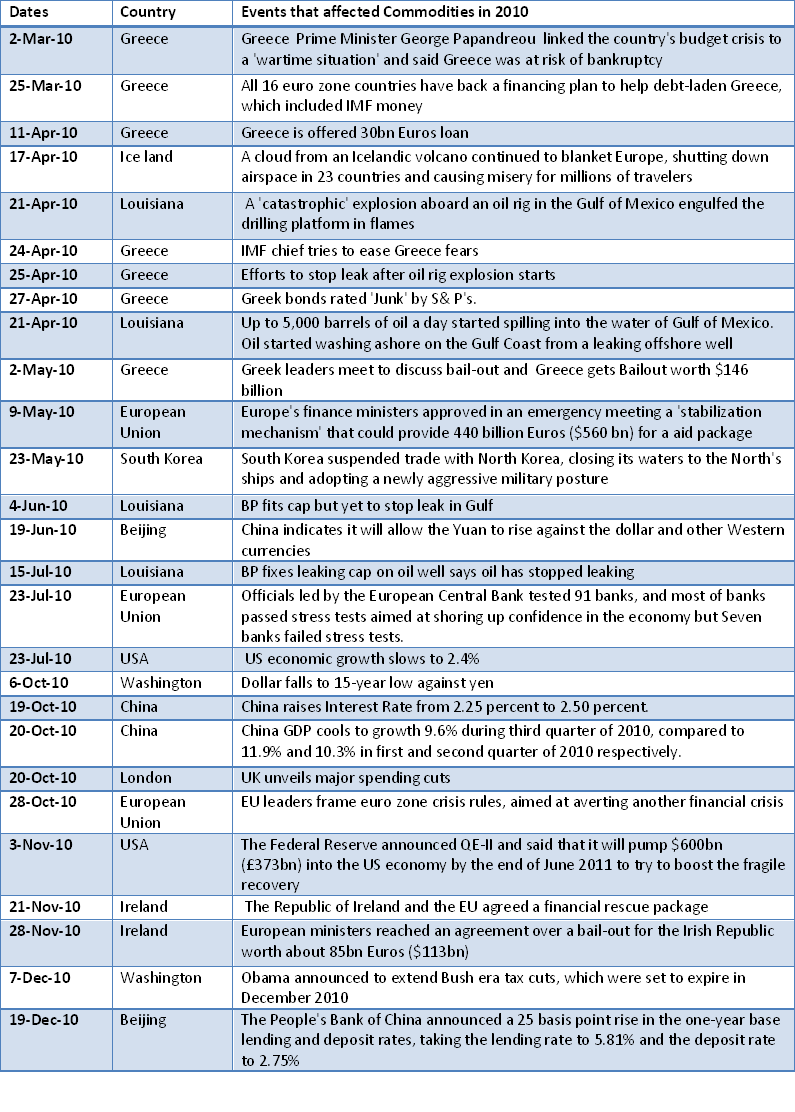 Notable events that affected commodity prices in 2010
IN THE STOCK MARKET, IT’S 1937 ALL OVER AGAIN
One of the most worrisome problems in the stock market right now is that we are basically repeating the exact same situation that occurred from 1937 to 1942.
Most Americans think we’ve had this amazing stock market recovery since the financial crisis of 2008… and we have to a certain extent.
But we are by no means out of the woods.
In fact, during America’s last real economic collapse, in the 1930s and 1940s, we saw a similar drop and recovery… before the markets crashed all over again.
In fact, the situation is eerily similar.
 Look at this chart… it’s one of the scariest I’ve seen in a long time. It shows an overlay of what happened in the stock market in 1937 compared to 2008. In both situations, we saw big crashes, of about the exact same magnitude… then a big recovery, again of about the same size.
But what will happen next?
Well, if history is any guide, we could well have another big leg down in the stock market. That’s exactly what happened 70 years ago.
And with all of the problems left unresolved in our economy today, it could certainly happen again, especially if the U.S. dollar loses its reserve status.
http://www.stansberryresearch.com/pro/1011PSIENDVD/PPSILC42/PR
Federal Reserve Banking System Explained
Federal Reserve Banking System Explained
Either America Or China Will Crash In 2011
Andy Xie’s latest sees the liquidity war getting worse in 2011.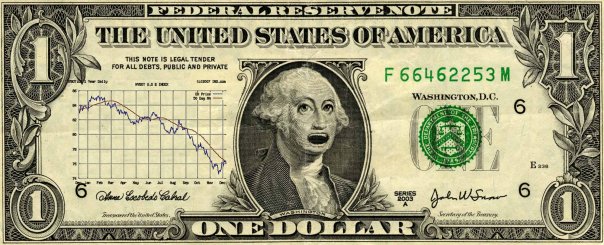
America will continue to pump the financial system with liquidity via tax cuts and quantitative easing. China will keep the yuan cheap and avoid clamping down on inflation.
The tense equilibrium can’t last for long, as either sovereign debt or inflation gets too heavy to bear. Whoever lasts longer, wins.
The most likely candidates to trigger the next global crisis are the U.S.’s sovereign debt or China’s inflation. When one goes down first, the other can prolong its economic cycle. China may have won the last race. To win the next one, China must tackle its inflation problem, which is ultimately a political and structural issue, in 2011. If China does, the U.S. will again be the cause for the next global crisis. China will suffer from declining exports but benefit from lower oil prices.
On the other hand, if China has a hard landing, the U.S.’s trade deficit can drop dramatically, maybe by 50 percent, due to lower import prices. It would boost the dollar’s value and bring down the U.S.’s treasury yield. The U.S. can have lower finacing costs and lower expenditures. The combination allows the U.S. to enjoy a period of good growth.
Xie notes that China may have the advantage here. While America has committed to a liquidity hose, Beijing still has the opportunity to crack down on inflation:
China’s inflation problem stems from the country’s rapid monetary growth in the past decade. That is due to the need to finance a vast property sector, which is, in turn, to generate fiscal revenues for local governments to finance their vast expenditure programs. Unless something is done to limit local government expenditure, China’s inflation problem is likely to get out of control…
There are two ways to limit local government expenditure. One is to cut their funding source. Their main revenue sources are land sales, property taxes, and bank loans. The last source is drying up a bit, as banks are saddled with high exposure to the sector already and are trying to decrease it. This change isn’t biting yet because local governments haven’t spent all the money they borrowed before.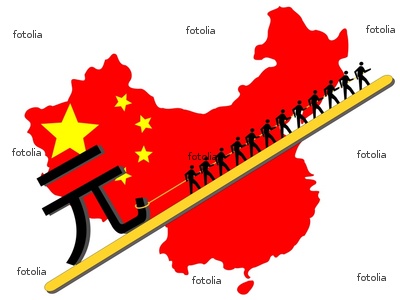
China needs America to consume their goods. This is the only way to keep its 1.3 billion people working and prevent protests and cause social instability. America has lost it manufacturing bases. They have only the printing press to print fit currency. America needs cheap imports from China to keep the illusion of high standard of living that they are used too.


![[Most Recent Quotes from www.kitco.com]](https://i0.wp.com/www.kitconet.com/charts/metals/gold/t24_au_en_usoz_2.gif)
![[Most Recent Quotes from www.kitco.com]](https://i0.wp.com/www.kitconet.com/charts/metals/silver/t24_ag_en_usoz_2.gif)

 crisisboom
 CRISISBOOM
You must be logged in to post a comment.