Archive
China spends $1 billion to tackle drought
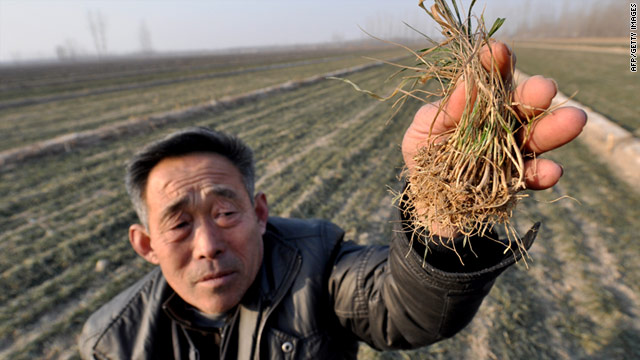
Beijing (CNN) — China’s government will invest $1 billion to combat a three month drought crippling the country’s north.
The worst drought in six decades threatens to ruin China’s winter harvest, the world’s largest producer of wheat.
To combat it, China’s government plans to spend around 6.7 billion yuan ($1.02 billion) to divert water to affected areas and irrigation facilities according to the state news agency, Xinhua.
Some 2.57 million people and 2.79 million livestock are suffering from drinking water shortages, Xinhua said.
The main affected provinces include Shandong, Jiangsu, Henan, Hebei and Shanxi, which together account for about 60% of the wheat planted this winter.
The United Nation’s Food and Agriculture Organization (FAO) issued an alert Tuesday, warning of severe wheat shortages, saying “the ongoing drought is potentially a serious problem.”
According to the FAO the drought is now affecting an area of around 5.16 million hectares, representing two-thirds of China’s wheat production.
Meanwhile the country’s capital Beijing got it first snowfall in more than three months overnight on Wednesday. But the precipitation is unlikely to end the area’s drought, reported Xinhua.
The precipitation followed cloud seeding by the municipal artificial weather intervention office, the agency said.
Drought ravages northern Kenya
Millions of people in northern Kenya are facing hunger and an uncertain future as a drought continues to destroy their crops and livestock.
The drought is also taking its toll on the population’s health and the number of malnourished and ill, increases by the day. And there seems to be little respite.
With no rains forecast over the next three months and the government saying that the country’s food reserves are dwindling fast, some in this region might not make it through.
Al Jazeera’s Mohammed Adow reports from Turkana, in Kenya.
CO2 Fears After Amazon Rainforest Droughts
Two severe Amazon droughts have sparked fears that the rainforest’s ability to absorb carbon emissions is being diminished – and, worse still, it may soon release almost as much CO2 as the US.
 A rare drought in 2005 – billed as a once-in-a-hundred-years event – was then followed by another drought in 2010 that may have been even worse, according to a study by a team of British and Brazilians scientists in the journal Science.
With a huge number of trees dying as a result of the droughts, the scientists predict that the Amazon will not be able to absorb as much carbon dioxide from the atmosphere as usual in future.
This would remove an important global buffer against pollution.
Even worse, rotting trees may release into the atmosphere as much as five billion tons of C02 in the coming years.
That would be almost as much as the 5.4 billion tons emitted from fossil fuel use by the US in 2009.
Based on the impact of the dry spell on tree deaths in 2005, the team projected that Read more…
Cheap food may be a thing of the past

U.S. grain prices should stay unrelentingly high this year, according to a Reuters poll, the latest sign that the era of cheap food has come to an end.
U.S. corn, soybeans and wheat prices — which surged by as much has 50 percent last year and hit their highest levels since mid-2008 — will dip by at most 5 percent by the end of 2011, according to the poll of 16 analysts.
The forecasts suggest no quick relief for nations bedeviled by record high food costs that have stoked civil unrest. It means any extreme weather event in a grains-producing part of the world could send prices soaring further.
The expectations may also strengthen importers’ resolve to build bigger inventories after a year in which stocks of corn and soybeans in the United States — the world’s top exporter — dwindled to their lowest level in decades.
Story: Global food chain stretched to the limit Read more…
Why Are Commodity Prices Rising? Let Me Count the Ways
 Our overview of 2011 ‘What Ifs’ concentrated on the concepts of bifurcation and biflation. Those themes are already playing out just a couple of weeks into the New Year. Inflation in all types of commodities has ramped up even further, leaving countries like China, India, Brazil, Thailand and South Korea to deal with more than their fair share of these inflationary forces. Meanwhile, easy monetary policy in the U.S. and Europe just adds fuel to the inflation fire.
The United Nations food agency (FAO) kicked off 2011 by announcing that December of 2010 saw food prices eclipse the record levels hit during the 2008 food crisis, which triggered riots in Egypt, Cameroon, and Haiti at the time. The current spike in food prices has already caused violent food riots in Algeria, Tunisia, Morocco, Yemen, and Jordan.
Food Inflation by the Numbers
Food inflation has already hit double digits in China, India and Brazil. It’s not hard to see why when you look at how some of the major soft commodities have performed over the last 12 months:
- Corn: + 69%
- Wheat: + 47%
- Soy Beans: + 44%
- Sugar: + 15%
- Coffee: + 65%
- Cotton: + 105%
(Trailing 12-month price moves as of January 12, 2011)
While these price spikes are causing food and clothing prices to rise, those effects will undoubtedly be exacerbated by the simultaneous rise in energy and raw materials we have seen:
- Oil: + 15% over 12 months and + 30% since the August, 2010 low
- Copper: + 30%
Overall, you can see the rise in commodity prices in the CRB Index, up about 30% since August of 2010, but well off the parabolic peak of 2008: Read more…


![[Most Recent Quotes from www.kitco.com]](https://i0.wp.com/www.kitconet.com/charts/metals/gold/t24_au_en_usoz_2.gif)
![[Most Recent Quotes from www.kitco.com]](https://i0.wp.com/www.kitconet.com/charts/metals/silver/t24_ag_en_usoz_2.gif)

 crisisboom
 CRISISBOOM
You must be logged in to post a comment.