Archive
Powerful Solar Flare Could Have Caused Serious Damage: Earth ‘Lucked Out’
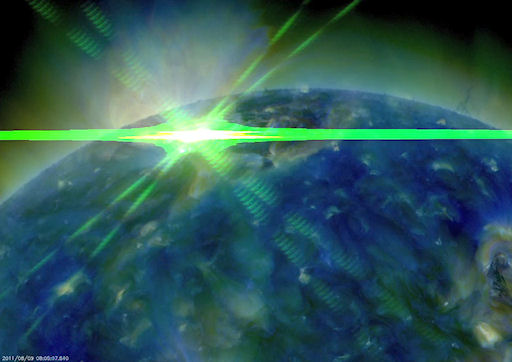 The sun unleashed its most powerful solar flare in four years Tuesday — an eruption that could have had serious consequences on Earth if it had taken place on the side of the sun facing the planet.
“We lucked out because the site of the eruption at the sun was not facing the Earth, so we will probably feel no ill effects,” Joe Kunches, a space scientist with the National Oceanic and Atmospheric Administration’s Space Weather Prediction Center, told MSNBC.
So far, it appears that any consequence felt on the Earth will not cause human injury. A minor proton storm currently on the Earth’s surface could affect satellites in high-altitude orbits, and radiation briefly disrupted Read more…
Earth’s Dirty Secret: Our Magnetic Field Traps Antimatter
Satellite confirms the existence of antimatter belts surrounding our planet, opens hopes for fuel use
The proton is a familiar figure for those who have taken high school physics. With a +1 charge it is a key constituent to most of the matter of the universe. But nature holds an outlandish vanishing twin — the antiproton. This exotic antimatter particle carries a -1 charge.
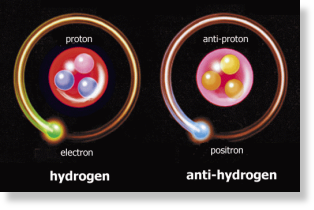
Fifty-six years after their first laboratory observation, a treasure trove of antiprotons — a component of antimatter (right) — has been discovered within the Earth’s magnetic field.
Now astrophysicists have discovered a treasure trove of antimatter hidden in the Earth’s magnetic field, which could hold the key to grand insights and new space travel possibilities.
I. What is Antimatter?
The antiproton was first predicted by luminary physicist Paul Dirac in his 1933 Nobel Prize lecture [PDF]. It would take physicists over two decades to prove Professor Dirac right. In 1955 Emilio Segrè and Owen Chamberlain, research professors at the University of California, Berkley, Read more…
A Strong M-class solar flare headed for Earth
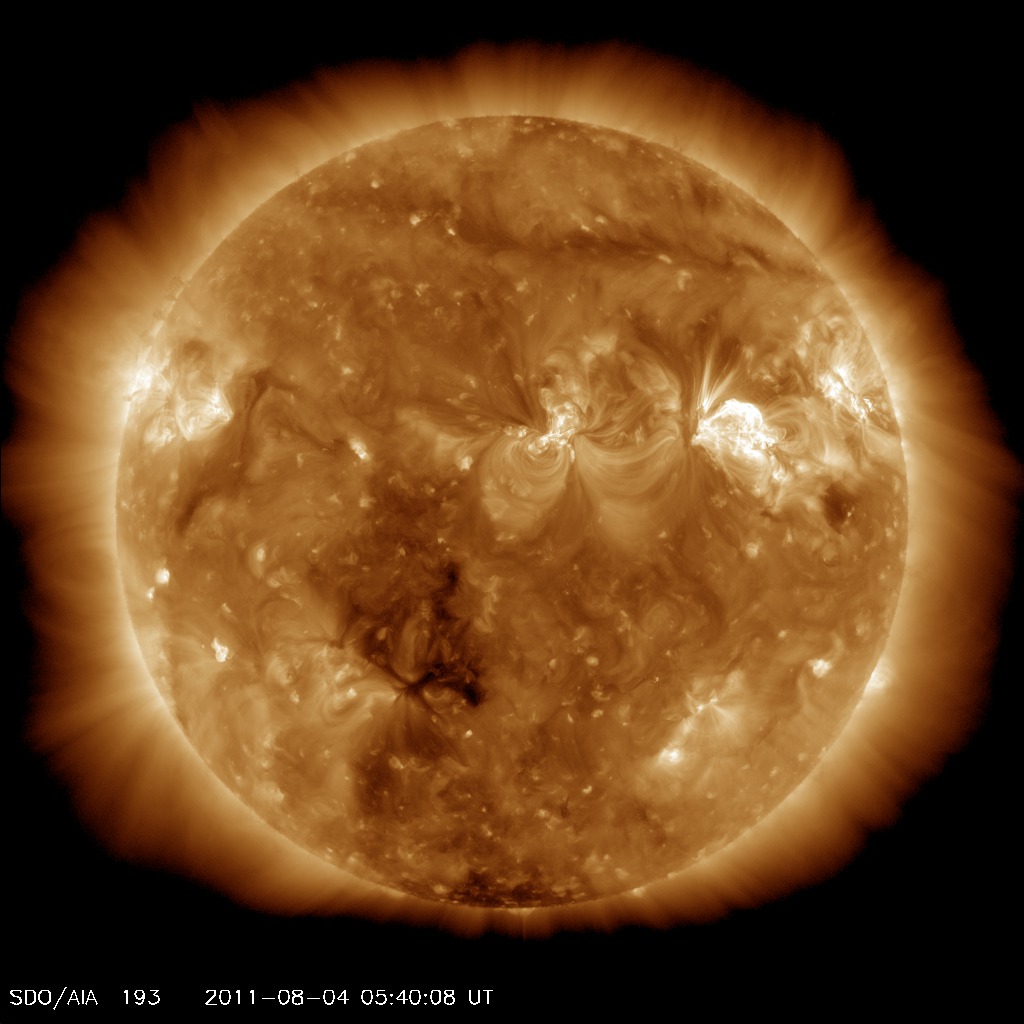
A solar wind stream flowing from the indicated coronal hole should reach Earth on Aug. 7th or 8th. Credit: SDO/AIA.
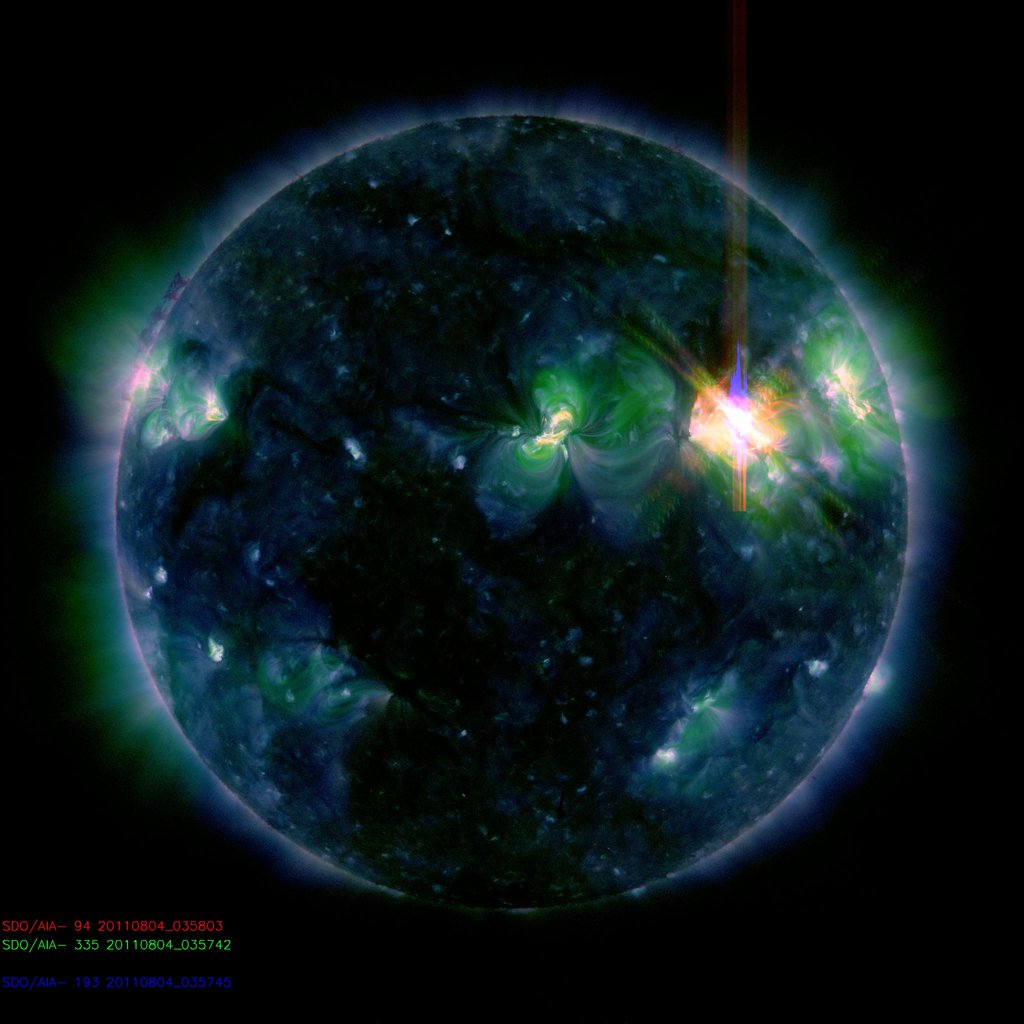
STRONG SOLAR ACTIVITY: For the third day in a row, active sunspot 1261 has unleashed a strong M-class solar flare. The latest blast at 0357 UT on August 4th registered M9.3 on the Richter Scale of Flares, almost crossing the threshold into X-territory (X-flares are the most powerful kind). The number of energetic protons around Earth has jumped nearly 100-fold as a result of this event. Stay tuned for updates.
INCOMING CLOUDS: At least two coronal mass ejections (CMEs) are now en route to Earth, propelled toward us by eruptions in the magnetic canopy of sunspot 1261 on August 2nd and 3rd. Analysts at the GSFC Space Weather Lab have just produced a new 3-D model of the advancing CMEs. Click on the image to set the clouds in motion below:
Massive Sunspot 1263 Forms-Wider than the Earth!
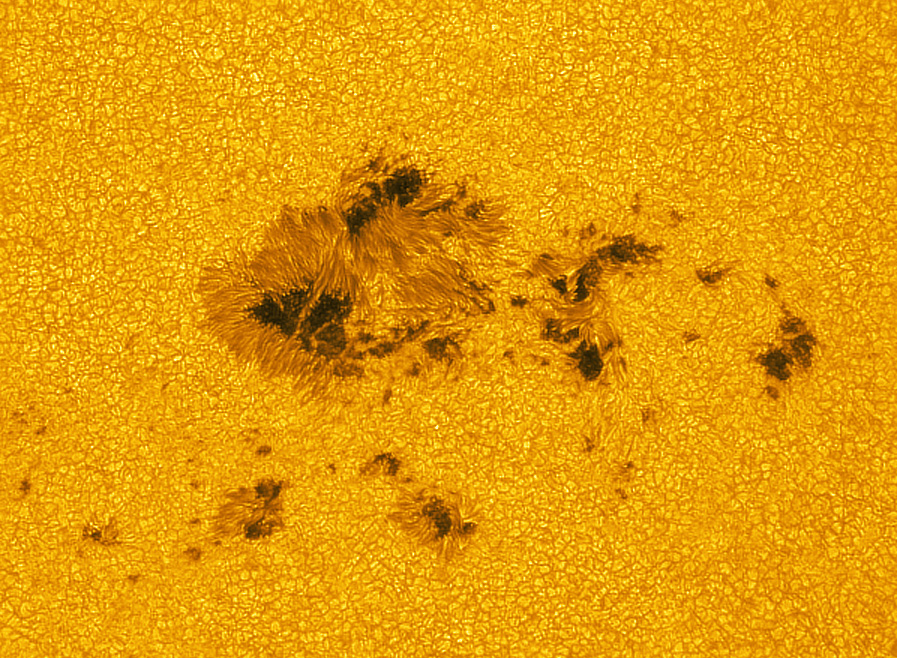
 Double sunspot 1263 is a whopper. Its two dark cores are each wider than Earth, and the entire region stretches more than 65,000 km from end to end. Yesterday in the Netherlands, Emil Kraaikamp took advantage of a break in the clouds and “a few moments of steady air” to capture this magnificent photo:
“To image this monster, I used a 10-inch Newtonian telescope capped by a white light solar filter,” says Kraaikamp. He used the same setup to photograph nearby sunspot 1261. The clarity of both images is impressive. Note the granulation of the stellar surface surrounding the main dark cores. Those are Texas-sized bubbles of plasma rising and falling like water boiling on top of a hot stove.
The magnetic field of sunspot 1263 harbors energy for powerful X-class solar flares. Because the sunspot is turning to face Earth, any such eruptions in the days ahead would likely be geo-effective
New NASA Data Blow Gaping Hole In Global Warming Alarmism
 Image by AFP/Getty Images via @daylife
NASA satellite data from the years 2000 through 2011 show the Earth’s atmosphere is allowing far more heat to be released into space than alarmist computer models have predicted, reports a new study in the peer-reviewed science journal Remote Sensing. The study indicates far less future global warming will occur than United Nations computer models have predicted, and supports prior studies indicating increases in atmospheric carbon dioxide trap far less heat than alarmists have claimed.
Study co-author Dr. Roy Spencer, a principal research scientist at the University of Alabama in Huntsville and U.S. Science Team Leader for the Advanced Microwave Scanning Radiometer flying on NASA’s Aqua satellite, reports that real-world data from NASA’s Terra satellite contradict Read more…
Evidence Found for Undiscovered Comet That May Threaten Earth
 |
| This February eta Draconid was filmed by Peter Jenniskens with one of the low-light-level video cameras of the Cameras for Allsky Meteor Surveillance (CAMS) station in Mountain View, California, at 07:59:24 UT on February 4, 2011. CREDIT: All Sky Cameras/Peter Jenniskens |
A surprise meteor shower spotted in February was likely caused by cosmic “bread crumbs” dropped by an undiscovered comet that could potentially pose a threat to Earth, astronomers announced today (July 27).
The tiny meteoroids that streaked through Earth’s atmosphere for a few hours on Feb. 4 represent a previously unknown meteor shower, researchers said. The “shooting stars” arrived from the direction of the star Eta Draconis, so the shower is called the February Eta Draconids, or FEDs for short.
The bits of debris appear to have been shed by a long-period comet. Long-period comets whiz by the sun very infrequently, so it’s tough to Read more…
Alarming NOAA data, Rapid Pole Shift

The NOAA National Geophysical Data Center maintains a data set of annual magnetic north pole coordinates going back to the year 1590, derived from early measurements from ships logs to modern day techniques.
Noting that there has been lots of reporting of pole shift lately, to the point where the phenomenon is actually causing real-world issues such as temporary airport closures, a deeper investigation was in order.
After transferring 420 years of north pole position data from the NOAA Geo Data Center, configuring it to fit in an Excel spreadsheet, adding a complicated formula to determine exact distance between 2 sets of latitude-longitude coordinates, applying the formula to each data point in the series, and then finally plotting it all in a visual graph, it is alarming to discover the Read more…
Cosmic Turnaround As Earth Tracks Trojan Asteroid

Astronomers have discovered the first known “Trojan” asteroid orbiting the sun along with Earth.
The 300-metre-wide (1,000 ft) asteroid is located approximately 50 million miles (80 million kilometres) from earth and was discovered by astronomers studying observations taken by NASA’s Wide-field Infrared Survey Explorer (WISE) mission.
The asteroid’s orbit is well-defined and for at least the next 100 years, it will not come closer to Earth than 15 million miles (24 million kilometres).
The findings will be published in the July 28 issue of the journal Nature.
Trojans are asteroids that share an orbit with a planet near stable points in front of or behind the planet. Because they constantly lead or follow in the same orbit as the planet, they never can collide with it. In our solar system, Trojans also share orbits with Neptune, Mars and Jupiter. Two of Saturn’s moons share orbits with Trojans.
Scientists had predicted Earth should have Trojans, but they have been difficult to find because Read more…
Laws of physics must be rewritten: Mysterious sun particles alter radioactive decay on Earth
 The scientific process, as any experienced researcher can attest, provides a kind of road map through the forest of the natural world. By developing hypotheses and designing methods by which to test them, we use the scientific process to make the abstract world more concrete.
Once we clarify our questions about matter, time, and reality, we can move forward from one conclusion to another in a logical attempt to answer them. But the path in front of us often extends into kind of fog, a compounding cloud of questions, with each conclusion often leading only to additional questions that multiply indefinitely.
And the path behind us can be equally shrouded. Sometimes generations of observations about the Read more…


![[Most Recent Quotes from www.kitco.com]](https://i0.wp.com/www.kitconet.com/charts/metals/gold/t24_au_en_usoz_2.gif)
![[Most Recent Quotes from www.kitco.com]](https://i0.wp.com/www.kitconet.com/charts/metals/silver/t24_ag_en_usoz_2.gif)

 crisisboom
 CRISISBOOM
You must be logged in to post a comment.