Archive
Mars is left behind, Earth is ahead!
 L. Elenin / ISON-NM observatory
At the end of June 2011, Comet Elenin will cross the orbit of the fourth planet of the Solar System – Mars. It must be noted that from April to June, the comet did not come closer to the Earth, but moved “parallel” with it. Right at the beginning of July, the comet will begin to very quickly move toward our planet. I again want to emphasize, the comet will pass 35 million kilometers from the Earth. It is an absolutely safe distance, just a little closer to the Earth than the second planet, Venus, comes.
At left you can see an image of the comet taken June 21th at our observatory. In the earthly sky the comet is quite close to the Sun, and soon it will be impossible to observe – it will be hidden the rays of the setting Sun. C/2010 X1 (Elenin) will not emerge from solar conjunction until the beginning of October, when it will be visible in binoculars and maybe even with the unaided eye.
Collapsing Coastlines


Storms can ravage coastal permafrost, as shown near the village of Kaktovik, Alaska.© Accent Alaska.com/Alamy
Gray waves surged over miles and miles of open water, breaking against the bluffs underlying Kaktovik. The tiny village sits precariously on the Beaufort Sea, a frigid body of water bordering Alaska’s northeastern Arctic coast. As the choppy waters inundated vulnerable stretches of shoreline, the surf carved deep chasms into the tall bluffs.
Torre Jorgenson, a geomorphologist working near Kaktovik, watched the storm boil up, shaking homes and boats for nearly two days in July 2008. Dramatic erosion followed soon after. Blocks of graphite-colored earth, as much as 10 meters wide and several meters deep, toppled into the sea one by one like skyscrapers in a Japanese monster film.
“The locals had never seen that type of erosion,” says Jorgenson, also president of the U.S. Permafrost Association. “It was something new, a regime change.”
The erosion Jorgenson witnessed was a potent warning to Kaktovik’s residents of the instability of their coastal home. Seaside bluffs and beaches across the Arctic are Read more…
Britain in list of countries ‘most at risk’ if an asteroid strikes
Britain has been identified among a host of countries scientists believe would be worst affected in the event of an asteroid strike.

Experts at Southampton University have drawn up a league table of countries most likely to suffer severe loss of life or catastrophic damage should a large asteroid hit Earth.
The list is largely made up of developed nations including China, Japan, the United States and Italy, on the basis that the size of their populations would mean millions of deaths.
The US, China, Indonesia, India and Japan are most in danger on this basis. Canada, the US, China, Japan and Sweden are rated most at risk in terms of potential damage to their infrastructure.
The report comes after a rock the size of a house came within 7,500 miles of Earth earlier this Read more…
2010 – 2011: Earth’s most extreme weather since 1816?
 Every year extraordinary weather events rock the Earth. Records that have stood centuries are broken. Great floods, droughts, and storms affect millions of people, and truly exceptional weather events unprecedented in human history may occur. But the wild roller-coaster ride of incredible weather events during 2010, in my mind, makes that year the planet’s most extraordinary year for extreme weather since reliable global upper-air data began in the late 1940s. Never in my 30 years as a meteorologist have I witnessed a year like 2010–the astonishing number of weather disasters and unprecedented wild swings in Earth’s atmospheric circulation were like nothing I’ve seen. The pace of incredible extreme weather events in the U.S. over the past few months have kept me so busy that I’ve been unable to write-up a retrospective look at the weather events of 2010. But I’ve finally managed to finish, so fasten Read more…
Another Asteroid To Give Earth a Close Shave June 27, 2011
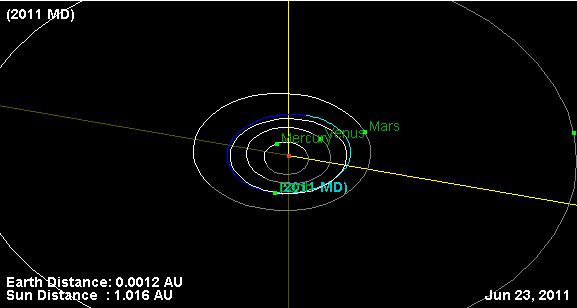 2011 MD’s orbital parameters. Credit: JPL Small-Body Database Browser
A newly discovered house-sized asteroid will miss the Earth by less than 17,700 km (11,000 miles) on Monday June 27, 2011. That’s about 23 times closer than the Moon. The size and location of the asteroid, named 2011 MD, should allow observers in certain locations to take a look at the space rock, even with small telescopes. It’s closest approach will be at 13:26 UTC on June 27.
According to Skymania, 2011 MD was found just yesterday, June 22, by LINEAR, a pair of robotic telescopes in New Mexico that Read more…
Solar Activity Intensifying
Dr. Mark Sircus, Contributing Writer
Activist Post
On June 7th, Dr. C. Alex Young from the NASA Goddard Space Flight Center woke to an email from a friend saying, “I have never seen anything like this before.” There are many things happening around us that we have not seen before, but when it happens on the sun certain people take notice. On the 7th the sun produced a prominence eruption and Dr. Young had never seen such a spectacular event, which luckily did not affect the Read more…
Incoming Geomagnetic Storm Alert:C7-Flare/CME (June 21st, 2011).
INCOMING: Magnetic fields above sunspot complex 1236 erupted during the early hours of June 21st, producing a C7-class solar flare and a full-halo CME. The expanding cloud appears to be heading almost directly toward Earth:
This does not appear to be an especially powerful CME. Nevertheless, the incoming cloud could trigger polar geomagnetic storms when it reaches Earth on or about June 23rd. The aurora outlook favors southern hemisphere observers, where solstice skies are winter-dark. Stay tuned for updates.
Solar Threat: We’ll Have Minutes to Respond; Government Plans Controlled Blackouts; Elite Contingency Plans
 While many will claim that solar storms are an unrealistic threat to our world, the governments of the United States and the United Kingdom aren’t taking any chances.
According to a report put together by Alex Thomas of The Intel Hub, the threat is not only real, but very likely, and could change the world as we know it from one day to the next:
In a stunning announcement, The United States and United Kingdom are likely set to began “controlled” power cuts in preparation of a giant solar storm.
The announcement by Thomas Bogdan, the director of the US Space Weather Prediction Centre, comes a week after a large scale solar flare released a massive amount of radiation and threatened to cause moderate disruption.
The solar flare on June 7th, 2011 was luckily pointed away from Earth but caused Read more…
Study finds global warming over past 400 years was due to increased Solar activity

Apparently previous studies of the sun-climate connection looked at the equatorial polar magnetic field which produces sun spots, but they did not consider the polar magnetic component of the solar dynamo. The polar fields are less strong than the equatorial fields, but it is claimed that the total magnetic fluxes of both fields are comparable. With proxy data they derive an empirical relation between tropospherical temperatures and solar equatorial and polar magnetic fields. The polar field could contribute about Read more…
‘Dramatic’ solar flare could disrupt Earth communications
Handout photo released by NASA Earth Observatory on June 7, 2011 and taken from NASA’s Solar Dynamics Observatory (SDO), sunspot complex 1226-1227, shows the Sun unleashing an M-2 (medium-sized) solar flare.
WASHINGTON – An unusual solar flare observed by a NASA space observatory on Tuesday could cause some disruptions to satellite communications and power on Earth over the next day or so, officials said.
The potent blast from the Sun unleashed a firestorm of radiation on a level not witnessed since 2006, and will likely lead to moderate geomagnetic storm activity by Wednesday, according to the National Weather Service.
“This one was rather dramatic,” said Bill Murtagh, program coordinator at the NWS’s Space Weather Prediction Center, describing the M-2 (medium-sized) solar flare that peaked at 1:41 a.m. Eastern time in North America, or 0541 GMT.
“We saw the initial flare occurring and Read more…


![[Most Recent Quotes from www.kitco.com]](https://i0.wp.com/www.kitconet.com/charts/metals/gold/t24_au_en_usoz_2.gif)
![[Most Recent Quotes from www.kitco.com]](https://i0.wp.com/www.kitconet.com/charts/metals/silver/t24_ag_en_usoz_2.gif)

 crisisboom
 CRISISBOOM

You must be logged in to post a comment.