Archive
Stimulus law will cost $43 billion more than estimated

The Congressional Budget Office said in a new report that President Obama’s economic stimulus law will raise the federal deficit $830 billion over ten years, $43 billion more than the initially estimated cost of $787 billion.
During the law’s consideration in Congress, the Joint Committee on Taxation made the initial estimate.
CBO estimated the law lowered the unemployment rate by between .6 and 1.8 percent in the first quarter of 2011 and increased the number of people employed by between 1.2 million and 3.3 million during that same period.
Obama and congressional Democrats enacted the law, arguing it would provide a quick jolt to the economy. Republicans opposed the law, saying it would increase deficits and wasn’t designed to work quickly.
CBO estimated the government spending in the law had a major impact on the economy, increasing the Gross National Product by as much as 4.6 percent in the second quarter of 2010.
However, the unemployment rate has continued to remain high since 2009, hurting Obama politically.
CBO based its estimate on macroeconomic modelling, saying the jobs “created or saved” reports by recipients of stimulus dollars could not provide a full picture of the economic impact.
Signals Spain may seek bailout spelling disaster for eurozone
Violent protests against austerity cuts have broken out in Spain, as the country struggles to deal with record-high unemployment signaling that Madrid could possibly be next in line for an EU bailout.
Across the border, Portugal’s crumbling economy is desperate for a €78 billion rescue package. Read more…
United States to hit debt ceiling on Monday

WASHINGTON — The debt-laden US government’s credit card will hit its limit Monday, creating a cash crunch that puts the country’s credit standing at risk as politicians battle over its long-term deficit.
Reaching the $14.29 trillion ceiling set by Congress will not have an immediate impact on government finances, because the Treasury has found about ten weeks of wiggle-room in short-term adjustments and an unexpected April jump in tax revenues.
But with Republicans refusing to increase the ceiling without massive future spending cuts, the longer the fight over bridging the country’s deficit goes on, the higher the stakes will get.
If nothing is done by about August 2, there is a chance the United States, which has always merited a top-grade credit rating, could do the unthinkable — default on its debt payments.
Few think it will get that far, as the White House leads behind-the-scenes talks on a grand strategy on the deficit — with Republicans insisting on spending cuts and Democrats demanding tax increases as well.
Still, some liken the fight to a game of chicken being played with the country’s credit standing at Read more…
IMF Says Europe’s Debt Woes Could Spread
 The International Monetary Fund is warning that the governmental debt problems in Greece, Ireland and Portugal could spread to other European countries that employ the euro currency and also to the emerging economies in eastern Europe.
In its semi-annual report on the European economy, the IMF said Thursday that officials so far have been able to contain the continent’s debt contagion to the three countries on Europe’s geographic periphery. But the Washington-based financing agency said there “remains a tangible downside risk” of debt problems spreading. It said European nations will have to make “unrelenting” efforts to contain their financial problems.
The IMF said weak banking systems remain a threat to the financial health of the 17 nations where the euro is the common currency. It said the reduction in the number of banks in Europe is proceeding too slowly and that greater financial integration on the continent is needed.
Greece and Ireland reluctantly accepted bailouts from the IMF and their European neighbors last year and now Portugal is Read more…
Greece ‘runs out of tear gas’ during violent protests
Greece has issued an international appeal for more tear gas after supplies ran low because police fired so much of it during a week of violent protests across the country.

Officers released 4,600 capsules of tear gas during confrontations in Athens and nearly a dozen other cities since riots erupted over the fatal shooting of a 15-year-old schoolboy by a policeman last Saturday.
The greek government is urgently seeking fresh supplies of tear gas from Israel and Germany, the police said.
Yesterday, a report disputed claims by lawyers for the policeman accused of killing Alexandros Grigoropoulos that the bullet hit the boy after ricocheting.
The Kathimerini newspaper said that the results of forensic tests on the bullet indicated that it had been fired directly at the teenager.
Athens Bar Association condemned the policeman’s lawyer, Alexis Kougias, for “desecrating the dead” by claiming that the Read more…
Forbes Predicts U.S. Gold Standard Within 5 Years
 A return to the gold standard by the United States within the next five years now seems likely, because that move would help the nation solve a variety of economic, fiscal, and monetary ills, Steve Forbes predicted during an exclusive interview this week with HUMAN EVENTS.
“What seems astonishing today could become conventional wisdom in a short period of time,” Forbes said.
Such a move would help to stabilize the value of the dollar, restore confidence among foreign investors in U.S. government bonds, and discourage reckless federal spending, the media mogul and former presidential candidate said. The United States used gold as the basis for valuing the U.S. dollar successfully for roughly 180 years before President Richard Nixon embarked upon an experiment to end the practice in the 1970s that has contributed to a number of woes that the country is suffering from now, Forbes added.
If the gold standard had been in place in recent years, the value of the U.S. dollar would not have weakened as it has and excessive federal spending would have been curbed, Forbes told HUMAN EVENTS. The constantly changing value of the U.S. dollar leads to marketplace uncertainty and consequently spurs speculation in commodity investing as a hedge against inflation. Read more…
Our Fear-Based Society and the Resultant Loss of Liberty
 What do the Patriot Act, X-ray scanners and “enhanced” pat downs at airports, our new healthcare system (I hate calling it “Obamacare” because he’s just a puppet like all Presidents), Roosevelt’s “New Deal,” and all other government programs have in common? They’re all sold to us by politicians as a means to keep us safe: safe from terrorists, safe from the bad insurance companies who will uninsure you when you get sick, safe from economic hardships.
Notice, if you will, that these sort of programs get passed by our government when something bad happens that affects the psyche of the entire US. 9/11 happens and we get the PATRIOT Act, the Department of Homeland Security (DHS) and a host of other anti-liberty, supposedly pro-safety, laws and agencies; the Christmas Day underwear bomber detonates a small bomb setting himself ablaze and we get body scanners and “enhanced” pat downs at airports; the economy hits the skids and it’s the perfect time to pass sweeping healthcare “reform” because everyone’s concerned they will lose their job and their healthcare.
As Rahm Emmanuel famously said, “You don’t ever want a crisis to go to waste; it’s an opportunity to do important things that you would otherwise avoid.”
However, I would argue Ben Franklin’s perspective is the healthy one. In 1818, he wrote: “They willing to give up essential liberty for a little temporary safety, deserve neither and will lose both.”
Benjamin Franklin was a wise man; a student of history. He studied — as all the founders did — the toll this forfeiture of liberty for Read more…
Russian resources fuel China’s economic growth
 China has increased high tech exports to Russia 300% in the past five years, while its imports from Russia are dominated by commodities, the Economic Development Ministry said.
China accounted for the bulk of Russia’s bilateral trade, which reached $60 billion in 2010. Russia has increased equipment exports by only 30% since 2005, according to a ministry report on economic relations with China.
No government documents pertaining to Russia’s relations with economic partners are ever published. There is a confidential part to Russia’s foreign economic strategy through 2020, which gives a detailed description of goals and risks related to contacts with each of Russia’s economic partners. Based on this strategy, two years ago the Economic Development Ministry worked out very specific country plans through 2012.
The 2010 report on the China plan progress is addressed to Deputy Prime Minister Alexander Zhukov, who chairs the Russian-Chinese Commission.
In 2009 Zhukov said shortly before Prime Minister Vladimir Putin’s visit to China: “Unfortunately, the share of machinery and equipment in our exports to China is sparse. Our plan is to increase exports of products with a high level of processing.”
However, the ministry report indicates that the progress has been unimpressive so far. Russia’s imports from China are $19bn Read more…
Where is the Global Economy Headed? The Experts Weigh In
 I’m writing today after spending the last three days in Boca Raton, Florida, attending The Next Few Years: A Casey Research Summit. If you’re not already familiar, the purpose of this summit was to bring together many of the world’s top economic and investing minds to share with us where they believe we’re headed in the months and years ahead.
The cast of speakers was impressive, to say the least. They brought a variety of view points, an almost overwhelming amount of data and analysis, and a perspective on what the current world means for investors that would be hard to build on. Yet, with all this variety of thought and perspective, one central theme seemed to emerge.
If you’re able to see the annihilation of your currency coming down the pike, and you take the right steps to protect your wealth, you can come out on the other side largely unscathed. Given the right investment strategy, you may even be able to grow your wealth significantly during this time.
While I knew this on some level coming into this event – I’ve been reading Casey Research’s work for just a few months now, and this was the first of their events I’ve attended – I was given pause by Casey CEO Olivier Garret’s welcoming remarks.
“While no one can predict the future with complete certainty,” he said, “it should give you comfort to know that the faculty for this summit have in common that they correctly anticipated the trends now dominating the global landscape.”
When you bring together 35 experts who each correctly predicted what’s happened in recent years – while the mainstream media Read more…
QE2 Is Damaging The Economy And Reducing GDP Growth
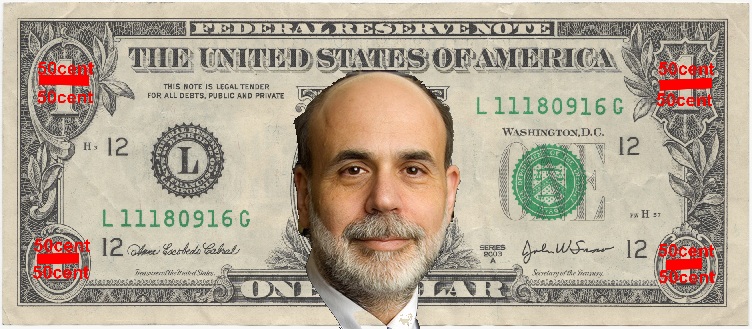 QE2 is going to go down as one of the worst monetary policy initiatives in the history of the modern Federal Reserve era. On almost any metric applied, QE2 ends up not only falling well short of its proposed goals, but actually turns certain metrics like GDP growth negative compared with the prior quarter, and heading in the wrong direction.
Costs Eat into Corporate Profits = No Hiring
Analysts all over Wall Street are starting to revise their 2nd quarter GDP forecasts down, and some like Goldman Sachs have made several downward revisions as higher input costs due to a weak dollar are creating an additional burden on businesses and consumers and thus slowing economic growth.
A weak dollar (Fig. 1) to a point can help exports, but an extremely weak dollar which in combination with QE2 liquidity juicing up commodities even further, turns out to be a net negative on the economy, and risks sending the Read more…


![[Most Recent Quotes from www.kitco.com]](https://i0.wp.com/www.kitconet.com/charts/metals/gold/t24_au_en_usoz_2.gif)
![[Most Recent Quotes from www.kitco.com]](https://i0.wp.com/www.kitconet.com/charts/metals/silver/t24_ag_en_usoz_2.gif)

 crisisboom
 CRISISBOOM
You must be logged in to post a comment.