Archive
German Bank Nears Purchase of NYSE
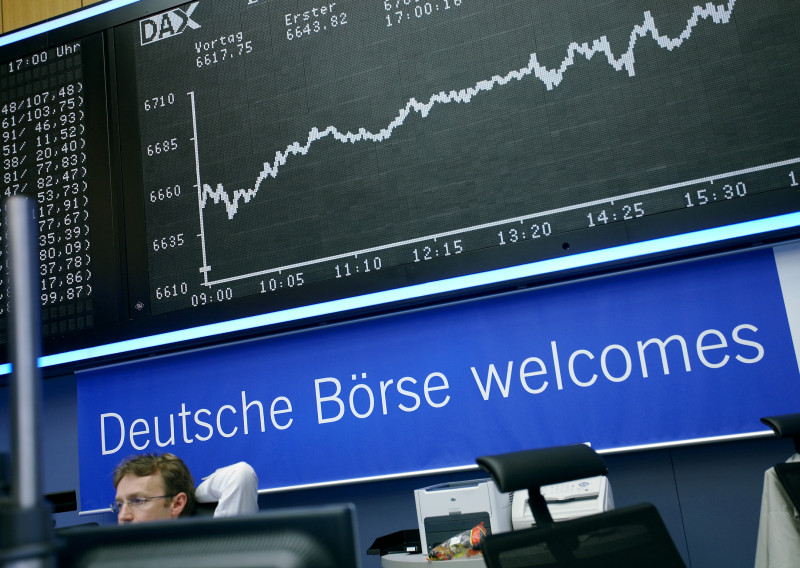 Deutsche Boerse AG is in advanced talks to buy NYSE Euronext in an all-stock transaction that would create the world’s biggest exchange operator, accelerating a day of takeovers that began with London Stock Exchange Group Plc’s acquisition of Canada’s TMX Group Inc.
NYSE and Deutsche Boerse said they will produce 300 million euros ($410 million) in cost savings, according to a statement. Duncan Niederauer, New York-based NYSE Euronext’s chief executive officer, will hold the same job at the combined company. Frankfurt-based Reto Francioni, CEO of Deutsche Boerse, will be chairman. Deutsche Boerse will own about 59 percent to 60 percent of the joined corporation.
The combination, following a decade-long wave of mergers among exchange companies, would unite equity and derivatives platforms from the U.S. and Germany to France, the Netherlands and Portugal. Since 2000, there has been at least Read more…
The What? And Why? Of Rare Earth Metals
Over the past few months, there’s been a buzz surrounding rare earth metals. These are metals such as europium, lanthanum, neodymium and 14 others found in small concentrations attached to other metals and resource deposits. They’re actually not that rare, just expensive and difficult to pull out of the ground.
These naturally occurring elements are essential in everything from wind turbines to lasers to iPads.
Rare earths are a conundrum for the environmentally conscious—they hold the key to green energies but create toxic waste when being separated away from other elements. “Just one wind turbine generating 3 megawatts of electricity requires 600 kilograms of rare earths for its magnets,” a source told the United Kingdom’s Guardian newspaper.
 Electric and hybrid cars can contain more than twice as much rare earth metals as a standard car. This image from the NY Times breaks down how these metals make up critical elements of a Prius.
Currently, China controls 97 percent of the world’s production of rare earth metals. In October 2010, the country cut exports of the metals by 70 percent, disrupting manufacturing in Japan, Europe and the U.S., and sending the prices of these metals up 40 percent.
China currently controls production but the country only has 37 percent of Read more…
Russian volcano activity causes global concern
Now the world has something else to grip about when it comes to Russia – the weather.
A string of volcanoes on Russia’s eastern seaboard of Kamchatka have been unusually active for the last six months. The dust they threw up diverted winds in the Arctic, pushing cold air over Europe and North America and causing the unusually cold winter this year, say scientists.
The volcanoes (160 in total, of which 29 are active) are still on the go and could create more problems this year, depressing harvests around the world just as global food prices soar and Read more…
THE EURO & U.S. DOLLAR COLLAPSE & DEVALUATION OF 50-70%
Global Effort To Outlaw Vitamins Now Underway
 (NaturalNews) The global effort to outlaw herbs, vitamins and supplements is well under way, and in just four months, hundreds of herbal products will be criminalized in the UK and across the EU. It’s all part of an EU directive passed in 2004 which erects “disproportionate” barriers against herbal remedies by requiring them to be “licensed” before they can be sold.
It’s called the Traditional Herbal Medicinal Products Directive (THMPD), Directive 2004/24/EC.
The licensing requirements, however, were intentionally designed to make sure that virtually no herbs could ever meet them. It costs from $125,000 to $180,000 to license a single herb with the EU, and since herbs cannot be patented and don’t have the monopolistic pricing found in pharmaceuticals, there’s simply not enough profit margin in most herbs to justify such huge expenditures from any one company.
But that’s sort of the point. Governments of the world have been conspiring with the pharmaceutical industry for decades to destroy the competition by outlawing nutritional supplements, herbal remedies and many other forms of natural medicine.
They really are coming for your natural medicine
Some people in the USA are still skeptical that Read more…
Soros says Israel is “main stumbling block” in Mideast

The Arab liberation revolution will fundamentally change the Middle East. The acceleration of the West’s decline will change the world. One outcome will be a surge toward China, Russia and regional powers like Brazil, Turkey and Iran. Another will be a series of international flare-ups stemming from the West’s lost deterrence. But the overall outcome will be the collapse of North Atlantic political hegemony not in decades, but in years. When the United States and Europe bury Mubarak now, they are also burying the powers they once were. In Cairo’s Tahrir Square, the age of Western hegemony is fading away.
Egypt is more complex and, ultimately, more influential, which is why it is so important to get it right. The protesters are very diverse, including highly educated and Read more…
The Youth Unemployment Bomb
From Cairo to London to Brooklyn, too many young people are jobless and disaffected. Inside the global effort to put the next generation to work

Cairo, Egypt: A cloud of tear gas drives back antigovernment protesters on Jan. 28 Jorge Dirkx/Reporters/Redux
By Peter Coy
In Tunisia, the young people who helped bring down a dictator are called hittistes—French-Arabic slang for those who lean against the wall. Their counterparts in Egypt, who on Feb. 1 forced President Hosni Mubarak to say he won’t seek reelection, are the shabab atileen, unemployed youths. The hittistes and shabab have brothers and sisters across the globe. In Britain, they are NEETs—”not in education, employment, or training.” In Japan, they are freeters: an amalgam of the English word freelance and the German word Arbeiter, or worker. Spaniards call them mileuristas, meaning they earn no more than 1,000 euros a month. In the U.S., they’re “boomerang” kids who move back home after college because they can’t find work. Even fast-growing China, where labor shortages are more common than surpluses, has its “ant tribe”—recent college graduates who crowd together in cheap flats on the fringes of big cities because they can’t find well-paying work.
In each of these nations, an economy that can’t generate enough jobs to absorb its young people has created a Read more…
How Cyclone Yasi compares in size to countries

Date/Time: 2011:02:02 13:29:18 Source: news.com.au
IF you’re struggling to grasp the magnitude of Tropical Cyclone Yasi, consider this: it is so large it would almost cover the United States, most of Asia and large parts of Europe.
Most of the coverage about the scale of Yasi has tried to compare it with storms of the past – it’s bigger than Larry, more powerful than Tracy.
But just as powerful is this comparison, showing this storm is continental in size. The main bloc of the cyclone is 500km wide, while its associated activity, shown above in a colour-coding to match intensity, stretches over 2000km.
The storm’s scale of destruction is as shocking as it is inevitable. In the map above, the United States from Pennsylvania in the east to Nevada in the west, from Georgia in the south to Canada in the north and well into Mexico would be battered with 300km/h winds and up to one metre of rain.
The economic impact would be felt around the world.
Scroll down to see a close-up comparison of the heart of Yasi over New Orleans and other centers. Read more…
Map shows most of Northern Hemisphere is covered in snow and ice
At first glance it looks like a graphic from a Discovery Channel program about a distant ice age. But this astonishing picture shows the world as it is today – with half the Northern Hemisphere covered with snow and ice.
The image was released by the National Oceanic And Atmospheric Association (NOAA) on the day half of North America was in the grip of a severe winter storm.
The map was created using multiple satellites from government agencies and the US Air Force.
That Antarctica, the Arctic, Greenland and the frozen wastes of Siberia are covered in white comes as no surprise. But it is the extent to which the line dips down over the Northern Hemisphere that is so remarkable about the image.
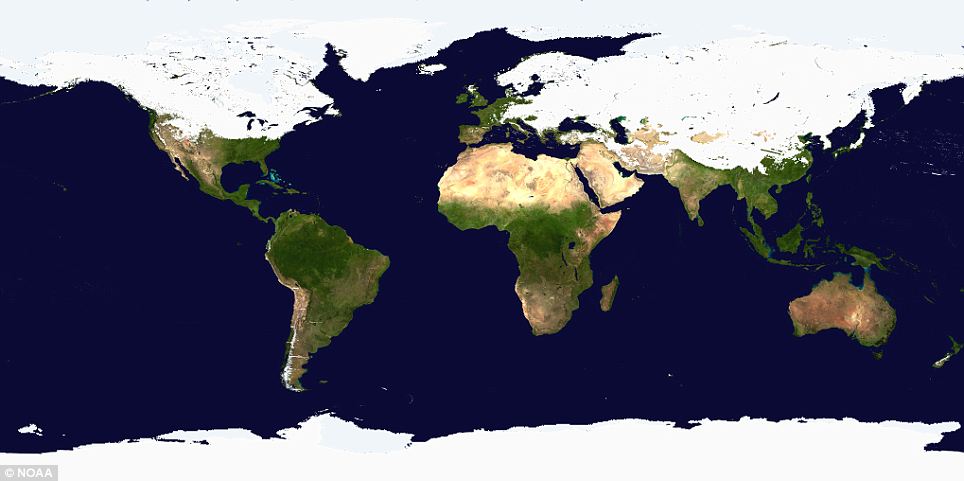
The shroud of white stretches down from Alaska and sweeps through the Midwest and along to the Eastern seaboard. The bitter cold has reached as far as Texas and northern Mexico where in Ciudad Juarez temperatures today were expected to dip to minus 15C.
In the U.S. tens of millions of people chose to stay at home rather than venture out. In Chicago, 20in of snow fell leading to authorities closing schools for the first time in 12 years. The newspaper for Tulsa, Okalahoma, was unable to publish its print edition for the first time in Read more…
Red alert in Britain’s forests as Black death sweeps in
Millions of larches have had to be felled to prevent the spread of a lethal virus from Asia. Christopher Middleton reports from the bleak and bare hillsides of South Wales.

Just before Christmas, you could stand at the top of Crynant Forest in South Wales and not have a clue that there was a village in the valley below. Today, the view down to the little white houses is uninterrupted. Where in mid-December there were thousands of larch trees, now there is a mass of stumps and branches.
It looks like a photograph from a First World War battlefield. A featureless no-man’s-land, interrupted by the occasional blasted tree trunk, pointing at an unnatural angle.
And that’s just the start of it. Turn your gaze in any direction, and there is a scene of devastation. Bare hillsides as far as the eye can see; slopes that look as if they’re covered in bracken are in fact coated with fallen trees.
Meanwhile, piles of logs as tall as barns are stacked up neatly by the roadside, like casualties awaiting collection from clearing stations.
The force that swept through here was not a hurricane, but an army of tree-felling engines sent in by the Forestry Commission. Already they’ve cleared 380 acres, but there’s more to be done. Much more.
And they’re in a race against time. Across the country, some 1.4 million larches have been cut down in the Read more…


![[Most Recent Quotes from www.kitco.com]](https://i0.wp.com/www.kitconet.com/charts/metals/gold/t24_au_en_usoz_2.gif)
![[Most Recent Quotes from www.kitco.com]](https://i0.wp.com/www.kitconet.com/charts/metals/silver/t24_ag_en_usoz_2.gif)

 crisisboom
 CRISISBOOM
You must be logged in to post a comment.