Archive
Report: heavy growth in biometrics
The research firm MarketsandMarkets has released a new study of the biometrics marketplace that projects a heavy growth rate over the next four years. Advances in Biometric Technologies and Market Analysis breaks down the various modes of biometrics such as fingerprint, iris and facial and by regions such as North America, Asia and Europe.
Specifically, the report projects a compound annual growth rate of 21.6% between 2010 and 2015 which would result in a marketplace worth over $11 billion.
While the mode projected to have the largest share of the marketplace in 2015 is still fingerprint biometrics with a 19% growth rate, iris, vein and facial biometrics are expected to close their respective gaps with growth rates of 27.5%, 25.4% and 24.2%. Majority of the reasoning the authors are using for the expected booms in the marketplace are due to growing concerns for national security and the need for ID programs to deal with such concerns
1180 new snowfall records set in the USA this past week
It’s been a very busy week for snow and also for lowest max temperature, thanks to our El Nino induced weather patterns, while the Pacific Northwest is seeing warmer conditions, the southeast and eastern US gets lots of snow thanks to the pattern.

 click for interactive source
EU Debt bought up by China
Published: January 6, 2011 07:46 ET in Asia

China has been increasing its holdings of European government debt, including that issued by Spain, amid the euro-zone crisis, Chinese Vice Commerce Minister Gao Hucheng was quoted as saying on Thursday.
The Spanish daily El Pais on Thursday cited Spanish government sources as saying China has committed to buy about 6 billion euros ($7.89 billion) worth of Spanish sovereign debt.
In a statement on the ministry’s website, Gao also said that China was confident in Spanish and European financial markets and confident that they would be able to overcome Europe’s debt crisis, the Wall Street Journal reported.
“We will continue to buy debt and work together with Spain,” said Gao, who is accompanying Chinese Vice Premier Li Keqiang on a visit to Spain and other European countries.
Both officials have expressed confidence that Spain will recover from its economic crisis despite market fears of an Irish-style bailout.
El Pais published an article written by Vice Premier Li, titled, “China and Spain: A brighter future through win-win cooperation.”
Political and corporate leaders increasingly see China as a source of capital. China’s foreign-exchange reserves are by far the world’s largest, totaling $2.648 trillion at the end of September.
In the meantime, the economic mood in Europe ended 2010 on a high note, a key indicator released Thursday showed.
The European Commission’s closely watched business and consumer survey for the members of the euro currency bloc rose from 105.2 in November to a more-than-forecast 106.2 last month. The consensus among economists was that the index would nudge up to 105.5.
Ben May, European economist with the research group Capital Economics, told Monstersandcritics.com the data suggested that, “the improving global economic outlook is offsetting the ongoing troubles in the periphery.”
2010 in Review-Commodities affected by World Events
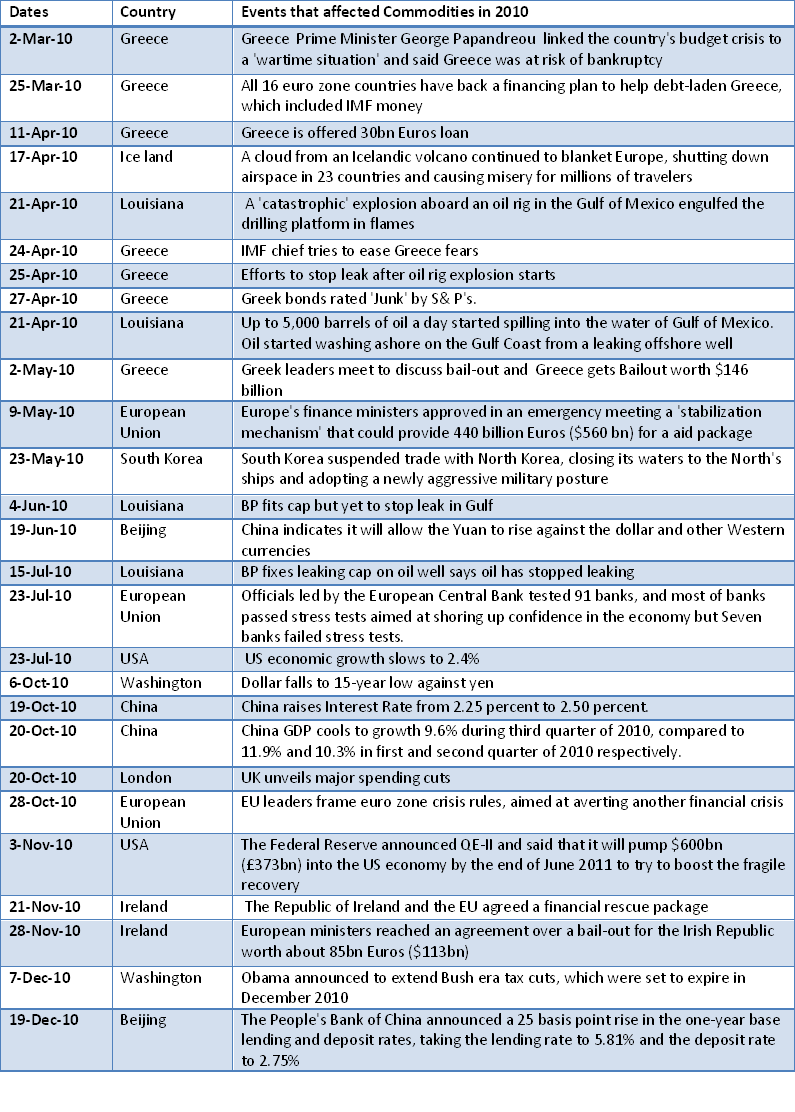 Notable events that affected commodity prices in 2010
BRIC-The Trillion Dollar World Club
Brazil, Russia, India and China matter individually. But does it make sense to treat the BRICs—or any other combination of emerging powers—as a block?
 IN ANY global gathering, the American president is usually seen, at a minimum, as primus inter pares: the one who can make or break the final bargain and select his favoured interlocutors. So in Copenhagen last December, as negotiations for a new climate-change
treaty were entering their final hours, a hastily convened meeting between Barack Obama and China’s prime minister, Wen Jiabao, looked as if it would be the critical moment when a deal might be struck. But when the president turned up, he found not only Mr Wen but the heads of government of Brazil, South Africa and India. This was unexpected. The Americans even thought the Indians had already left the summit. What was conceived as a bilateral talk turned instead into a negotiation with an emerging-market block. As an additional sign that things were changing in the world, the president got a finger-wagging from one of Mr Wen’s hangers-on. But at least Mr Obama was in the room; Europeans were shut out while the emerging powers and America put the final touches to their deal.
This week the same developing countries are meeting again, in Brasília. On April 15th Brazil, India and South Africa—rising powers that are also democracies—put their heads together. The next day South Africa will drop out and Russia and China will join the party, to create a meeting of the so-called BRICs.
For this group, it is a second summit; last June their leaders met in Yekaterinburg, in Russia. That inaugural summit, which produced almost nothing concrete, appeared to be Read more…


![[Most Recent Quotes from www.kitco.com]](https://i0.wp.com/www.kitconet.com/charts/metals/gold/t24_au_en_usoz_2.gif)
![[Most Recent Quotes from www.kitco.com]](https://i0.wp.com/www.kitconet.com/charts/metals/silver/t24_ag_en_usoz_2.gif)

 crisisboom
 CRISISBOOM
You must be logged in to post a comment.