Archive
Cosmic burst in distant galaxy puzzles NASA

This NASA image from Swift’s Ultraviolet/Optical (white, purple) and X-ray telescopes (yellow and red) were combined in this view of a cosmic burst at the center of distant galaxy that has burned for more than a week, longer than astronomers have ever seen before, the US space agency said Thursday.
NASA is studying a surprising cosmic burst at the center of distant galaxy that has burned for more than a week, longer than astronomers have ever seen before, the US space agency said Thursday.
Calling it “one of the most puzzling cosmic blasts ever observed,” NASA said it has mobilized the Hubble Space Telescope along with its Swift satellite and Chandra X-ray Observatory to study the phenomenon.
“More than a week later, high-energy radiation continues to brighten and fade from its location,” NASA said in a statement.
“Astronomers say they have never seen such a bright, variable, high-energy, long-lasting burst before. Usually, gamma-ray bursts mark the destruction of a massive star, and flaring Read more…
NASA Shuts Down Prolific Sky-Mapping Space Telescope
 A prolific sky-mapping telescope that has spent more than a year scanning the heavens for asteroids, comets and other cosmic objects received its last command today (Feb. 17).
NASA shut down its WISE spacecraft – short for Wide-field Infrared Survey Explorer – at 3:00 p.m. EST (2000 UTC) today. The mission’s principal investigator, Ned Wright of the University of California in Los Angeles, sent the final command to the now-hibernating spacecraft, according to an update from the WISE mission’s official Twitter account.
“The WISE spacecraft will remain in hibernation without ground contacts awaiting possible future use,” NASA officials said via Twitter.
WISE launched on Dec. 14, 2009 to begin a 10-month mission to collect Read more…
Nibiru, What NASA Knows & You Don’t
Ancient Folklore most of the time can be traced back to some actual event. The folklore around Nibiru and planet X goes back thousands of years, and can even be seen in the symbolism of every day architecture provided to us via secret societies, mysticism and most religions around the world.

Commonly referred to as the Crossing Planet, Planet X, Nibiru, Winged Orb, Nemesis, Wormwood, The Death Star and the Destroyer. This mystical heavenly body very well may exist. Given the misinterpretation of planet X actually being a planet, is the first mistake, which has likely led to the lack of supporting scientific evidence of its existence. Only the misnomer of Planet X would allude to this planet actually being a planet. According to mystical and esoteric history, Planet X is not a planet at all but a Brown Dwarf star, that may have its own orbiting planets.
Infrared anomalies were found in the Sagittarius constellation, and Lloyd believes the ‘dark star’ lies in this direction. Irregularities in the Kuiper Belt (a region beyond Neptune), such as objects with odd inclined orbits, indicate that science is catching up with the idea of a Planet X, he pointed out. It’s possible, he added, that NASA already discovered such a celestial body years ago, and has deliberately kept its presence a secret.
When NASA tells you that there are no large planets in our solar system that have gone undetected, they are Read more…
Green Blob in Space
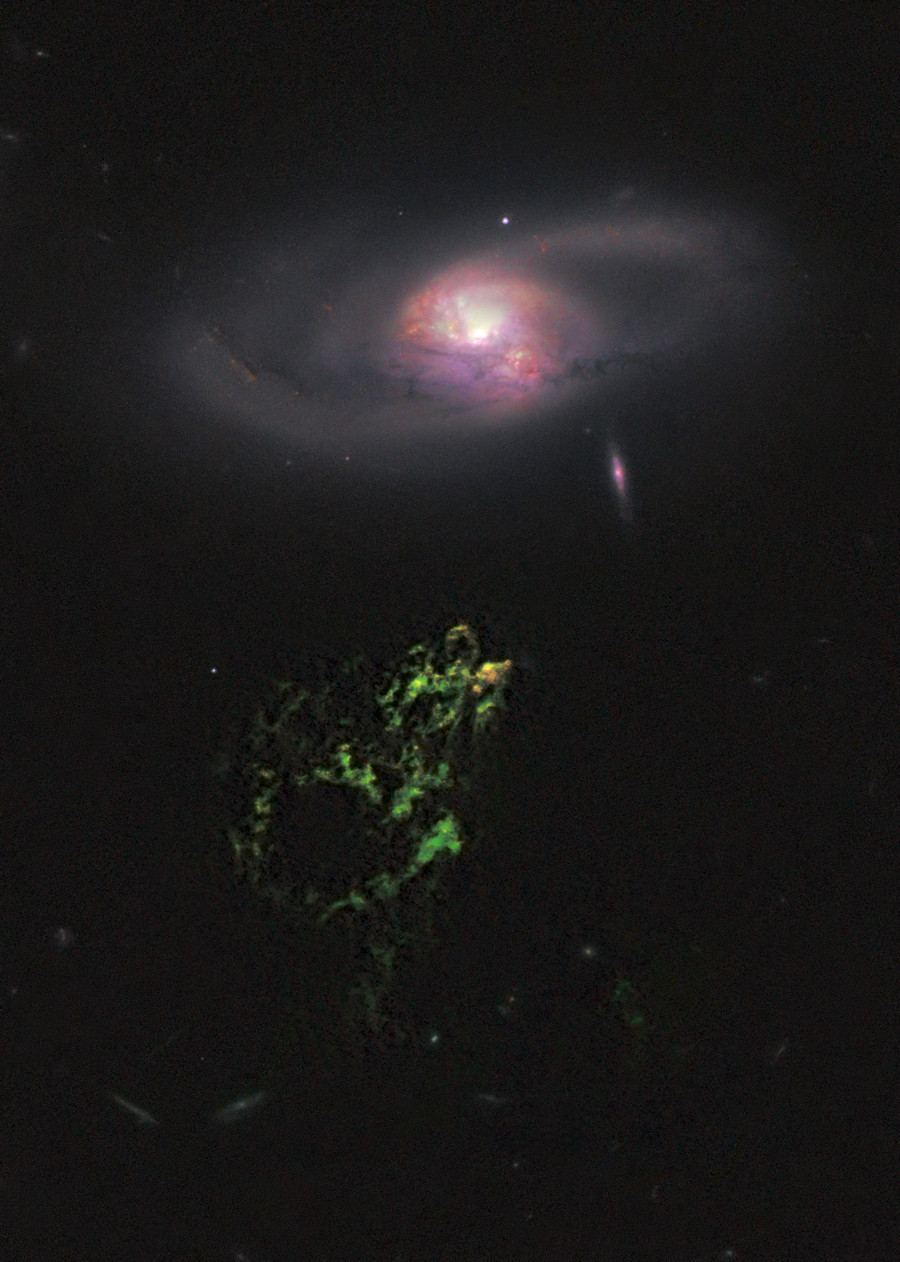 The Hubble Space Telescope got its first peek at a mysterious giant green blob in outer space and found that it’s strangely alive. The bizarre glowing blob is giving birth to new stars, some only a couple million years old, in remote areas of the universe where stars don’t normally form.
The blob of gas was first discovered by a Dutch school teacher in 2007 and is named Hanny’s Voorwerp (HAN’-nee’s-FOR’-vehrp). Voorwerp is Dutch for object.
NASA released the new Hubble photo Monday at the American Astronomical Society meeting in Seattle.
Parts of the green blob are collapsing and the resulting pressure from that is creating the stars. The stellar nurseries are outside of a normal galaxy, which is usually where stars live.
That makes these “very lonely newborn stars” that are “in the middle of nowhere,” said Bill Keel, the University of Alabama astronomer who examined the blob.
The blob is the size of our own Milky Way galaxy and it is 650 million light years away. Each light year is about 6 trillion miles.
The blob is mostly hydrogen gas swirling from a close encounter of two galaxies and it glows because it is illuminated by a quasar in one of the galaxies. A quasar is a bright object full of energy powered by a black hole. Read more…


![[Most Recent Quotes from www.kitco.com]](https://i0.wp.com/www.kitconet.com/charts/metals/gold/t24_au_en_usoz_2.gif)
![[Most Recent Quotes from www.kitco.com]](https://i0.wp.com/www.kitconet.com/charts/metals/silver/t24_ag_en_usoz_2.gif)

 crisisboom
 CRISISBOOM
You must be logged in to post a comment.