Archive
800-Mile-Wide Hot Anomaly Found Under Seafloor off Hawaii
 Hot lava spills into the sea from under a hardened lava crust on the Big Island of Hawaii (file picture).
Photograph by Patrick McFeeley, National Geographic
Dave Mosher
Updated May 27, 2011 (First posted May 26, 2011)
Hawaii‘s traditional birth story—that the volcanic islands were, and are, fueled by a hot-rock plume running directly to Earth’s scorching core—could be toast, a new study hints.
(See pictures of a recent eruption Hawaii’s Kilauea volcano.)
Scientists say they’ve found solid evidence of a giant mass of hot rock under the seafloor in the region. But it’s not a plume running straight from the core to the surface—and it’s hundreds of miles west of the nearest Hawaiian island.
Until now, the researchers say, good seismic data on the region has been scarce, so it was tough to question the Read more…
Radiation in US rainwater likely from Japan
 Health officials said Sunday that one sample of Massachusetts rainwater has registered very low concentrations of radiation, most likely from the Japanese nuclear power plant damaged earlier this month by an earthquake and tsunami.
John Auerbach, the Massachusetts commissioner of public health, said that the radioactive isotope iodine-131 found in the sample – one of more than 100 that have been taken around the country – has a short life of only eight days. He said the drinking water supply in the state was unaffected and officials do not expect any health concerns.
Nevada, California, Hawaii, Colorado and Washington state have also reported tiny amounts of radiation from the Japan Read more…
Scientists Project Path of Radiation Plume
A United Nations forecast of the possible movement of the radioactive plume coming from crippled Japanese reactors shows it churning across the Pacific, and touching the Aleutian Islands on Thursday before hitting Southern California late Friday.
March 18 2:00 AM
 The Comprehensive Nuclear Test Ban Treaty Organization shows how weather patterns this week might disperse radiation from a continuous source in Fukushima, Japan. The forecast does not show actual levels of radiation, but it does allow the organization to estimate when different monitoring stations, marked with small dots, might be able to detect extremely low levels of radiation. Read more…
Iceland hit by 400 earthquakes in 24 hour, Krisuvik volcano show activity
After four days of continues earthquake activity it appears that Krísuvík volcano has stepped up it’s activity by a order of magnitude. Since midnight there have been over 400 earthquakes in Krísuvík volcano. The activity is continuing when this is written and does not show any signs of slowing down at this moment. Geologist in Iceland are expecting more earthquakes in this area over the next hours and even earthquakes that are larger then ML3.0 in size.
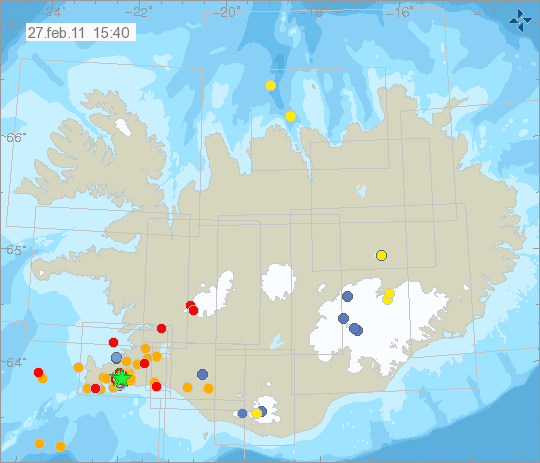 Earthquake location 27 Feb 15:40 GMT
The largest earthquakes where ML3.3 and ML3.7 in size. This is automatic size by the SIL system. The depth of the earthquakes was 4.7 km and 1.1 km according to the automatic SIL system. Due to high number of earthquakes the SIL system is putting earthquakes down all around the Reykjanes Peninsula. While there might be some earthquakes there, the number is not nearly as high as can be seen on the map. The earthquakes can be located by there low quality number.
Given the location and how this earthquake swarm is behaving by opinion of jonfr.com (Iceland volcano and earthquake blog) that this is due to a magma is pushing up the crust in this area. It remains a question of this is going to start a eruption or not. But the chances are growing for as long as this earthquake pattern holds up in Krísuvík volcano. If a eruption starts in Krísuvík volcano it is going to one of Hawaii type eruption, unless it is Read more…
Hawaii official now swears: No Obama birth certificate Read more: Hawaii official now swears: No Obama birth certificate
By Jerome R. Corsi
Former Hawaii elections clerk Tim Adams has now signed an affidavit swearing he was told by his supervisors in Hawaii that no long-form, hospital-generated birth certificate existed for Barack Obama Jr. in Hawaii and that neither Queens Medical Center nor Kapi’olani Medical Center in Honolulu had any record of Obama having been born in their medical facilities.
 Notary seal on Timothy Adams’ affidavit |
Adams was employed at the City and County of Honolulu Elections Division from May 2008 through September 2008.
His position was senior elections clerk, overseeing a group of 50 to 60 employees responsible for verifying the identity of voters at the Absentee Ballot Office. It was in this capacity that Adams became aware of the search for Obama’s birth-certificate records.
USGS records sights and sounds of Hawaii Volcano
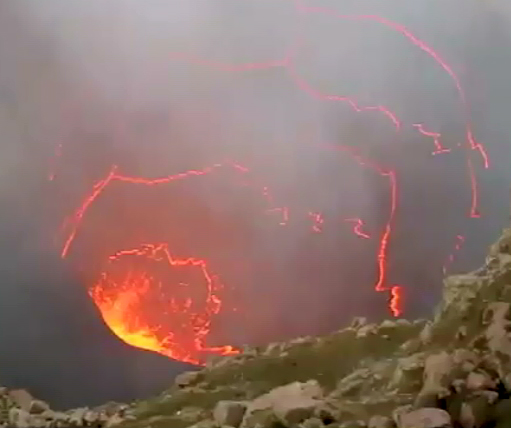
The Hawaiian Volcano Observatory has been keeping a close eye on the fascinating activity at the summit of the Kilaeua volcano.
This footage – taken last week – shows spattering of the lava lake within the Halemaumau vent. The video also captures audio from the vent, which sounds like the churning of the ocean.
In recent weeks, geologists have observed high lava stands – which is what the scientists call the rise-and-fall cycles of the lava lake – at the summit of the active volcano. For each high stand, the lava surface rose several meters over a base level of about 395 ft. below the Halema`uma`u Crater floor.
The lava lake continues to have an overall north-to-south circulation.
Since early 2010, glow has been most intense between high stands from the Jaggar Museum Overlook overnight.


![[Most Recent Quotes from www.kitco.com]](https://i0.wp.com/www.kitconet.com/charts/metals/gold/t24_au_en_usoz_2.gif)
![[Most Recent Quotes from www.kitco.com]](https://i0.wp.com/www.kitconet.com/charts/metals/silver/t24_ag_en_usoz_2.gif)

 crisisboom
 CRISISBOOM
You must be logged in to post a comment.