Archive
Japan tsunami broke huge icebergs off Antarctica

The massive March 11 Japan earthquake and its ensuing tsunami were so powerful that they broke off huge icebergs thousands of miles away in Antarctica, according to a new study.
The calving of icebergs (where a huge chunk of ice breaks off from a glacier or ice shelf) from the Sulzberger Ice Shelf in Antarctica was linked to the tsunami, which originated with the magnitude 9.0 earthquake off the coast of the Japanese island of Honshu, by satellite observations of the Antarctic coast immediately after the earthquake.
Icebergs have been reported to calve following earthquakes before, including after the magnitude 6.3 earthquake that struck Christchurch, New Zealand, on Feb 22. But the new finding marks the first direct observation of such a connection between tsunamis and iceberg calving.
China puts pressure on Japan, sends navy fleet to North Korea
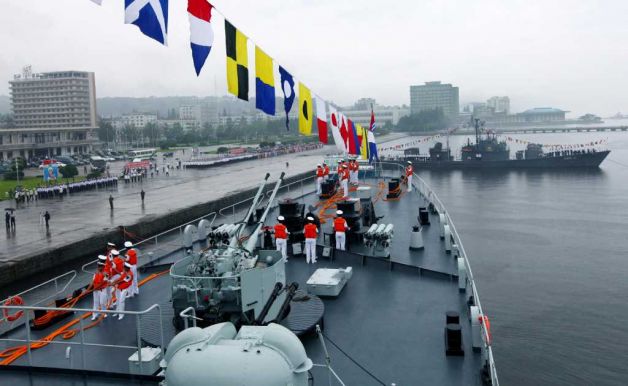 BEIJING: China has put Japan under immense pressure by sending a navy fleet to neighboring North Korea, and accusing Tokyo of issuing misleading statement about Beijing’s military threat.
The fleet includes a missile frigate ” Luoyang“, which landed in Wanson in Democratic People’s Republic of Korea or North Korea on Thursday. It also includes a training ship. Tokyo has for long been worried about close military relationship between China and North Korea.
The move came immediately after Japan warned that China’s naval forces were likely to increase activities around its waters. The two countries have been involved in bickering over ownership of parts of the East China Sea.
Tokyo’s issued a white paper discussing military threat posed by an increasingly aggressive China. Tokyo is particularly worried because China is close to launching its first aircraft carrier, which might be put afloat in seas close to Japan.
The white paper said China’s defense budget has shot up Read more…
Japan’s Big Earthquake Rattled The Ionosphere
The giant 11 March 2011 magnitude 9 Tohoku earthquake not only shook the Earth and caused devastating tsunamis but also rattled the ionosphere, according to a new study.
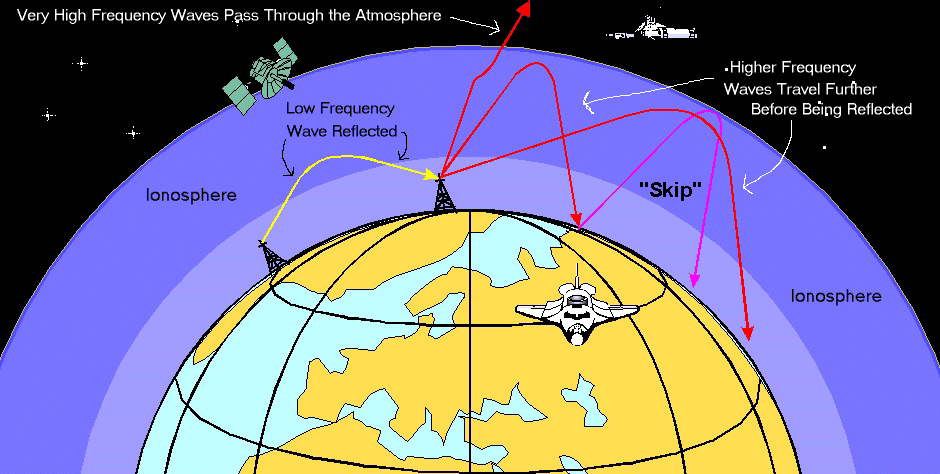 Image: NASA
The ionosphere is a part of the upper atmosphere, comprising portions of the mesosphere, thermosphere and exosphere, distinguished because it is ionized by solar radiation. It plays an important part in atmospheric electricity and forms the inner edge of the magnetosphere. It has practical importance because, among other functions, it influences radio propagation to distant places on the Earth. Read more…
Japan should have nuclear weapons: Tokyo Governor
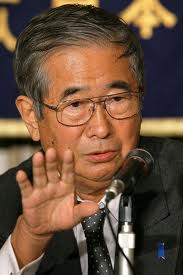 TOKYO – Tokyo Governor Shintaro Ishihara has criticised Japanese Prime Minister Naoto Kan’s vow to reduce dependency on atomic energy after the Fukushima disaster, saying instead the country should deepen its nuclear embrace to include weapons.
“Japan should absolutely possess nuclear weapons,” Mr Ishihara said in a July 15 interview at his office citing China and North Korea as potential threats.
“I don’t think we can easily do away with atomic power. Nuclear energy is inexpensive if managed well,” he also said.
Mr Ishihara has built a political career by taking on consensus views on everything from Japan’s pacifist constitution to economic ties with the United States, with a record of success with voters that’s withstood controversial remarks that have forced public apologies.
The 78-year-old Governor expressed regret in March after calling the earthquake and tsunami disaster “divine punishment” for the “egoism” of Japnese society. He was re-elected in April to a fourth four-year term governing Japan’s biggest and richest city. Bloomberg
1 BILLION BECQUERELS PER HOUR Emission of Radioactive Materials from Fukushima I Nuke Plant at the End of June
That’s an amazing reduction from the maximum emission of 2,000 terabecquerels per hour on March 15, it is actually one-2 millionth of the maximum, says TEPCO in the Reference No. 2 of the progress report on the “roadmap” to God knows where.
Is this number, 1 billion becquerels per hour emission, good? TEPCO’s Matsumoto, in the press conference on July 19, avoided the judgment, and said he didn’t know, but it was one-2 millionth of what it had been on March 15.
On closer reading of the document, though, I noticed one strange thing about this emission number. TEPCO is talking about the radiation emission measured in cesium (cesium-134 and -137), not in iodine equivalence.
To come up with the iodine-131 equivalence, you have to multiply cesium-134 Read more…
Typhoon Ma-on approaches Japan
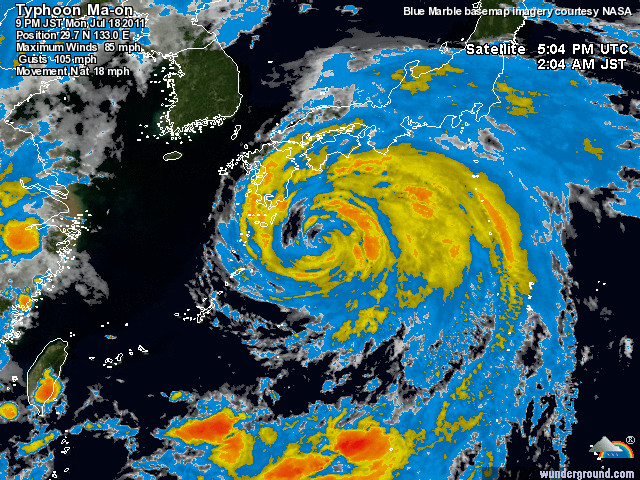
Typhoon Ma-on is threatening the Japanese island of Shikoku. According to forecasters, the typhoon is likely to make landfall on Wakayama Prefecture (Honshu Island) early on July 20th. Later on Wednesday, July 20th or early on Thursday, July 21st, the typhoon, weakened by that time into a category-one storm, is expected to hit the south of Kanto Plain and Tokyo-Yokohama metropolitan area. Consequently, heavy downpours and strong winds are forecast while flash floods and landslides remain possible. Power cuts, telecommunication and water outages are possible in affected areas. Transport disruptions are also expected as the typhoon could force the closure of several airports including Osaka International airport, Tokyo International Airport (Haneda) and Narita International Airport. Ferry and train services (including the high-speed trains Shinkansen) are likely to be disrupted in southern and central Honshu.
Typhoon Ma-on will generate heavy Read more…
Why China Wants South China Sea
By Tetsuo Kotani
Beijing is interested in more than just energy and fishery resources. The area is also integral to its nuclear submarine strategy.

In an effort to underscore its importance to Asia, geostrategist Nicholas Spykman once described it as the ‘Asiatic Mediterranean.’ More recently, it has been dubbed the ‘Chinese Caribbean.’ And, just as Rome and the United States have sought control over the Mediterranean and Caribbean, China now seeks dominance over the South China Sea.
It’s clear that China’s claims and recent assertiveness have increased tensions in this key body of water. Yet while most attention has focused on Beijing’s appetite for fishery and energy resources, from a submariner’s perspective, the semi-closed sea is integral to China’s nuclear strategy. And without understanding the nuclear dimension of the South China Sea disputes, China’s maritime expansion makes little sense.
Possessing a credible sea-based nuclear deterrent is a priority for China’s military strategy. China’s single Type 092, or Xia-class, nuclear-powered ballistic missile submarine, equipped with short-range JL-1 submarine-launched ballistic Read more…
Scientists Aglow After Big Discovery During Tsunami

Researchers using a camera on Maui have photographed the glow from atmospheric pressure disturbances generated by the March 11 tsunami, raising hopes that the technique could be used to predict the arrival of future waves.
The first observation of its kind was made from the Air Force Maui Optical and Supercomputing Station atop Haleakala by scientists in France, Brazil and the United States.
The March 11 earthquake in Japan generated a seismic sea wave that devastated parts of northern Honshu and caused millions of dollars of damage in Hawaii.
On the open ocean, such waves move at 500 mph but are only an inch high. Nevertheless, they put pressure on the atmosphere, scientists say.
“The atmosphere gets less and less dense as you get higher, and that allows the Read more…
Straw Fed To Japanese Found To Be Radioactive
 MINAMISOMA, JAPAN (BNO NEWS) — Japan’s nuclear crisis has spread to its cattle as high levels of radioactive cesium were detected at a farm in Fukushima, officials said Monday.
The radioactive cesium was found in straw fed to cattle at a farm in Minamisoma, Fukushima Prefecture with an average of 75,000 becquerels of the radioactive isotope per kilogramme (2.25 pounds), which is about 56 times the allowable limit, Kyodo news agency reported.
According to officials, the contaminated straw was stored in an exposed area of the farm without roofs during the March 11 earthquake and tsunami that caused a series of explosions that crippled the Fukushima Daiichi nuclear power plant. Furthermore, the farm is located in one of the high-risk areas of the region, and officials suspect the straw could be the radioactive source of contaminated beef that had been detected in meat shipped from that area.
The contaminated meat of eleven cows was detected in Tokyo, where the meat was shipped for processing. However, at the time of the shipment, the Read more…
Britain in list of countries ‘most at risk’ if an asteroid strikes
Britain has been identified among a host of countries scientists believe would be worst affected in the event of an asteroid strike.

Experts at Southampton University have drawn up a league table of countries most likely to suffer severe loss of life or catastrophic damage should a large asteroid hit Earth.
The list is largely made up of developed nations including China, Japan, the United States and Italy, on the basis that the size of their populations would mean millions of deaths.
The US, China, Indonesia, India and Japan are most in danger on this basis. Canada, the US, China, Japan and Sweden are rated most at risk in terms of potential damage to their infrastructure.
The report comes after a rock the size of a house came within 7,500 miles of Earth earlier this Read more…


![[Most Recent Quotes from www.kitco.com]](https://i0.wp.com/www.kitconet.com/charts/metals/gold/t24_au_en_usoz_2.gif)
![[Most Recent Quotes from www.kitco.com]](https://i0.wp.com/www.kitconet.com/charts/metals/silver/t24_ag_en_usoz_2.gif)

 crisisboom
 CRISISBOOM
You must be logged in to post a comment.