Archive
Rising world food prices may soon hit Africa hard, but could be a future boon
 Damaged rice is seen in a paddy field destroyed by flood- waters near a village in Manmunai West in Batticaloa district, about 199 miles east of Colombo, Sri Lanka, on Jan. 26. The floods inundated rice paddies, and according to the UN Food and Agriculture Organization, at least 15.5 percent of the main annual rice harvest could be lost.
Andrew Caballero-Reynolds/Reuters
Johannesburg, South Africa
Global food prices reached a historic high last month, a fact that may cause even the most comfortable of Americans to cinch in their belts and cut back on spending.
But what about the world’s poor?
“Global food prices are rising to dangerous levels and threaten tens of millions of poor people around the world,” World Bank Group President Robert Zoellick said Tuesday as he announced the bank’s findings that about 44 million people in developing countries have been pushed into poverty since Read more…
China Prevents Release of U.N. Report on North Korea
 China has advised other nations on the U.N. Security Council that it intends to prevent the release of a U.N. document that charges North Korea with flouting international sanctions placed on its nuclear activities, Reuters reported yesterday (see GSN, Feb. 16).
The Security Council committee that monitors implementation of U.N. sanctions on the Stalinist state received the report at the end of January from the U.N. Panel of Experts on North Korea. Western diplomats said Beijing advised it would not allow the report to be forwarded to the broader Security Council for dissemination. The decision was perplexing to some as a Chinese expert was involved in drafting the report.
As one of five permanent Security Council members, China has veto authority over decisions made by the body. As the sanctions committee must have total agreement on all actions, Beijing can also block the Read more…
Highlights of the $3.73 Trillion Budget Request for 2012
WASHINGTON—President Barack Obama released a $3.73 trillion budget for fiscal-year 2012 Monday where he sought to balance two competing and conflicting agendas: dramatic cuts to federal spending while also investing in programs to improve U.S. competitiveness.

A look at what President Barack Obama has requested in his $3.73 trillion budget for the 2012 fiscal year beginning Oct. 1.
Summary: Homeland Security gets $44 Billion with a priority on naked body scanners. The Transportation Department gets over a half Trillion dollars for new highway and rail construction, including $53 billion for high-speed trains. $500 million will go to the new Bureau of Ocean Energy Management and Enforcement (See my article on LOST.) and NIST, the group that dropped the ball on the Sept. 11th investigation will be getting $764 million, roughly a 17% increase from last year.
____
Agency: NASA
Spending: $18.7 billion
Percentage Change from 2011: 0.9 percent decrease
Discretionary Spending: $18.7 billion
Highlights: Obama’s space budget is about the same as the previous year, avoiding the major proposed cuts other agencies are facing, partly because of the long planned Read more…
CIA Spy Captured Giving Nuclear Bomb To Terrorists
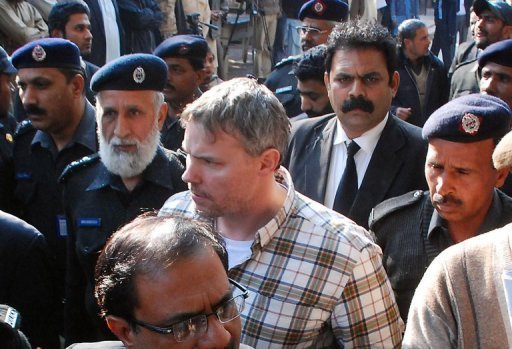
While all eyes in the West are currently trained on the ongoing revolution taking place in Egypt, Russia’s Foreign Intelligence Service (SVR) is warning that the situation on the sub-continent has turned “grave” as it appears open warfare is about to break out between Pakistan and the United States.
Fueling this crisis, that the SVR warns in their report has the potential to ignite a total Global War, was the apprehension by Pakistan of a 36-year-old American named Raymond Allen Davis (photo), whom the US claims is one of their diplomats, but Pakistani Intelligence Services (ISI) claim is a spy for the Central Intelligence Agency (CIA).
Davis was captured by Pakistani police after he shot and killed two men in the eastern city of Lahore on January 27th that the US claims were trying to rob him.
Pakistan, however, says that the two men Davis killed were ISI agents sent to follow him after it was discovered he had been making contact with al Qaeda after his cell phone was tracked to the Waziristan tribal area bordering Afghanistan where the Pakistani Taliban and a dozen other militant groups have forged a Read more…
Pakistan successfully test fires Hatf-VII missile
Pakistan successfully test fires Hatf-VII missile
 The missile can carry conventional and other warheads, the ISPR said. — Photo by AFP (File)
ISLAMABAD: Pakistan’s military says it has successfully test-fired a cruise missile capable of carrying ”strategic and conventional” war heads.
An army statement says the Hatf-VII or Babur missile, which has a range of 360 miles (600 kilometers), was test-fired from an undisclosed location Thursday. The statement did not specifically say if the missile could carry nuclear warheads.
Senior army officials and scientists attended the testing.
Pakistan and its nuclear-armed rival neighboring India routinely test different versions of their missiles. The two countries have fought three wars since they gained independence from Britain in 1947. – AP
APP adds:
Chairman Joint Chiefs of Staff Committee, officers and scientists witnessed the test.
President Asif Ali Zardari and Prime Minister Yousaf Raza Gilani congratulated the scientists and engineers for successfully conducting the test.
Climate phenomenon La Nina to blame for global extreme weather events

Cyclone Yasi over Australia in February 2011. Image credit: NASA
(PhysOrg.com) — Recent extreme weather events as far as Australia and Africa are being fueled by a climate phenomenon known as La Nina — or “the girl” in Spanish. La Nina has also played a minor role in the recent cold weather in the Northeast U.S.
The term La Niña refers to a period of cooler-than-average sea-surface temperatures in the Equatorial Pacific Ocean that occurs as part of natural climate variability. This situation is roughly the opposite of what happens during El Niño (“the boy”) events, when surface waters in this region are warmer than normal. Because the Pacific is the largest ocean on the planet, any significant changes in average conditions there can have consequences for temperature, rainfall and vegetation in distant places.
Scientists at the International Research Institute for Climate and Society (IRI), part of Columbia’s Earth Institute, expect moderate-to-strong La Niña conditions to continue in the tropical Pacific, potentially causing additional shifts in rainfall patterns across Read more…
“War Without Borders”: Washington Intensifies Push Into Central Asia
By Rick Rozoff
A recent editorial on the website of Voice of America reflected on last year being one in which the United States solidified relations with the five former Soviet republics in Central Asia: Kazakhstan, Kyrgyzstan, Tajikistan, Turkmenistan and Uzbekistan.
 One or more of the five nations border Afghanistan, Russia, China and Iran and several more than one of the latter. Kazakhstan, for example, adjoins China and Russia.
The U.S. and Britain, with the support of the North Atlantic Treaty Organization, invaded Afghanistan and fanned out into Kyrgyzstan, Tajikistan and Uzbekistan in October of 2001, less than four months after Russia, China, Kazakhstan, Kyrgyzstan, Tajikistan and Uzbekistan founded the Shanghai Cooperation Organization (SCO) to foster expanding economic, security, transportation and energy cooperation and integration in and through Central Asia. In 2005 India, Iran and Pakistan joined the SCO as observers and Afghan President Hamid Karzai has attended its last five annual heads of state summits. [1]
Now the U.S. and the NATO have over 150,000 troops planted directly south of three Central Asian nations.
Kazakhstan and Turkmenistan are also on the Caspian Sea, a reservoir of oil and natural gas whose dimensions have only been accurately determined in the past twenty years and where American companies are active in hydrocarbon projects.
After the U.S. invasion of Afghanistan, the Pentagon and its NATO allies deployed military forces to, in addition to Soviet-constructed air bases in Afghanistan, bases in Kyrgyzstan, Tajikistan and Uzbekistan. The first two countries Read more…
WikiLeaks: tension in the Middle East and Asia has ‘direct potential’ to lead to nuclear war
Tension in the Middle East and Asia has given rise to an escalating atomic arms and missiles race which has “the direct potential to lead to nuclear war,” leaked diplomatic documents disclose.
By Heidi Blake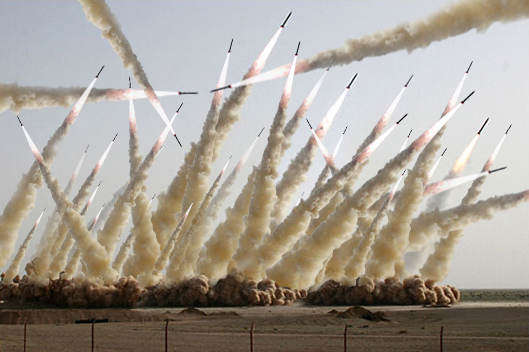 Rogue states are also increasing their efforts to secure chemical and biological weapons, and the means to deploy them, leaving billions in the world’s most densely populated area at risk of a devastating strike, the documents show.
States such as North Korea, Syria and Iran are developing long-range missiles capable of hitting targets outside the region, records of top-level security briefings obtained by WikiLeaks show.
Long-running hostilities between India and Pakistan – which both have nuclear weapons capabilities – are at the root of fears of a nuclear conflict in the region. A classified Pentagon study estimated in 2002 that a nuclear war between the two countries could result in 12 million deaths.
Secret records of a US security briefing at an international non-proliferation summit in 2008 stated that “a nuclear and missile arms race [in South Asia] has the Read more…
Saudis already have 2 Pakistani Nukes
 It’s a story that pops up again and again. Saudi Arabia has acquired at least 2 functional Nuclear Weapons from cash strapped Pakistan. Certainly Saudi Arabia has the money to buy nukes from sources like France, China, Russia, North Korea and Pakistan or even India.
The worrisome thing is that Pakistani nukes may be on the move and the west has very little knowledge or control over it. Pakistan is the most dangerous country on earth. It has a population of 185 million and the majority of people there hate the west and hate Americans. Intelligence experts privately concede that the battle for Pakistan is over. They are now a de facto enemy of the U.S. Al Qaida, the Taliban and the Muslim Brotherhood have won. The ties between Read more…
DEADLY SUPERBUG NDM-1 in BRITAIN
 The bacteria have spread from India and Pakistan and are now being found in hospitals here
Back in 1987 Dr. Robin Cook wrote the medical thriller “Outbreak.” The best-selling novel focused on a team of brilliant medical researchers desperately racing against time to stop a deadly virus from spreading across the United States and potentially killing millions.
Once again fiction becomes reality as England faces its own potentially deadly outbreak with the looming possibility that a superbug from India could bring mass fatalities and spread like wildfire across an unprotected population.
According to the British Health Protection Agency (HPA), a virulent super-bacteria called NDM-1 has invaded the island nation from the Indian sub-continent and Pakistan.
Concerned health professionals have found the bacteria cropping up in hospitals across the country.
Bacteriologists are now burning the midnight oil in a desperate attempt to get a handle on a disease that has the ability to kill thousands.
Superbugs—of which the NDM-1 bacteria is one—are resistant to Read more…


![[Most Recent Quotes from www.kitco.com]](https://i0.wp.com/www.kitconet.com/charts/metals/gold/t24_au_en_usoz_2.gif)
![[Most Recent Quotes from www.kitco.com]](https://i0.wp.com/www.kitconet.com/charts/metals/silver/t24_ag_en_usoz_2.gif)

 crisisboom
 CRISISBOOM

You must be logged in to post a comment.