Archive
South African Charged With Making Bioterrorism Threat
 A South African man was arrested this weekend on suspicion of threatening to attack the United Kingdom and the United States with foot and mouth disease, the Associated Press reported today (see GSN, June 30, 2010).
Brian Roach, the owner of a Johannesburg-area engineering company, was apprehended on Saturday and brought into court today. The 64-year-old man allegedly warned the British government through e-mail and written communication that he planned to release the biological agent in the United Kingdom and the United States if he was not paid $4 million.
“We have the expertise and resources to do this very effectively and will be able to devastate the industry in the U.K. which will cost billions to the economy,” Roach said in an e-mail message sent to the British government. “We will devastate your farms and then we will then take the problem to Read more…
What does China want from Zimbabwe?
Zimbabwe has claimed that China is ready to pour $10 billion (£6.2 billion) into its ailing economy. If the figure is true, what might Beijing want in return?


By Malcolm Moore, Shanghai 8:13AM GMT 10 Feb 2011
When Yang Jiechi arrives in Harare on Thursday, for the first visit by a Chinese Foreign minister in a decade, he is almost certain to be bearing gifts.
After almost three years in which China has publicly shied away from Zimbabwe, there are signs that Beijing has its eyes, once again, on the country’s rich mineral reserves.
Since the deadly elections in 2008, which forced Robert Mugabe, Zimbabwe’s president, to form a “unity” government with his opponent Morgan Tsvangirai, relations have cooled while Chinese officials hedged their bets over the country’s leadership and squirmed in the fierce glare of international condemnation.
“China gets embarrassed when embarrassing details become public,” said Philip Barclay, a former British diplomat in Harare and the author of Zimbabwe, Years of Hope and Despair.
“And the Chinese weapons shipment which arrived in 2008, just at the time when violence broke out around the Zimbabwean elections, was very embarrassing. They really did not like that,” he added.
On Thursday, however, Mr Yang is likely to start negotiations over a significant injection of Chinese investment.
According to Tapiwa Mashakada, the Zimbabwean Economic planning minister, Mr Yang may be carrying with him as much as $10 billion of investment from Beijing.
“We have met with officials from China Development Bank and they have said they are willing to invest up to $10 billion,” he said, at a business conference in Harare earlier this month.
“The Chinese are looking into mining development, that is exploration and exploitation, agriculture, infrastructure development and information communication technology,” added Mr Mashakada, a member of Mr Tsvangirai’s Movement for Democratic Change party.
Previous rumors suggested, however, that the money on the table is actually a $3 billion loan from China’s Export-Import (Exim) Bank. Both sums dwarf previous Chinese investments in Zimbabwe, and Mr Mashakada’s claim represents more than twice the value of Zimbabwe’s entire economy last year, and more than all other Chinese direct investments in Africa in 2009 put together.
“It is a pie-in-the-sky figure,” said Mr Barclay. “It is much larger than previous Chinese investments and when they do invest money, the Chinese expect concrete benefits, usually closely linked to concessions,” he added.
More likely are targeted deals, perhaps for Zimbabwe’s platinum and zinc mines. Zimbabwe has the second-largest reserves of platinum in the world after South Africa.
Details of the Exim bank deal reported in Zimbabwe’s respected “Independent” newspaper cite documents proposing a “master-loan facility” aimed at resuscitating Zimbabwe’s struggling economy after years of hyperinflation and disastrous government policies.
In return, China reportedly wants control over platinum deposits currently owned by the Zimbabwean government in the Selous and Northfields concession covering 68 square miles and valued at between $30 billion to $40 billion.
More controversially, China may also have its eyes on the Marange diamond fields in Chiadzwa. In late 2008 the Zimbabwean military is alleged to have seized control of the fields, shooting illegal miners from helicopter gunships.
Currently, a small proportion of the diamonds from this vast mine are certified by the Kimberley Process to avoid being tagged as “blood” diamonds, but a much greater quantity is thought to be bought up by dubious traders with profits flowing to Mr Mugabe’s Zanu-PF.
China already mines one alluvial diamond concession at Chiadzwa in partnership with the government under the banner of Anjin Investments. There have also been rumors that China may be involved in further illegal mining activities, but they have never been confirmed.
In addition, some Chinese investment could flow into agriculture. China imports a significant quantity of tobacco from Zimbabwe, and may have one eye on a future source of food for its growing middle class.
Around 5,000 Chinese workers live in Zimbabwe, and the two countries have a relationship stretching back to the founding of Robert Mugabe’s Zanu-PF, whose Marxist revolution was partly funded by Beijing. Over the years, China has found it easy to do business with a country that was run along similar lines, with Zanu-PF’s politburo making unilateral decisions.
It is not clear if dealing with the unity government and Mr Tsvangirai’s MDC party will be to Beijing’s taste, but for Zimbabwe there seems little option.
“The MDC will send China warm and fuzzy messages too,” said Mr Barclay. “Although the investment from China is not a particularly good fit, the Chinese are the only investors out there. There was a small delegation from Germany in 2010, but they backed off.”
The What? And Why? Of Rare Earth Metals
Over the past few months, there’s been a buzz surrounding rare earth metals. These are metals such as europium, lanthanum, neodymium and 14 others found in small concentrations attached to other metals and resource deposits. They’re actually not that rare, just expensive and difficult to pull out of the ground.
These naturally occurring elements are essential in everything from wind turbines to lasers to iPads.
Rare earths are a conundrum for the environmentally conscious—they hold the key to green energies but create toxic waste when being separated away from other elements. “Just one wind turbine generating 3 megawatts of electricity requires 600 kilograms of rare earths for its magnets,” a source told the United Kingdom’s Guardian newspaper.
 Electric and hybrid cars can contain more than twice as much rare earth metals as a standard car. This image from the NY Times breaks down how these metals make up critical elements of a Prius.
Currently, China controls 97 percent of the world’s production of rare earth metals. In October 2010, the country cut exports of the metals by 70 percent, disrupting manufacturing in Japan, Europe and the U.S., and sending the prices of these metals up 40 percent.
China currently controls production but the country only has 37 percent of Read more…
Climate phenomenon La Nina to blame for global extreme weather events

Cyclone Yasi over Australia in February 2011. Image credit: NASA
(PhysOrg.com) — Recent extreme weather events as far as Australia and Africa are being fueled by a climate phenomenon known as La Nina — or “the girl” in Spanish. La Nina has also played a minor role in the recent cold weather in the Northeast U.S.
The term La Niña refers to a period of cooler-than-average sea-surface temperatures in the Equatorial Pacific Ocean that occurs as part of natural climate variability. This situation is roughly the opposite of what happens during El Niño (“the boy”) events, when surface waters in this region are warmer than normal. Because the Pacific is the largest ocean on the planet, any significant changes in average conditions there can have consequences for temperature, rainfall and vegetation in distant places.
Scientists at the International Research Institute for Climate and Society (IRI), part of Columbia’s Earth Institute, expect moderate-to-strong La Niña conditions to continue in the tropical Pacific, potentially causing additional shifts in rainfall patterns across Read more…
Gold buying spree grips Chinese households
In this world of chaos and tumult, the Chinese people know what to do to preserve their wealth – they buy gold. When Americans finally wake up, if that ever happens, there is a good chance that there won’t be any gold to buy at any price.
By David Lew
 BEIJING (Commodity Online):An unprecedented investor interest in gold is turning Chinese households as store houses of wealth these days as people are on a gold buying spree across the rural and urban areas of the dragon country.
Bundles of news stories are these days written on the gold buying spree by the Chinese households. If not an overstatement, it is now a fact that people’s houses in China have soared in value thanks to the rising prices of gold in the last two years.
“People in China are buying gold like never before. They believe that gold is the best form of investment. So they are buying gold coins, bars and jewelery items and stocking up safely in their homes,” says Beijing-based bullion dealer J Kim Lee.
Quoting the World Gold Council figures, Lee says that if the gold buying spree by Chinese households goes on at the current pace, private gold Chinese demand may overtake Indian gold demand by 2014, giving the world’s two most populous nations two ounces of gold in every five sold worldwide that year.
Indian households are estimated to be owning 15,000 tonnes of gold. India continues to the largest consumer and importer of gold worldwide.
According to precious metals analyst Steven Jon Kaplan, a significant percentage of gold’s price increase in 2009-2010 was caused by the incremental demand from Read more…
South Africa: Floods kill 120 and destroy crops
JOHANNESBURG, South Africa — South Africa is reeling from unusually heavy rainfall that has caused flooding in many parts of the country, wiping out crops in what is the continent’s main breadbasket.
More than 120 people have been killed in the thunderstorms and flooding since mid-December, and some 20,000 people are in need of assistance. The South African government has declared disaster areas in eight of its nine provinces.
And it’s not over yet. Above-average rainfall is forecast for South Africa and neighboring countries for the next few months.
Much of southern Africa is now on flood alert, including Mozambique, where at least 13 people have died from floods and thousands have fled their homes for higher ground. Namibia, Botswana, Zimbabwe and Zambia are also on alert for flooding.
While this is the annual rainy season in southern Africa, the heavier than usual rainfall has been blamed on La Nina, the weather pattern behind the severe flooding in other southern hemisphere countries including Australia, Brazil and the Philippines.
In South Africa, the government has put the flood damage at $211 million, but this is an early estimate and expected to rise. At least Read more…
The African Chinese Connection
Shu Yunguo & James Shikwati
 China and Africa had established relations as early as 2,000 years ago, during which, there were no wars, aggression or looting but only exchanges of trade between China and Africa. The history and tradition of China-Africa relations not only exerted positive and enormous influence, but also laid a solid foundation on the relationship development between countries in modern times.
Secondly, developing countries have common qualities. Both China and African countries are developing countries meaning they have not only common history, but also share similar targets for development. Developing countries’ common qualities determine that there is no conflict of interest between them, and also that the countries have the same or similar opinions on many major international issues (such as the establishment of a new international political and economic system).
Thirdly, they are all eager to develop themselves. Currently, developing countries are still weak compared with the strong developed countries. When dialogue between developing and developed countries is progressing slowly, the cooperation between developing countries becomes especially important. Both China and African countries are developing countries, and strengthening cooperation is the request of the era and the common need to develop.
Fourthly, the countries stood the test of practice. The establishment of the People’s Republic of China and African countries gaining independence proved that the equal, reciprocal and win-win relationship between China and Africa has strong vitality and the prospect of sustainable development. Fifthly, the relationship can be guaranteed by a system and mechanism. China and Africa launched the Read more…
South African Corn Rises as Dry Weather Stresses Argentina Crop
Corn in South Africa advanced as dry weather continues to stress crops in Argentina, the world’s largest shipper of the grain after the U.S., raising concerns that global stockpiles may be depleted.
White corn for March delivery, the most active contract on the South African Futures Exchange, gained 28 rand, or 2.2 percent, to close trade at 1,328 rand ($194) a metric ton. Meal made from the grain is the country’s staple food.
Argentina will continue to have a rainfall deficit in the seven days from yesterday, Telvent DTN Inc. said in a forecast. The lack of rain, combined with above-normal temperatures, will stress pollinating corn and developing soybeans, it said.
Yellow corn for March delivery advanced 36 rand, or 2.6 percent, to 1,442 rand a ton. The grain is used mainly as animal feed in South Africa.
Wheat for March delivery fell 1 rand to 2,888 rand a ton.
Gains or losses for the most active contracts of three additional crops today were as follows. All prices are in rand and the crops are sold per ton:
            Today’s Price   Previous Close   % Change
Sunflowers       4,219           4,186          +0.8
Soybeans         3,320           3,270          +1.5
Sorghum          1,500           1,500           0.0
BRIC-The Trillion Dollar World Club
Brazil, Russia, India and China matter individually. But does it make sense to treat the BRICs—or any other combination of emerging powers—as a block?
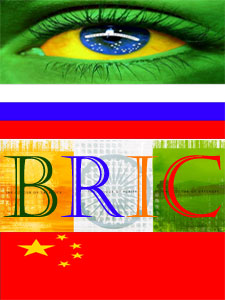 IN ANY global gathering, the American president is usually seen, at a minimum, as primus inter pares: the one who can make or break the final bargain and select his favoured interlocutors. So in Copenhagen last December, as negotiations for a new climate-change
treaty were entering their final hours, a hastily convened meeting between Barack Obama and China’s prime minister, Wen Jiabao, looked as if it would be the critical moment when a deal might be struck. But when the president turned up, he found not only Mr Wen but the heads of government of Brazil, South Africa and India. This was unexpected. The Americans even thought the Indians had already left the summit. What was conceived as a bilateral talk turned instead into a negotiation with an emerging-market block. As an additional sign that things were changing in the world, the president got a finger-wagging from one of Mr Wen’s hangers-on. But at least Mr Obama was in the room; Europeans were shut out while the emerging powers and America put the final touches to their deal.
This week the same developing countries are meeting again, in Brasília. On April 15th Brazil, India and South Africa—rising powers that are also democracies—put their heads together. The next day South Africa will drop out and Russia and China will join the party, to create a meeting of the so-called BRICs.
For this group, it is a second summit; last June their leaders met in Yekaterinburg, in Russia. That inaugural summit, which produced almost nothing concrete, appeared to be Read more…


![[Most Recent Quotes from www.kitco.com]](https://i0.wp.com/www.kitconet.com/charts/metals/gold/t24_au_en_usoz_2.gif)
![[Most Recent Quotes from www.kitco.com]](https://i0.wp.com/www.kitconet.com/charts/metals/silver/t24_ag_en_usoz_2.gif)

 crisisboom
 CRISISBOOM

You must be logged in to post a comment.