Archive
NAM 12: Scientists see solar outburst in exquisite detail
The largest disturbances to the Earth’s geomagnetic environment occur when it is buffeted by solar material hurled in our direction by explosive changes in the Sun’s atmosphere. These Coronal Mass Ejections or CMEs contain approximately a billion tonnes of ionized gas or plasma and can have a dramatic and damaging impact on everything from satellites to power grids.

Now a team of scientists have used two spacecraft to study these events in unprecedented detail. Graduate student Anthony Williams of the University of Leicester will present their results on Tuesday 19 April at the Royal Astronomical Society’s National Astronomy Meeting in Llandudno, Wales.
Mr Williams and his team used the Heliospheric Imagers (HI) on the Solar TErrestrial RElations Observatory (STEREO) spacecraft to examine the internal structure of an Earth-impacting CME – seen as sunlight scattered from high density blobs of plasma – as it travels outwards from the Sun. They compared this with the internal structure measured in situ by the Read more…
Solar Activity Heats Up
April 14, 2011: If you’ve ever stood in front of a hot stove, watching a pot of water and waiting impatiently for it to boil, you know what it feels like to be a solar physicist.
 NASA’s Solar Dynamics Observatory recorded this X1.5-class solar flare on March 9, 2011. [movie]
Back in 2008, the solar cycle plunged into the deepest minimum in nearly a century. Sunspots all but vanished, solar flares subsided, and the sun was eerily quiet.
“Ever since, we’ve been waiting for solar activity to pick up,” says Richard Fisher, head of the Heliophysics Division at NASA Headquarters in Washington DC. “It’s been three long years.”
Quiet spells on the sun are nothing new. They come along every 11 years or so—it’s a natural part of the solar cycle. This particular solar minimum, however, was lasting longer than usual, prompting some researchers to wonder if it would ever end.
News flash: The pot is starting to boil. “Finally,” says Fisher, “we are beginning to see some action.”
As 2011 unfolds, sunspots have returned and they are crackling with activity. On February 15th and again on March 9th, Earth orbiting satellites detected a pair of “X-class” solar flares–the most powerful kind of x-ray flare. The last such eruption occurred back in December 2006.
Another eruption on March 7th hurled a billion-ton cloud of plasma away from the sun at five million mph (2200 km/s). The rapidly expanding cloud wasn’t aimed directly at Earth, but it did deliver a glancing blow to our planet’s magnetic field. The off-center impact on March 10th was enough to send Northern Lights spilling over the Canadian border into US states such as Read more…
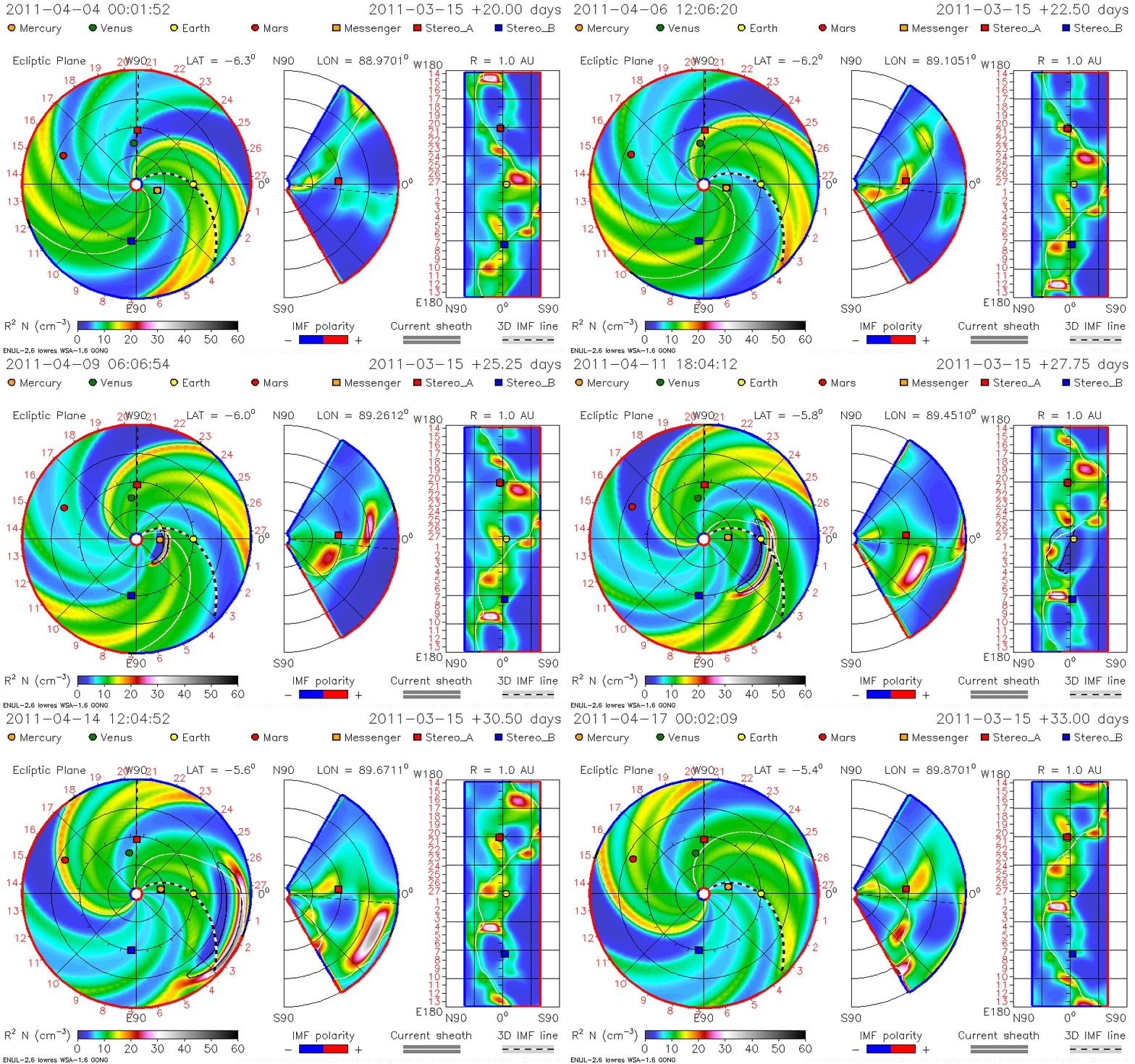
G2-Geomagnetic Storm / Solar Watch April 8th 2011
Researcher cites ancient Minoan-era ‘computer’
(ANA-MPA) — The Minoan civilisation on pre-Classical Crete discovered the first rudimentary analog computer in mankind’s history, according to researcher Minas Tsikritsis, an academic who specialises in ancient Aegean writing systems.
Tsikritsis, who also hails from Crete — where the Bronze Age Minoan civilization flourished from approximately 2700 BC to 1500 century BC — maintains that the Minoan Age object discovered in 1898 in Paleokastro site, in the Sitia district of western Crete, preceded the heralded “Antikythera Mechanism“ by 1,400 years, and was the first analog and “portable computer“ in history.
“While searching in the Archaeological Museum of Iraklion for Minoan Age findings with astronomical images on them we came across a stone-made matrix unearthed in the region of Paleokastro, Sitia. In the past, archaeologists had expressed the view that the carved symbols on its surface are related with the Sun and the Moon,” Tsikritsis said.
The Cretan researcher and university professor told ANA-MPA that after the relief image of a spoked disc on the right side of the matrix was analysed it was established that it served as a cast to build a mechanism that functioned as an analog computer to calculate solar and lunar eclipses. The mechanism was also used as sundial and as an instrument calculating the geographical latitude. (ANA-MPA)
Strong geomagnetic storm slams Earth on Wednesday
 (TheWeatherSpace.com) — A solar storm is in progress right now with the highest Kp-index in a while being recorded.
The solar storm has a Kp-Index of 6, out of the 0-9 scale. This is higher than any previous solar storms, including the March event. What caused this without a flare?
“This solar storm is likely a flare caused storm,” TheWeatherSpace.com Senior Meteorologist Kevin Martin said. “It may not have been Earth directed but a blast from the sun a couple days ago hurled a lot of material into space. This material sometimes does not follow a straight line, but can curve with the influence of magnetic fields and gravity.”
Mid and High latitude observer should check out the skies and see if the northern and southern lights are around.
Martin is the scientist that thinks solar storms are triggers to earthquake activity. Will it cause a large quake? Time will tell but enjoy the skies for the next nine hours if it is clear, dark, and you are in a higher latitude.
Ozone layer damaged by unusually harsh winter

An image of total ozone column profile around the North Pole on March 30, 2011, developed by the Finnish Meteorological Institute using satellite and ground-based data, is seen in this handout, April 5, 2011. Satellite measurement of total ozone from OMI (Ozone Monitoring Instrument) shows a region of low ozone (blue region) above the Arctic regions. As of late March the ozone-poor region is shifted away from the pole and covers Greenland and Scandinavia. — WMO via Reuters
The stratospheric ozone layer, which shields the Earth from the Sun’s harmful ultraviolet rays, has been damaged to its greatest-ever extent over the Arctic this winter.
The protective layer of gas, which can be destroyed by reactions with industrial chemicals, has suffered a loss of about 40 per cent from the start of winter until late March, exceeding the previous seasonal loss of about 30 per cent, according to the World Meteorological Organisation (WMO).
The phenomenon is annual in the Antarctic, where after its discovery in the 1980s it came to be known as the “ozone hole“. Although CFC levels are now dropping, they remain in the atmosphere for so long that they will still be causing ozone depletion for decades in certain conditions, particularly the intense cold of the stratosphere.
Arctic ozone conditions vary more and the temperatures are always warmer than over Antarctica, where the ozone hole forms high in the stratosphere near the South Pole each winter and spring. Because of changing weather and temperatures, some Arctic winters experience almost no ozone loss – but others with exceptionally cold stratospheric conditions can occasionally lead to substantial ozone depletion.
This is what has happened over the Arctic this winter; for while at ground level the Arctic region was unusually warm, temperatures 15-20km above the Earth’s surface plummeted. WMO officials say the latest losses, which are unprecedented, were detected in Read more…
NASA admits all previous warming trends caused by sun
I wonder what Al Gore’s rebuttal is going to sound like…
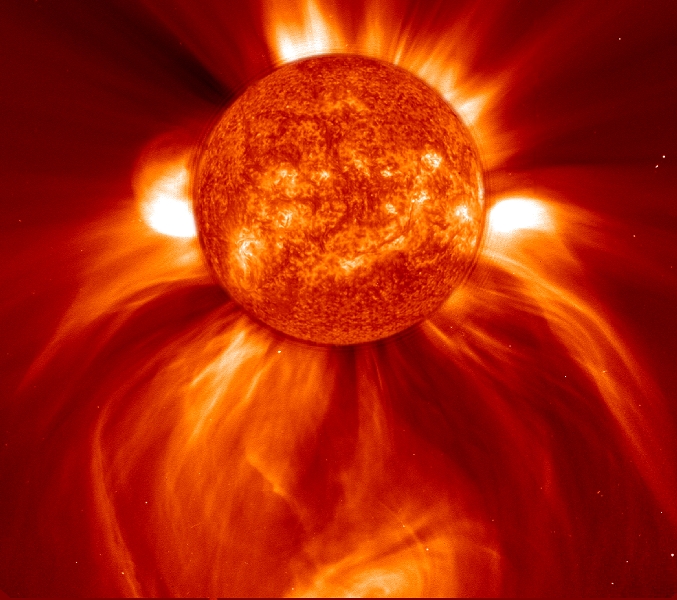 Under mounting pressure from scientists that reject the politically popularized man-made global warming and climate models—the Anthropogenic Global Warming (AGW) theory—the American space agency NASA has admitted that all past warming trends were driven by solar activity.
A victory for the man-made ‘global warming deniers’
As more scientists have joined the outcry over the politicization of Earth’s climate cycles—the current number exceeds 20,000—promoters of the AGW model have denounced the “global warming deniers” countering that little evidence supports the view that the sun is driving the observed warming trend.
Now, however, new study released from NASA’s Goddard Space Flight Center in Greenbelt, Maryland measuring the global temperature variance during the past 100 years has found the sun’s heat and variable cycles have indeed made a significant, measurable impact and greatly influenced Earth’s climate.
In fact, the influence extends as far back as the Read more…
Strange, Second Sun Appears in the Sky at Stevenage UK; Nibiru
I was just informed today of a strange phenomenon in the sky that occurred at Stevenage, UK March 31, 2011. Pamela writes “I recorded it from Stevenage, UK between 17:30 and 18:00 GMT roughly. Very cloudy day with just glimpses of sun in between clouds.” You can see this incredible event clearly at 1:10 mark on the video. Note: Just a few weeks ago in China, a second sun was also spotted in the sky that took news media by storm. Thanks Pamela!
Huge Coronal Mass Ejection behind the Sun
If we were in the path of this CME, it would have been very bad.
The STEREO (Ahead) spacecraft caught this bright, substantial coronal mass ejection blast that emerged from the far side of the Sun, out of direct view from Earth (Mar. 21, 2011). Because it was from the far side (from Earth perspective), none of the ejected particle cloud was headed towards Earth. When that active region rotates around again, we will see if its potential power for generating solar storms remains as strong.


![[Most Recent Quotes from www.kitco.com]](https://i0.wp.com/www.kitconet.com/charts/metals/gold/t24_au_en_usoz_2.gif)
![[Most Recent Quotes from www.kitco.com]](https://i0.wp.com/www.kitconet.com/charts/metals/silver/t24_ag_en_usoz_2.gif)

 crisisboom
 CRISISBOOM
You must be logged in to post a comment.