Archive
NASA’s buzz about comet Elenin

IMAGE: NASA JPL
NASA posted a video on their website Buzzroom last week, bringing attention to a recently discovered comet in our solar system. The comet was discovered by Russian astronomer Leonid Elenin in December last year. Comet Elenin, as it is called, is of particular interest to NASA because of the close proximity to Earth that its orbit will reach during its turn around the sun on its way back out through the solar system later this year.
Most orbits of planets are not circles; they are ellipses. The elongated ends of elliptical orbits are called aphelions and perihelions; the aphelion being the end farthest away from the stationary object being orbited, and perihelion being the end closest to the stationary object. In Elenin’s case, its trip around our sun represents the comet’s perihelion.
So little is known about this comet because of its relatively recent-discovery status, therefore, Read more…
Upcomming days of interest for possible Seismic Activity
- Keep in mind of sunspot 1176’s possible activity
Powerful sunspot emerges, extreme UV radiation detected
(TheWeatherSpace.com) — A sunspot is emerging around the southeastern limb of the Sun and it is a powerful one at that.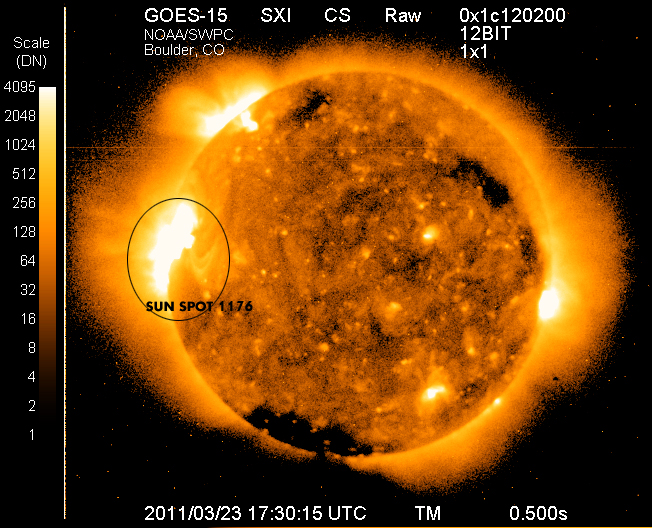
Labeled 1176, this sunspot may have been old sunspot 1165 when it was last seen in early March on the southwestern limb of the Sun.
Since then it has rotated to the far side of the Sun and it looks as if it was busy doing so. This sunspot will have the power to generate large solar flares for the next couple weeks as it crosses the Earth facing side of the Sun.
NASA’s Solar Dynamics Observatory has recorded very high levels of UV radiation from this sunspot, a clear signal to unsettled times ahead for it and the Earth should it blast a solar flare this way.
“If this puts a flare in this direction you can bet on more powerful earthquakes in the world,” TheWeatherSpace.com Senior Meteorologist Kevin Martin said. “We’ve been quiet and that is not a coincidence.”
Moon at Maximum Traction During Latest Earthquake Clusters
The moon’s gravitational impact on the earth, especially between February and April this year, coincides with the latest cluster of major earthquakes.
 (13th March 2011) Many astronomers and climate scientists studying the relationship of the moon with the orbits of the earth and sun, have noted that lunar perigree can coincide with major tectonic activity.
Lunar perigree is when the moon’s orbit is closest to the earth, as on 19th March 2011, but a proxigean cycle is even stronger.
This occurs when the moon is closest in orbit to the Earth, (this year between March 18th and 21st), and also in its new or full Moon phase.
Present proxigean cycle has maximum effect
This proxigean cycle is when the moon Read more…
EARTHQUAKE WARNING FROM RUSSIAN INSTITUTE of PHYSICS of the EARTH

A new report released today in the Kremlin prepared for Prime Minister Putin by the Institute of Physics of the Earth, in Moscow, is warning that the America’s are in danger of suffering a mega-quake of catastrophic proportions during the next fortnight (14 days) with a specific emphasis being placed on the United States, Mexico, Central America and South American west coast regions along with the New Madrid Fault Zone region.
This report further warns that catastrophic earthquakes in Asia and the sub-continent are, also, “more than likely to occur” with the 7.3 magnitude quake in Japan today being “one of at least 4 of this intensity” to occur during this same time period.
Raising the concerns of Read more…
Impact of space weather threat examined
 Professor Hapgood examines the linkage between the science of space weather and its impact on technological systems, potential impact of Solar weather on orbital and ground based systems including power, energy and communications – as well as atmospheric physics.
Space weather is concerned with disturbances in Earth’s upper atmosphere and in near-Earth space that can disrupt the advanced technologies on which our society now relies. A proper understanding of space weather requires us to bring together a range of scientific, engineering and economic expertise, emphasizing the role of the electromagnetic force in many of the physical processes that cause space weather.
One example is the crucial role of plasma physics within the sources of space weather on the Sun, in the transmission of energy from the Sun to the Earth via the solar wind and Earth’s magnetosphere.
Another is the role of the electric currents that naturally flow with Read more…
Sun Emitting Solar Flare
Look at the size of that solar flare! Lots of activity on the way folks.

Two planets found sharing one orbit
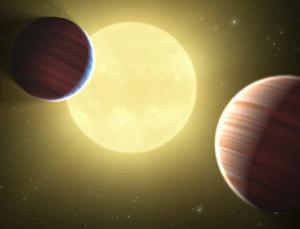 Buried in the flood of data from the Kepler telescope is a planetary system unlike any seen before. Two of its apparent planets share the same orbit around their star. If the discovery is confirmed, it would bolster a theory that Earth once shared its orbit with a Mars-sized body that later crashed into it, resulting in the moon’s formation.
The two planets are part of a four-planet system dubbed KOI-730. They circle their sun-like parent star every 9.8 days at exactly the same orbital distance, one permanently about 60 degrees ahead of the other. In the night sky of one planet, the other world must appear as a constant, blazing light, never fading or brightening.
Gravitational “sweet spots” make this possible. When one Read more…
Get ready for a ‘global Katrina’: Biggest ever solar storm could cause power cuts which last for MONTHS

- Earth is overdue a solar storm as the sun enters its most active period.
The world is overdue a ferocious ‘space storm’ that could knock out communications satellites, ground aircraft and trigger blackouts – causing hundreds of billions of pounds of damage, scientists say.
Astronomers today warned that mankind is now more vulnerable to a major solar storm than at any time in history – and that the planet should prepare for a global Katrina-style disaster.
A massive eruption of the sun would save waves of radiation and charged particles to Earth, damaging the satellite systems used for synchronizing computers, airline navigation and phone networks.


![[Most Recent Quotes from www.kitco.com]](https://i0.wp.com/www.kitconet.com/charts/metals/gold/t24_au_en_usoz_2.gif)
![[Most Recent Quotes from www.kitco.com]](https://i0.wp.com/www.kitconet.com/charts/metals/silver/t24_ag_en_usoz_2.gif)

 crisisboom
 CRISISBOOM
You must be logged in to post a comment.