Archive
Chile’s Puyehue volcano spews lava
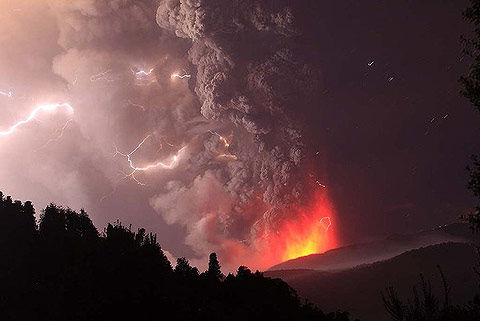 Lava has begun spilling from Chile’s Puyehue volcano, 18 days after it first erupted, but there’s no danger to nearby residents, according to the National Service of Geology and Mining.
But the ash cloud created by the eruption continues to wreak havoc on airlines around the world.
The Chilean airline LAN cancelled flights to Temuco and Valdivia in the south of the country, and a number of flights were suspended in Australia and New Zealand.
“Viscous lava has flowed slowly westward in a channel roughly 50 metres wide and 100 metres long,” the national geology service known as SERNAGEOMIN said in its latest report.
Last week, SERNAGEOMIN chief Enrique Valdivieso said the appearance of lava would signal Read more…
Argentine towns suffer under falling volcanic ash

Divers of the Prefectura Naval Argentina inspect the Rio Limay covered with ash from Chile's Puyehue-Cordon Caulle volcano chain at the mountain resort of San Carlos de Bariloche in Argentina's Patagonia June 16, 2011. Some towns in Argentina's Patagonia remain blanketed in volcanic ash. Airline activity is getting back to normal after days of chaos caused by a towering ash cloud, but Andean towns are covered in a thick, ashed blanket that is disrupting water and power supplies and raising fears over the key winter ski season that starts next month.
BUENOS AIRES, Argentina (AP) — The government of one province in Argentina declared an economic emergency on Thursday to aid towns where falling ash from Chile’s erupting volcano is endangering livestock and keeping tourists away.
The emergency in Neuquen province follows a similar measure by the national government in other parts of Patagonia where agriculture has been hit by accumulating volcanic ash.
The decree by Gov. Jorge Sapag will mean that those affected can receive tax benefits, among other measures.
Chile’s Cordon Caulle volcano began erupting June 4, spewing ash that has disrupted flights in countries ranging from Uruguay to Australia.
The ash has also blanketed towns across the border in Argentina. In the area of Villa La Angostura, located 24 miles (38 kilometers) from the volcano, up to one foot (30 centimeters) of ash has accumulated on the ground.
The ash has made it difficult to drive safely on roads, and the eruption came Read more…
Shiveluch volcano erupts in northern Russia
 A volcano in northern Russia has erupted, and is churning out ash to a height of 10,000 metres, scientists said on Friday. The 3,283-metre Shiveluch volcano increased activity in May 2009 and has been periodically spewing ash from three to eight kilometres. “Low clouds prevent us from getting a clear visual of the event, but our seismic data indicates that Shiveluch has churned out ash plumes to a height of up to 10,000 metres,” said an official at the Far Eastern Institute of Volcanology and Seismology.
Scientists said that the volcanic activity over the past two-three years has altered the contour of the volcano, with the crater increasing in size by nearly 50% and the slopes becoming far steeper than before.
The current eruption poses no immediate threat to nearby settlements. But the ash fallouts could be hazardous to health and the environment.
Ash Cloud Spreads From Erupting Nabro Volcano In Eritrea

The Anabro (Nabro) volcano in the Northern Red Sea Region of Eritrea has erupted sending an ash plume more than 13.5 kilometres into the sky and disrupting air traffic across eastern Africa.
Part of the Afar Triangle, the stratovolcano is one of many volcanic caldera complexes in the north easternmost part of the East African Rift valley region. Nabro is located in the Danakil Depression, close to Eritrea’s border with Ethiopia and north of Djibouti, and has not erupted in at least 150 years. It is the most prominent of 3 large volcanoes (Nabro, Dubbi, Mallahle) in the region, each containing a large summit caldera.
The volcano erupted at 2103 GMT Sunday evening. The Volcanic Ash Advisory Center (VAAC) said Monday that the 5,331 ft volcano has resulted in a large ash plume of up to 13.5 kilometres (8 miles) high. The scale of the eruption, compared to the ongoing eruption in Chile and 2010′s eruption at Eyjafjallajökull in Read more…
Hawaii Volcano May Overflow As Lava Levels Rise
Rising lava levels at the Kilauea volcano in Hawaii are being monitored closely by scientists.
Video released by the US Geological Survey showed a stream of orange molten rock gathering at the volcano’s Halema’uma’u vent.
It represents a natural phenomena scientists call a pyroclastic flow, with lava surging into a lake where temperatures can rise as high as 700C.
The lake, which is believed to have formed in the later part of 2009, has been reported to resemble an above-ground swimming pool.
But there are concerns the lava level could overflow the rim – while there was also new activity at the Puu Oo crater, which appeared to be draining lava until recently.
Something Strange With Volcano Eruption in Chile

What appears to be an enormous ash cloud rising from the eruption of a long dormant volcano named Puyehue in southern Chile on June 4, 2011, isn’t quite matching up with the location of the recorded earthquakes today in the immediate area.
“The Cordon Caulle (volcanic range) has entered an eruptive process, with an explosion resulting in a 10-kilometer-high gas column,” Chilean state emergency office said.
The thing is, for some unknown reason, as of this writing, eight earthquakes near magnitude 5 have shook the earth near the Puyehue volcano. The problem is, the earthquakes are located 20 to 40 miles away from the eruption! Very Strange Indeed. (Strange because one would think that Read more…
Kilauea crater lava lake grows
A raised lava lake, described by volcano scientists as looking “somewhat like an above-ground swimming pool,” has been building since lava returned to Pu‘u ‘O‘o crater in March, scientists from the Hawaiian Volcano Observatory reported.
The rim of the raised lava lake was about Read more…
800-Mile-Wide Hot Anomaly Found Under Seafloor off Hawaii
 Hot lava spills into the sea from under a hardened lava crust on the Big Island of Hawaii (file picture).
Photograph by Patrick McFeeley, National Geographic
Dave Mosher
Updated May 27, 2011 (First posted May 26, 2011)
Hawaii‘s traditional birth story—that the volcanic islands were, and are, fueled by a hot-rock plume running directly to Earth’s scorching core—could be toast, a new study hints.
(See pictures of a recent eruption Hawaii’s Kilauea volcano.)
Scientists say they’ve found solid evidence of a giant mass of hot rock under the seafloor in the region. But it’s not a plume running straight from the core to the surface—and it’s hundreds of miles west of the nearest Hawaiian island.
Until now, the researchers say, good seismic data on the region has been scarce, so it was tough to question the Read more…
Drifting apart: Amazing underwater photos that show the growing gap between two tectonic plates
Swimming through an area of extreme natural beauty, this diver surveys the underwater canyons on his either side.
But this British scuba diver is actually between two tectonic plates.
Alex Mustard, 36, dived 80ft into the crevice between the North American and Eurasian plates near Iceland to capture these spectacular photos.


![[Most Recent Quotes from www.kitco.com]](https://i0.wp.com/www.kitconet.com/charts/metals/gold/t24_au_en_usoz_2.gif)
![[Most Recent Quotes from www.kitco.com]](https://i0.wp.com/www.kitconet.com/charts/metals/silver/t24_ag_en_usoz_2.gif)

 crisisboom
 CRISISBOOM
You must be logged in to post a comment.