Archive
World Bank president: ‘One shock away from crisis’
 The president of the World Bank has warned that the world is “one shock away from a full-blown crisis”.
Robert Zoellick cited rising food prices as the main threat to poor nations who risk “losing a generation”.
He was speaking in Washington at the end of the spring meetings of the World Bank and International Monetary Fund.
Meanwhile, G20 finance chiefs, who also met in Washington, pledged financial support to help new governments in the Middle East and North Read more…
World Bank: Food prices have entered the ‘danger zone’
 Robert Zoellick, World Bank president, said food prices are at “a tipping point”, having risen 36pc in the last year to levels close to their 2008 peak. The rising cost of food has been much more dramatic in low-income countries, pushing 44m people into poverty since June last year.
Another 10pc rise in food prices would push 10m into extreme poverty, defined as an effective income of less than $1.25 a day. Already, the world’s poor number 1.2bn.
Mr Zoellick said he saw no short term reversal in the damaging effect of food inflation, which is felt much more in the developing world as packaging and distribution accounts for a far larger proportion of the cost in the advanced economies.
Asked if he thought prices would remain high for a year, Mr Zoellick said: “The general trend lines are ones where we are in a danger zone… because prices have already gone up and stocks are relatively low.”
Rising prices have been driven by the changing diet of the ballooning middle classes in the emerging markets. “There is a demand change going on, with the higher incomes in developing countries. People will eat more meat products, for example, that will use more grain.
“I am not suggesting that the improved diets in the developing world are the source of the problem but it means it takes longer to Read more…
Fires and Drought Trouble Texas and Other US Plains States

Photo: Alberto Tomas Halpern
A volunteer firefighter fights a fire which began outside Marfa, Texas, and was carried by winds to nearby Fort Davis, April 9, 2011
Drought conditions and high winds have fueled destructive wildfires in northern Mexico and the southern U.S. plains states, especially Texas, where dozens of homes have burned in recent days. The dry weather is also having an impact on agriculture that is likely to cause some food prices to rise.
Fast-moving wildfires scorched around 32,000 hectares of land in the west Texas ranch country around Fort Davis on Saturday and Sunday, killing cattle and horses, and leaving pastures charred and smoky. The fires reached populated areas near Fort Read more…
U.S. braces for floods as Red River rises
 Movers this week pulled furniture from the lower level of the Sterns’ house and ripped out the carpet to reduce damage from seeping water as the Red River continued a rapid rise.
“Any spring there is anxiety,” Sherri Stern said on Thursday. “We didn’t expect to have water that we would have to start pumping this fast.”
The Red River swelled to within four feet of its forecasted crest at Fargo-Moorhead on Thursday as volunteers piled up sandbags. At the forecasted level, the Red River crest would be the third highest on record behind 2009 and 1997.
The flood has potential to force thousands of people from their homes in North Dakota and Minnesota based on past similar floods, but protection is better this year, said Cecily Fong, spokeswoman for the North Dakota Department of Emergency Services.
RED TO CREST SUNDAY AT FARGO
The Red, which forms the boundary between the two states, rose to 35.9 feet at Fargo- Read more…
Wal-Mart US CEO To America: “Prepare For Serious Inflation”
 To those who think that buying food in the corner deli is becoming a luxury, we have five words: you ain’t seen nuthin’ yet. U.S. consumers face “serious” inflation in the months ahead for clothing, food and other products, the head of Wal-Mart’s U.S. operations warned Wednesday talking to USA Today. And if Wal-Mart which is at the very bottom of commoditized consumer retail, and at the very peak of avoiding reexporting of US inflation by way of China is concerned, it may be time to panic, or at least cancel those plane tickets to Zimbabwe, which is soon coming to us.
The world’s largest retailer is working with suppliers to minimize the effect of cost increases and believes its low-cost business model will position it better than its competitors.
Still, inflation is “going to be serious,” Wal-Mart U.S. CEO Bill Simon said during a meeting with USA TODAY’s editorial board. “We’re seeing cost increases starting to come through at a pretty rapid rate.”
Along with steep increases in raw material costs, John Long, a retail strategist at Kurt Salmon, says labor costs in China and fuel costs for transportation are weighing heavily on retailers. He predicts prices will start increasing at all retailers in June. Read more…
The Causes of Rising Food Prices
 Food prices are rising quickly around the world. Part of the problem is weather. The winter wheat crop in China has been poor. Australia has suffered floods, while Russia has undergone a drought. The earthquake and tsunami in Japan, no doubt, will hammer the very intensive agricultural production of the limited arable land on that archipelago. Weather-related agricultural problems, however, balance out fairly quickly. Mythical “global warming” aside, weather has ups and downs, and farmers, who are smart folks, take that into account. The Soviet Union, whose vassal state the Ukraine was once one of the best farmlands on earth, never managed to feed its people well, because a communist-controlled economy destroys Read more…
The Coming Rout QE3
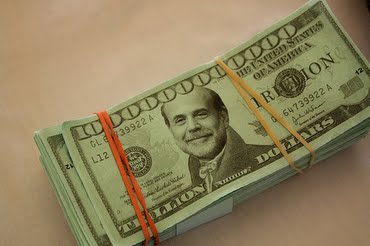 There’s a scenario that could play out between May and September in which commodities (including my beloved silver) and the stock and bond markets could all sell off between 20% and 40%. The trigger will be the cessation of QE II and a multi-month pause before QE III.
This is a reversal in my thinking from the outright inflationary ‘buy with both hands’ bent that I have held for the past two years. Even though it’s quite a speculative analysis at this early stage, it is a possibility that we must consider.
Important note: This is a short-term scenario that stems from my trading days, so if you are a long-term holder of a core position in gold and silver, as am I, nothing has changed in my extended outlook for these metals. The fiscal and monetary path we are on has a very high likelihood of failure over the coming decade, and I see nothing that shakes that view.
But over the next 3-6 months, I have a few specific concerns.
It’s time to build on the idea I planted in the Insider article entitled Blame the Victim (February 28, 2011) where I speculated on the idea that the Fed might be forced to end its Read more…
People Of Earth: Prepare For Economic Disaster
 It is not just the United States that is headed for an economic collapse. The truth is that the entire world is heading for a massive economic meltdown and the people of earth need to be warned about the coming economic disaster that is going to sweep the globe. The current world financial system is based on debt, and there are alarming signs that the gigantic global debt bubble is getting ready to burst. In addition, global prices for the key resources that the major economies of the planet depend on are rising very rapidly. Despite all of our advanced technology, the truth is that human civilization simply cannot function without oil and food. But now the price of oil and the price of food are both increasing dramatically. So how is the current global economy supposed to keep functioning properly if it soon costs much more to ship products between continents? How are the billions of people that are just barely surviving today supposed to feed themselves if the price of food goes up another 30 or 40 percent? For decades, most of the major economies around the globe have been able to Read more…
Need Versus Greed

NEW YORK – India’s great moral leader Mohandas Gandhi famously said that there is enough on Earth for everybody’s need, but not enough for everybody’s greed. Today, Gandhi’s insight is being put to the test as never before.
The world is hitting global limits in its use of resources. We are feeling the shocks each day in catastrophic floods, droughts, and storms – and in the resulting surge in prices in the marketplace. Our fate now depends on whether we cooperate or fall victim to self-defeating greed.
The limits to the global economy are new, resulting from the unprecedented size of the world’s population and the unprecedented spread of economic growth to nearly the entire world. There are now seven billion people on the planet, compared to just three billion a half-century ago. Today, average per capita income is $10,000, with the rich world averaging around $40,000 and the developing world around $4,000. That means that the world economy is now producing around $70 trillion in total annual output, compared to around $10 trillion in 1960.
China’s economy is growing at around 10% annually. India’s is growing at Read more…
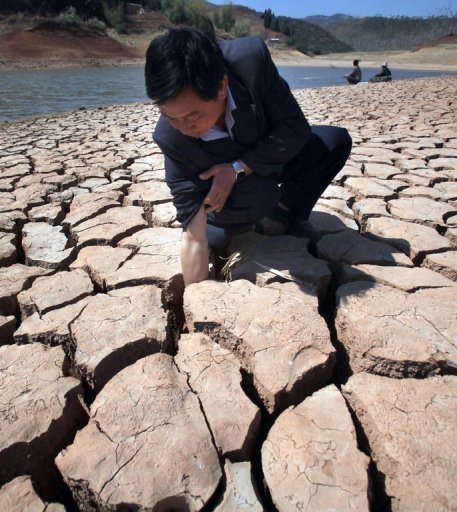
China’s droughts nears worst in 200 years, adding pressure to world food prices
The recent unrest in the Middle East, which has been attributed, in part, to high food prices, gives us a warning of the type of global unrest that might result in future years if the climate continues to warm as expected. A hotter climate means more severe droughts will occur. We can expect an increasing number of unprecedented heat waves and droughts like the 2010 Russian drought in coming decades. This will significantly increase the odds of a world food emergency far worse than the 2007 – 2008 global food crisis. When we also consider the world’s expanding population and the possibility that peak oil will make fertilizers and agriculture much more expensive, we have the potential for a perfect storm of events aligning in the near future, with droughts made significantly worse by climate change contributing to events that will cause disruption of the global economy, intense political turmoil, and war. Read more…


![[Most Recent Quotes from www.kitco.com]](https://i0.wp.com/www.kitconet.com/charts/metals/gold/t24_au_en_usoz_2.gif)
![[Most Recent Quotes from www.kitco.com]](https://i0.wp.com/www.kitconet.com/charts/metals/silver/t24_ag_en_usoz_2.gif)

 crisisboom
 CRISISBOOM
You must be logged in to post a comment.