Archive
Ozone hole linked to southern rain increases
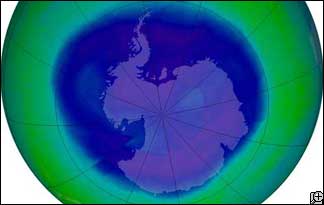 WASHINGTON — The hole in the ozone layer over Antarctica is a significant driver of climate change and rain increases in the southern hemisphere over the past 50 years, US scientists said Thursday.
The findings by a team at Columbia University’s School of Engineering and Applied Science are the first to link ozone depletion in the polar region to climate change all the way to the equator.
Researchers said the analysis should lead policy-makers to consider the ozone layer along with other environmental factors such as Arctic ice melt and greenhouse gas emissions when considering how to tackle climate change.
“It’s really amazing that the ozone hole, located so high up in the atmosphere over Antarctica, can have an impact all the way to the tropics and affect rainfall there,” said Sarah Kang, lead author of the study in the journal Science. Read more…
Disease hits wheat crops in Africa, Mideast
 PARIS — Aggressive new strains of wheat rust disease have decimated up to 40 percent of harvests in some regions of north Africa, the Middle East, Central Asia and the Caucasus, researchers said Wednesday.
The countries most affected are Syria and Uzbekistan, with Egypt, Yemen, Turkey, Iran, Morocco, Ethiopia and Kenya also hit hard, they reported at a scientific conference in Aleppo, Syria.
“These epidemics increase the price of food and pose a real threat to rural livelihoods and regional food security,” Mahmoud Solh, director general of the International Center for Agricultural Research in the Dry Areas (ICARDA), said in a statement.
In some nations hit by the blight, wheat accounts for 50 percent of calorie intake, and 20 percent of protein nutrition.
“Wheat is the cornerstone for food security in many of these countries,” said Hans Braun, director of the International Maize and Wheat Improvement Center (CIMMYT), near Mexico City, singling out Syria.
“Looking at the political and social situation, what they don’t need is a food crisis,” he told AFP by phone.
Wheat rust is a fungal disease that attacks the stems, grains and especially the Read more…
Fossil Sirenians Give Scientists New Look at Ancient Climate
 Geologist Mark Clementz samples tooth enamel from molars in the lower jaw of a Florida manatee.
April 21, 2011
What tales they tell of their former lives, these old bones of sirenians, relatives of today’s dugongs and manatees.
And now, geologists have found, they tell of the waters in which they swam.
While researching the evolutionary ecology of ancient sirenians–commonly known as sea cows–scientist Mark Clementz and colleagues unexpectedly stumbled across data that could change the view of climate during the Eocene Read more…
9/11 Responders To Be Warned They Will Be Screened By FBI’s Terrorism Watch List
 WASHINGTON — A provision in the new 9/11 health bill may be adding insult to injury for people who fell sick after their service in the aftermath of the 2001 Al Qaeda attacks, The Huffington Post has learned.
The tens of thousands of cops, firefighters, construction workers and others who survived the worst terrorist assault in U.S. history and risked their lives in its wake will soon be informed that their names must be run through the FBI’s terrorism watch list, according to a letter obtained by HuffPost.
Any of the responders who are not compared to the database of suspected terrorists would be barred from getting treatment for the numerous, worsening ailments that the James Zadroga 9/11 Health And Compensation Law was passed to address.
It’s a requirement that was tacked onto the law during the bitter debates over it last year.
The letter from Dr. John Howard, director of the National Institute for Occupational Safety and Health, informs Read more…
Minnesota to Test for Possible Driver’s Mileage Tax
Minnesota is looking for people to test technology that could one day be used to collect fees based on driving mileage.
“This research will provide important feedback from motorists about the effectiveness of using technology in a car or truck to gather mileage information,” said Cory Johnson, project manager for the Minnesota Department of Transportation in a statement on Monday.

A traffic aide directs vehicles along the 3rd Avenue bridge across the Mississippi River during rush hour in Minneapolis, Minnesota August 2, 2007.
“We are researching alternative financing methods today that could be used 10 or 20 years from now when the number of fuel efficient and hybrid cars increase and no longer produce enough revenue from a gas tax to build and repair roads,” he said.
The Department said if implemented, motorists would pay a fee based on miles driven, rather than how much gasoline the vehicle uses, which is now the case in the state.
The department is seeking 500 people for the Minnesota Road Fee Test, which is set to start in July. Volunteers should be from the counties of Hennepin or Wright. They will be given a small stipend for their time, along with smartphones with a GPS application to allow them to submit information. The research will end by December 2012.
Participants needed will be a mix of rural and metro area travelers.
‘Houston, we have a problem’: $500,000 of high-tech equipment goes missing at NASA in a year
They might be able to send men into outer space – but it seems NASA can’t stop losing cameras, televisions and computers at its offices on the ground.
The U.S. space agency lost almost $500,000 of high-tech equipment at Kennedy Space Center in Florida last year, including a Vidge digital recorder worth $100,391.
Other items lost since 2008 include 11 Motorola handheld radios worth $35,582, a $18,000 wave reflectometer that checks for breaks in wiring and a $3,379 golf cart.
 Lost property: Read more…
Pictures of China’s new submarines, tanks, stealth planes and railgun development

Here is a picture that compares the Chinese J20, the US F22 and the Russian T50 stealth fighter planes from the side and from the top

Terrifying scientific discovery: Strange emissions by sun are suddenly mutating matter…
The angry sun
This goes with another article that was posted 2 months ago.
 For months mounting fear has driven researchers to wring their hands over the approaching solar storms. Some have predicted devastating solar tsunamis that could wipe away our advanced technology, others voiced dire warnings that violent explosions on the surface of the sun could reach out to Earth, breach our magnetic field, and expose billions to high intensity X-rays and other deadly forms of cancer-causing radiation.
Now evidence has surfaced that something potentially more dangerous is happening deep within the hidden core of our life-giving star: never-before-seen particles—or some mysterious force—is being shot out from the sun and it’s hitting Earth.
Whatever it is, the evidence suggests it’s affecting all matter.
Strange and unknown
Alarmed physicists first became aware of this threat over the past several years. Initially dismissed as an anomaly, now frantic scientists are shooting e-mails back and forth to colleagues across the world attempting to grasp exactly Read more…
Nigeria rioting leaves charred bodies in streets, over 200 dead
 The mobs poured into the streets by the thousands in the dusty city of Kaduna, separating Nigeria’s Muslim north and Christian south, armed with machetes and poison-tipped arrows.
Muslim rioters burned homes, churches and police stations in Kaduna after results showed Nigeria’s Christian leader beat his closest Muslim opponent in Sunday’s vote.
Reprisal attacks by Christians began almost immediately, with one mob allegedly tearing a home apart to look for a Koran to prove the occupants were Muslims before setting the building ablaze.
The rioting in Kaduna and elsewhere across Nigeria’s north left charred bodies in the streets and showed the deep divisions in the African nation.
While curfews now stand in many areas, it remains unlikely the unrest will be soothed before the nation’s gubernatorial elections on Wednesday.
“Nigeria has spoiled … there is no peace,” said Rabiu Amadu, a 33-year-old technician in Kaduna. “I don’t think any of Read more…
Solar Storms Season Heating Up

Sunspots — cooler regions fraught with intense magnetic fields — now regularly dot the surface of the sun, and the star has unleashed several powerful flares in recent months, including a Feb. 14 blast that was the most powerful outburst in more than four years. All signs suggest that the sun has shaken itself out of its slumber, researchers say. After three years in a deep solar sleep of historic proportions, the sun is starting to wake up.
In 2008, the sun plunged into its least active state in nearly a century. Sunspots all but vanished, solar flares subsided and the star was eerily quiet. Quiet spells on the sun are nothing new. They come along every 11 years or so, as part of the sun’s natural activity cycle. But this latest solar minimum lasted longer than usual, prompting some researchers to wonder if it would ever end.
This year has started off with a bang, as sunspots are crackling with activity. Earth-orbiting satellites have detected Read more…


![[Most Recent Quotes from www.kitco.com]](https://i0.wp.com/www.kitconet.com/charts/metals/gold/t24_au_en_usoz_2.gif)
![[Most Recent Quotes from www.kitco.com]](https://i0.wp.com/www.kitconet.com/charts/metals/silver/t24_ag_en_usoz_2.gif)

 crisisboom
 CRISISBOOM
You must be logged in to post a comment.