Archive
FIRST X-CLASS FLARE OF THE NEW SOLAR CYCLE:
Sunspot 1158 has unleashed the strongest solar flare in more than four years. The eruption, which peaked at 0156 UT on Feb. 15th, registered X2 on the Richter scale of solar flares. NASA’s Solar Dynamics Observatory recorded an intense flash of extreme ultraviolet radiation, circled below:
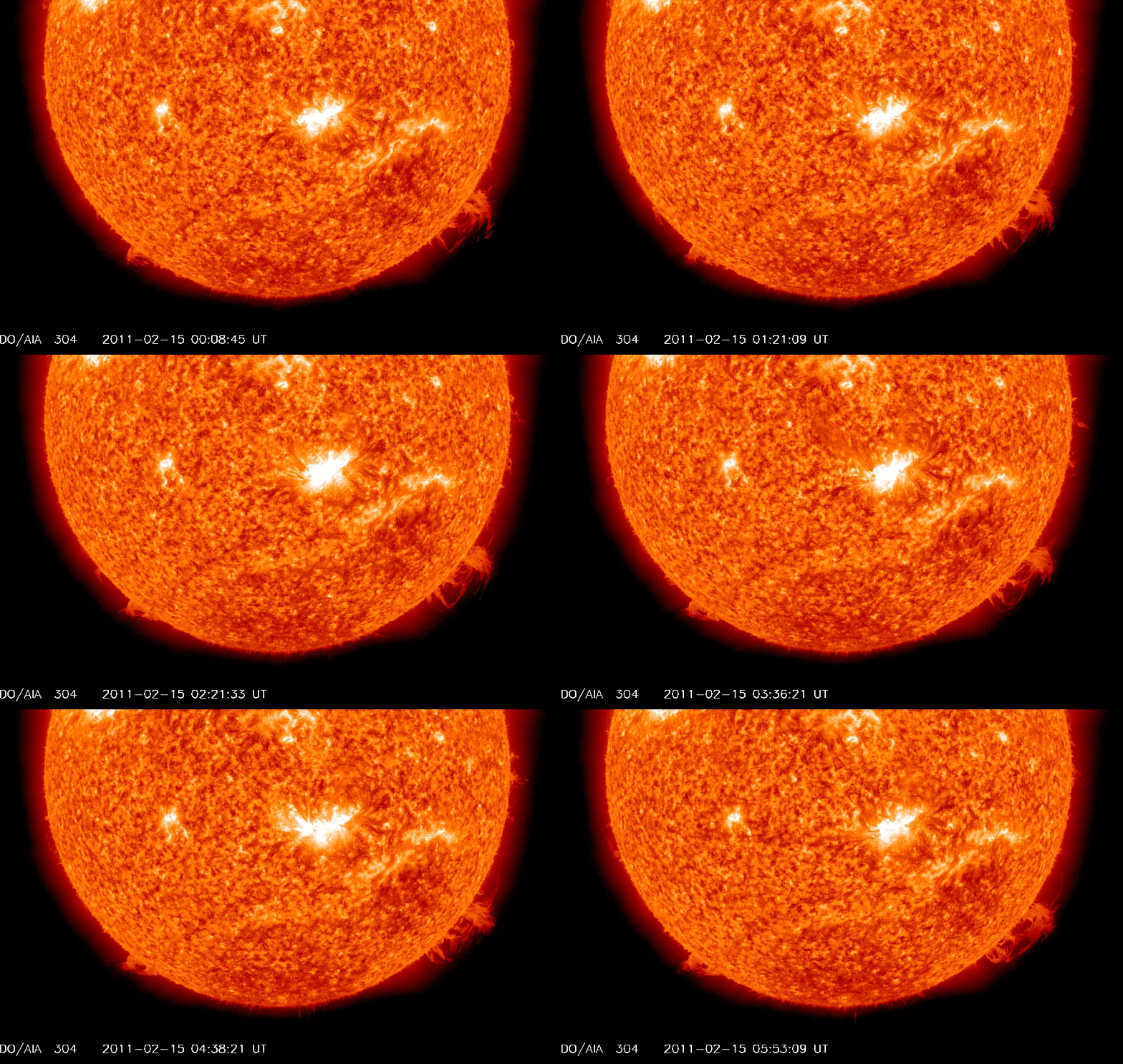
movie formats: 5 MB gif, 1.3 MB iPad, 0.6 MB iPhone
X-flares are the strongest type of solar flare, and this is the first such eruption of new Solar Cycle 24. In addition to flashing Earth with UV radiation, the explosion also hurled a coronal mass ejection (CME) in our direction. The expanding cloud may be seen in this movie from NASA’s STEREO-B spacecraft. Geomagnetic storms are possible when Read more…
Astronomers spot ‘planet’ in Oort Cloud, but are they mistaking Tyche for her sister?

If you grew up thinking there were nine planets and were shocked when Pluto was demoted five years ago, get ready for another surprise. There may be nine after all, and Jupiter may not be the largest.
The hunt is on for a gas giant up to four times the mass of Jupiter thought to be lurking in the outer Oort Cloud, the most remote region of the solar system. The orbit of Tyche, as it is provisionally called, would be 15,000 times farther from the Sun than the Earth’s, and 375 times farther than Pluto’s, which is why it hasn’t been seen so far.
But now scientists believe the proof of its existence has already been gathered by a NASA space telescope, Wise, and is just waiting to be analyzed.
The first tranche of data is to be released in April, and astrophysicists John Matese and Daniel Whitmire from the University of Louisiana at Lafayette think it will reveal Read more…
M CLASS Solar Flare Headed Toward Earth
Sunspot 1158 has just unleashed the strongest solar flare of the year, an M6.6-category blast @ 1738 UT on Feb. 13th and it is heading straight for Earth.
The eruption appears to have launched a coronal mass ejection (CME) toward Earth. It also produced a loud blast of radio emissions heard in shortwave receivers around the dayside of our planet. Amateur radio astronomer Thomas Ashcraft recorded these sounds. Stay tuned for updates!
Solar activity increased sharply over the weekend with the eruption of an M6.6-class solar flare from behemoth sunspot 1158. The blast produced a strong burst of radio waves heard in the loudspeakers of shortwave receivers around the dayside of our planet, and it appears to have hurled a faint coronal mass ejection toward Earth.
Sunspot 1158 is growing rapidly (48 hour movie) and crackling with M-class solar flares. The active region is now more than 100,000 km wide with at least a dozen Earth-sized dark cores scattered beneath its unstable magnetic canopy. Earth-directed eruptions are likely in the hours ahead.
The remains of old sunspot complex 1147-1149 are rotating over the eastern limb today. Although the region is in an advanced state of decay, it’s not dead yet. During the late hours of Feb. 11th, a plasma bullet came rocketing out of the region’s unstable core. Watch the movie–but don’t blink, because it’s fast.

Movie formats: 21 MB Quicktime, 1.3 MB mpeg, 0.5 MB iPad. Credit: SDO
Target Earth: Near Earth Asteroids Swarming the February Skies

Photo by Steve E. Farmer Jr.
February 12, another newly discovered hazardous asteroid (PHA) was announced. As most other NEO’s in the past, this one safely passed by Earth…this time.
Potentially Hazardous Asteroid 2011 CU46 was announced on February 12, 2011. This hazardous asteroid did not drift by Earth at only a few thousand miles as in the case of Near Earth Object 2011 CQ1; 2011 CU46 safely passed by at a distance of a little more than 316,000 miles – which is still considered a “near miss” in astronomical terms. PHA 2011 CU46 has a diameter of 20m – 50m; and this particular object would likely cause a massive fireball and surface damage if it were to impact Earth in a populated area.
Potentially Hazardous Asteroids & Near Earth Objects
As defined by NASA, A Potentially Hazardous Asteroid (PHA) is based on parameters that measure the asteroid’s potential to make threatening close approaches to the Earth. An asteroid which comes within an orbital intersection distance of 0.05 AU with Earths orbit and is of a diameter of 110m – 240m, is normally identified as a potentially hazardous object. Other factors are also included.
Since the February 4 announcement of NEO 2011 CQ1, over forty more Near Earth Objects have been discovered, identified, and catalogued.
Apophis Likely to Miss, What about PHA 2011 AG5?
PHA 2011 AG5 was discovered by Mt. Lemmon Survey on January 8, 2011. After more than one-hundred extra observations of this Potentially Hazardous Asteroid were collected by both amateur and professional astronomers, orbital elements were calculated and it was determined that 2011 AG5 could possibly impact Earth in the year 2052. More observations and research is needed to refine the orbit of this asteroid.


2011 AG5 is very similar to the famous asteroid Apophis which could possibly impact the Earth in the year 2036. Apophis is a little larger in diameter that 2011 AG5 and is expected to pass by Earth twice as close as 2011 AG5. Both of these minor planets are large enough to cause substantial damage to a major city on Earth if impact were to occur, but with any luck these minor planets will spare Earth and safely pass us by.
Preparing for Asteroid Impact
It’s only a matter of time before the announcement comes that Earth will obtain an impact from a minor planet large enough to cause wide-spread damage. It is this reason why more studies be performed on minor planets – to help further improve our understandings on these objects in hopes to give us a better defense option when that announcement comes. We have the technology to detect these hazardous objects and certain programs are working on methods to deflect or destroy asteroids. With any luck, they will design a fail-proof method to eliminate the potential risk from these objects impacting Earth.
Evidence of a False Solar Flare Cover Story for GPS system failure
 A solar flare cover story was used to explain worldwide GPS satellite system failure, Dec 2006. A GPS failure actually caused by a shift of the earth’s axis which misaligned the entire system…
NGDC (a division of NOAA) has stated that a solar flare of epic proportions occurred on Dec 5 & 6, 2006 and knocked down the world GPS satellite system as shown in this article on their website (Dec 5th 2006 at 10:18 UT X9 solar flare.)
Yet, neither the solar flare or the GPS failure were mentioned until April 2007 according to this April 4, 2007 news release by NOAA (GPS significantly impacted by powerful solar radio burst.)
It is virtually impossible to believe that not one of the space agencies, observatories, astronomers, astrophysicists, meteorologists or other scientists mentioned a word about this supposed “historic” solar flare for 4 months. It is inconceivable to believe that Read more…
Nibiru, What NASA Knows & You Don’t
Ancient Folklore most of the time can be traced back to some actual event. The folklore around Nibiru and planet X goes back thousands of years, and can even be seen in the symbolism of every day architecture provided to us via secret societies, mysticism and most religions around the world.

Commonly referred to as the Crossing Planet, Planet X, Nibiru, Winged Orb, Nemesis, Wormwood, The Death Star and the Destroyer. This mystical heavenly body very well may exist. Given the misinterpretation of planet X actually being a planet, is the first mistake, which has likely led to the lack of supporting scientific evidence of its existence. Only the misnomer of Planet X would allude to this planet actually being a planet. According to mystical and esoteric history, Planet X is not a planet at all but a Brown Dwarf star, that may have its own orbiting planets.
Infrared anomalies were found in the Sagittarius constellation, and Lloyd believes the ‘dark star’ lies in this direction. Irregularities in the Kuiper Belt (a region beyond Neptune), such as objects with odd inclined orbits, indicate that science is catching up with the idea of a Planet X, he pointed out. It’s possible, he added, that NASA already discovered such a celestial body years ago, and has deliberately kept its presence a secret.
When NASA tells you that there are no large planets in our solar system that have gone undetected, they are Read more…
Astronomy: “The Taurid Stream: A Cosmic Trail With Destruction In Its Wake”
by Nick Nuttall

According to astronomers such as Dr. Victor Clube, of Oxford University’s Department of Astrophysics, the coming and goings of the Taurid stream should be a source of concern to politicians, planners and anyone who cherishes life on Earth. A ”catastrophist”, Dr. Clube is one of many astronomers who are convinced that Read more…
Huge coronal hole on Sun turning towards Earth
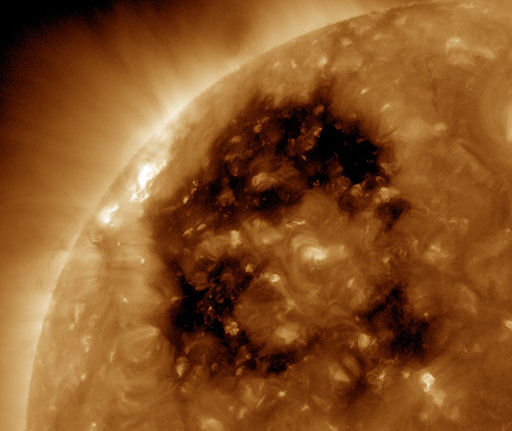
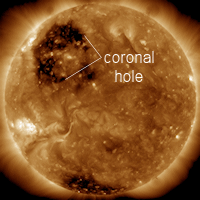
CORONAL HOLE: A dark croissant-shaped hole has opened up in the sun’s atmosphere, and it is spewing a stream of solar wind into space. NASA’s Solar Dynamics Observatory took this picture of the vast opening during the early hours of Jan. 30th. Researchers call this a “coronal hole.” Solar rotation is turning the coronal hole toward Earth. The stream of solar wind pouring from it will swing around and hit our planet in early February, possibly sparking polar magnetic storms. High-latitude sky watchers should be alert for auroras between Feb. 2nd and 4th. The coronal blast from the Sun storm’s arrival on Earth will coincide with a massive snow storm that will sweep across North America. –Space Weather
68 New Earths and 288 New Super Earths: The New Kepler exoplanet data – NASA videos and pictures
NASA press release on the 1202 new Kepler telescope exoplanets.
Exoplanets classified by size which are:
- 68 Earth-size exoplanets with a radius (Rp) of less than 1.25 Earth radius (Re)
- 288 super-Earth size exoplanets with 1.25 x Re < Rp ≤ 2.0 x Re - 662 Neptune-size exoplanets with 2.0 x Re < Rp ≤ 6.0 x Re - 165
Jupiter-size exoplanets with 6.0 x Re < Rp ≤ 15 x Re - 19
very-large-size with 15.0 x Re < Rp ≤ 22 x Re
“We went from zero to 68 Earth-sized planet candidates and zero to 54 candidates in the habitable zone – a region where liquid water could exist on a planet’s surface. Some candidates could even have moons with liquid water,” said William Borucki of NASA’s Ames Research Center, Moffett Field, Calif., and the Kepler Mission’s science principal investigator. “Five of the planetary candidates are both near Earth-size and orbit in the habitable zone of their parent stars.”
Kepler will continue conducting science operations until at least November 2012, searching for planets as small as Earth, including those that orbit stars in a warm habitable zone where liquid water could exist on the surface of the planet. Since transits of planets in the habitable zone of solar-like stars occur about once a year and require three transits for verification, it is expected to Read more…

NASA Issues 2012 Warning and Possible End of The World as we know it.
I had a POST on this about 2 weeks ago that goes in-depth on this issue. Hopefully it will become more mainstream now.

MORE EVIDENCE OF PHOTON BELT: Astrophysicist Alexia Demetriev says our solar system is entering an interstellar energy cloud
In light of recent news, the following information is paramount. On July 14, 2010 we learned that our sun is passing through an interstellar energy cloud which excites/energizes the sun. NASA, along with The National Academy of Science and other world renowned scientist are so concerned about this up and coming solar maximum in late 2012, that way back in March 10, 2006 NASA issued a solar storm warning (in writing) for 2012. What NASA omitted in their 2006 solar storm warning is what prompted NASA in the first place to issue a 2012 solar storm warning four years in advance? Then in 2010, NASA again warns the general population of a pending solar storm, telling the population to get ready for a once in a lifetime solar storm. Despite that news agencies and websites like this one are beginning to cover this developing story, no high government official has yet to stick his or her neck out to make an official announcement about the catastrophic implications as to allow the global population to begin preparing.
The following scientific data revealed by Alexei Dmitriev further supports NASA’s original 2012 solar storm warning issued back in March of 2006. Read more…


![[Most Recent Quotes from www.kitco.com]](https://i0.wp.com/www.kitconet.com/charts/metals/gold/t24_au_en_usoz_2.gif)
![[Most Recent Quotes from www.kitco.com]](https://i0.wp.com/www.kitconet.com/charts/metals/silver/t24_ag_en_usoz_2.gif)

 crisisboom
 CRISISBOOM


You must be logged in to post a comment.