Archive
Pilot program explores a ‘cashless society’
This is not good news as there are a lot more cons than pros in this debate

Aaron Rosenblatt, Rapid City Journal
Bernie Keeler, a mechanical engineering student at South Dakota School of Mines & Technology, demonstrates how to buy an item using biometric payment Tuesday at the Miner’s Shack snack bar. Nexus USA is piloting the Smart Pay system on the Mines campus.
School of Mines students and all of Rapid City could soon be at the cutting edge of a technology that developers say will eliminate the need for cash, IDs and maybe even car keys.
“We’re hoping that this is the future,” Al Maas, president of Nexus USA, said Tuesday at a news conference at Mines. “The applications for this are beyond your imagination.”
On Tuesday, mechanical engineering student Bernie Keeler showed just how easily the system works. After grabbing a Gatorade and a sandwich at the Miner’s Shack, he paid by swiping his index finger through Read more…
Scientist: East Coast Cities are ‘Sitting Ducks’ for Storms
Cities on the United States east coast are “sitting ducks” for the next big storm because of the destruction wrought by Hurricane Sandy, one of Barack Obama’s top scientists warned on Tuesday.
 Marcia McNutt, who last week announced her resignation as director of the U.S. Geological Survey, told a conference that Sandy had left coastal communities dangerously exposed to future storms of any size.
Hurricane Sandy churns off the U.S. east coast in the Atlantic Ocean.
Credit: NASA/Getty Images
“Superstorm Sandy was a threshold for the north-east and we have already crossed it,” McNutt told the National Council for Science and the Environment conference in Washington. “For the next storm, not even a super storm, even a run-of-the-mill nor’easter, the amount of breaches and the amount of coastal Read more…
WHY?
 Why does it seem like America is getting crazier with each passing year? It has become glaringly apparent that very deep corruption has taken root in our society from the lowest levels of society all the way up to the highest levels of society. In fact, some of the worst behavior of all is being exhibited by those that are supposed to be “examples” for our young people – politicians, bankers, lawyers, CEOs, etc. As we enter 2013, the American people are greedy, selfish, boastful, proud, arrogant, disrespectful, ungrateful, materialistic, unforgiving, without self-control and they are completely and totally addicted to entertainment. They believe that America will always be “the greatest nation on earth” just because of who we are, and they believe that the rest of the world should look up to us as a bright, shining example of everything that is good in the world. Meanwhile, we lead the world in a large number of negative categories and our society is decaying Read more…
Joe Biden says there is an agenda to get everyone microchipped and brain scanned
Scientists Expect A Massive Solar Event To Hit By Next Year
It was in January 1994 that two Canadian telecommunications satellites blanked out during a major sunburst while in geosynchronous orbit and communications were disrupted nationwide.

While recovery occurred after only a few hours on the first satellite, it took some six months and more than $70 million to recover the second satellite.
Then in January 2005, some 26 United Airlines flights had to be diverted during a space weather storm to non-polar routes – to avoid the prospect of high frequency radio blackouts.
Added were landings and takeoffs, flight time and other factors that elevated fuel consumption and costs. Each route change ended up costing more than $100,000.
Then in February 2011, there was a sun eruption experts described as the largest solar flare in four years. It caused interference in radio communications and global positioning system signals for aircraft traveling long-distances.
While it was a modest outburst, experts say it signaled the beginning of an upcoming Read more…
Widespread human tracking chips inevitable?
by Mark Lockie
 It may seem like an improbable scenario – and probably is – but new research has revealed growing social unease over electronic tracking technology that monitors workers’ activity, and which may evolve into implants placed directly under human skin.
Professors Nada and Andrew Kakabadse have examined developments in tracking technology already linked to company vehicles and mobile communication devices, alongside employee attitudes towards the prospect of ‘social tagging’ through Radio Frequency Identification (RFID) chips.
Nada Kakabadse commented: “In 2004, the US Food and Drug Administration approved an RFID implant called VeriChip, about the size of a grain of rice, for medical purposes. Nightclubs in Rotterdam and Barcelona already offer implants to customers for entry and payment purposes. Some claim the ‘Obamacare Health Act’ makes under-the-skin (subdermal) RFID implants mandatory for all US citizens.”
Perhaps irrationally (at least in Planet Biometrics’ point of view) study participants thought the Read more…
Statisticians Calculate Probability Of Another 9/11 Attack
According to the statistics, there is a 50 per cent chance of another catastrophic terrorist attack within the next ten years

Earthquakes are seemingly random events that are hard to predict with any reasonable accuracy. And yet geologists make very specific long term forecasts that can help to dramatically reduce the number of fatalities.
For example, the death toll from earthquakes in the developed world, in places such as Japan and New Zealand, would have been vastly greater were it not for strict building regulations enforced on the back of well-founded predictions that big earthquakes were likely in future.
The problem with earthquakes is that they follow a power law distribution–small earthquakes are common and large earthquakes very rare but the difference in their power is many orders of magnitude.
Humans have a hard time dealing intuitively with these kinds of statistics. But in the last few decades statisticians have learned Read more…
Minority Report: Fiction Has Become Reality
“The Internet is watching us now. If they want to. They can see what sites you visit. In the future, television will be watching us, and customizing itself to what it knows about us. The thrilling thing is, that will make us feel we’re part of the medium. The scary thing is, we’ll lose our right to privacy. An ad will appear in the air around us, talking directly to us.”—Steven Spielberg
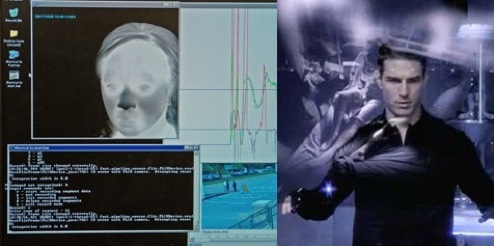 It was a mere ten years ago that Steven Spielberg’s action film Minority Report, based on a short story by Philip K. Dick, offered movie audiences a special effect-laden techno-vision of a futuristic world in which the government is all-seeing, all-knowing and all-powerful. And if you dare to step out of line, dark-clad police SWAT teams will bring you under control.
The year is 2054. The place is Washington, DC. Working in a city in which there has been no murder committed in six years—due in large part to his efforts combining widespread surveillance with behavior prediction technologies—John Anderton (played by Tom Cruise), Chief of the Department of Pre-Crime in Washington, DC, uses precognitive technology to capture would-be criminals before they can do any damage—that is, to prevent crimes before they happen. Unfortunately for Anderton, the technology, which proves to be fallible, identifies him as the next would-be criminal, and he flees. In the ensuing chase, Anderton finds himself not only attempting to prove his innocence but forced to take drastic measures in order to avoid capture in a surveillance state that uses biometric data and sophisticated computer networks to track its citizens.
Seemingly taking its cue from science fiction, technology has moved so Read more…
Is a cashless society inevitable?
 An RCMP officer holds Canada’s new $100 banknote, which is made from plastic polymer and is designed to last longer and thwart counterfeiters. (Fabiola Carletti/CBC) Sweden and several other countries are experimenting with cash-free transactions, a trend that is fuelling debate about the need for tangible currency.
Readers were quick to offer their two cents onFriday’s editorial about the idea, “The International movement for the end of cash” by CBC’s Brent Bambury.
The majority of commenters were resistant to the idea of a cashless society, citing everything from decreased privacy and higher-tech crime to corporate control and technological vulnerabilities.
- “Without strict laws, too, a cashless society will be one in which you have no fiscal privacy. Far from being more secure, intangible assets that Read more…


![[Most Recent Quotes from www.kitco.com]](https://i0.wp.com/www.kitconet.com/charts/metals/gold/t24_au_en_usoz_2.gif)
![[Most Recent Quotes from www.kitco.com]](https://i0.wp.com/www.kitconet.com/charts/metals/silver/t24_ag_en_usoz_2.gif)

 crisisboom
 CRISISBOOM
You must be logged in to post a comment.