Archive
NAM 12: Scientists see solar outburst in exquisite detail
The largest disturbances to the Earth’s geomagnetic environment occur when it is buffeted by solar material hurled in our direction by explosive changes in the Sun’s atmosphere. These Coronal Mass Ejections or CMEs contain approximately a billion tonnes of ionized gas or plasma and can have a dramatic and damaging impact on everything from satellites to power grids.

Now a team of scientists have used two spacecraft to study these events in unprecedented detail. Graduate student Anthony Williams of the University of Leicester will present their results on Tuesday 19 April at the Royal Astronomical Society’s National Astronomy Meeting in Llandudno, Wales.
Mr Williams and his team used the Heliospheric Imagers (HI) on the Solar TErrestrial RElations Observatory (STEREO) spacecraft to examine the internal structure of an Earth-impacting CME – seen as sunlight scattered from high density blobs of plasma – as it travels outwards from the Sun. They compared this with the internal structure measured in situ by the Read more…
Is this the age of megaquakes?
 Kyodo / Reuters
Buildings tossed together by the tsunami is seen in Miyagi Prefecture, northeastern Japan March 12, 2011. Scientists are asking if another megaquake will strike in the next six years.
By John Roach
First there was the earthquake and tsunami in Sumatra in 2004. Chile was shaken and lashed violently a year ago. Japan is still reeling from the twin disasters on March 11. It seems as if the Earth has woken from a long slumber and is violently re-jiggering its plates. Is there any truth to the notion?
The question of megaquake clustering, which I explored in the days following the 9.0 earthquake and tsunami in Japan, was a hot topic of conversation Thursday at the Seismological Society of America’s annual meeting in Memphis, Tenn., according to various media reports.
There, Charles Bufe, a seismologist retired from the U.S. Geological Survey in Denver, said the spate of recent megaquakes is very similar to a string of seven magnitude 8.5 or greater quakes that struck between 1950 and 1965. The intervening decades, he noted, were quiet.
Bufe and USGS colleague David Perkins analyzed the clustering and concluded that Read more…
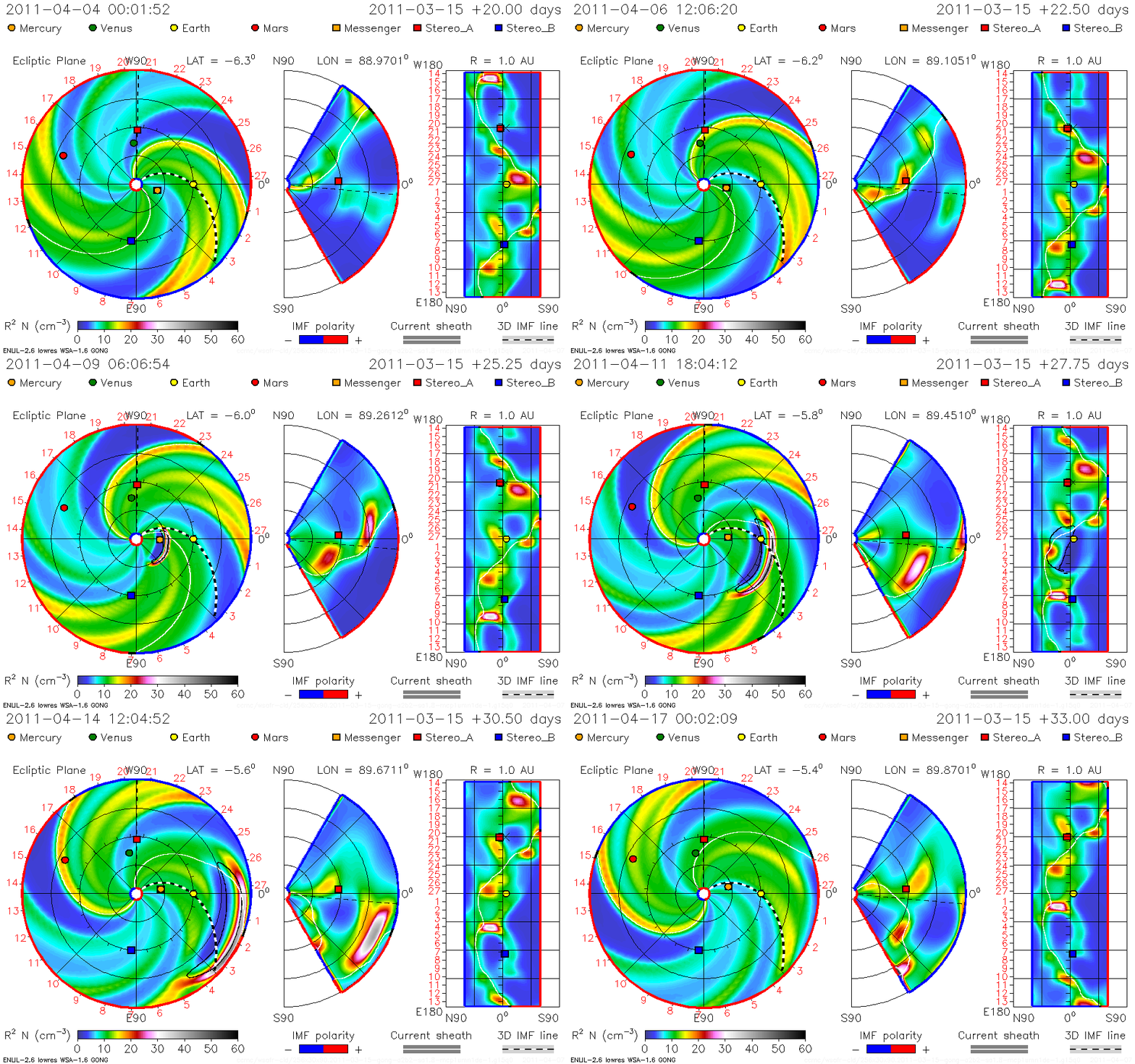
Strong geomagnetic storm slams Earth on Wednesday
 (TheWeatherSpace.com) — A solar storm is in progress right now with the highest Kp-index in a while being recorded.
The solar storm has a Kp-Index of 6, out of the 0-9 scale. This is higher than any previous solar storms, including the March event. What caused this without a flare?
“This solar storm is likely a flare caused storm,” TheWeatherSpace.com Senior Meteorologist Kevin Martin said. “It may not have been Earth directed but a blast from the sun a couple days ago hurled a lot of material into space. This material sometimes does not follow a straight line, but can curve with the influence of magnetic fields and gravity.”
Mid and High latitude observer should check out the skies and see if the northern and southern lights are around.
Martin is the scientist that thinks solar storms are triggers to earthquake activity. Will it cause a large quake? Time will tell but enjoy the skies for the next nine hours if it is clear, dark, and you are in a higher latitude.
Ozone layer damaged by unusually harsh winter

An image of total ozone column profile around the North Pole on March 30, 2011, developed by the Finnish Meteorological Institute using satellite and ground-based data, is seen in this handout, April 5, 2011. Satellite measurement of total ozone from OMI (Ozone Monitoring Instrument) shows a region of low ozone (blue region) above the Arctic regions. As of late March the ozone-poor region is shifted away from the pole and covers Greenland and Scandinavia. — WMO via Reuters
The stratospheric ozone layer, which shields the Earth from the Sun’s harmful ultraviolet rays, has been damaged to its greatest-ever extent over the Arctic this winter.
The protective layer of gas, which can be destroyed by reactions with industrial chemicals, has suffered a loss of about 40 per cent from the start of winter until late March, exceeding the previous seasonal loss of about 30 per cent, according to the World Meteorological Organisation (WMO).
The phenomenon is annual in the Antarctic, where after its discovery in the 1980s it came to be known as the “ozone hole“. Although CFC levels are now dropping, they remain in the atmosphere for so long that they will still be causing ozone depletion for decades in certain conditions, particularly the intense cold of the stratosphere.
Arctic ozone conditions vary more and the temperatures are always warmer than over Antarctica, where the ozone hole forms high in the stratosphere near the South Pole each winter and spring. Because of changing weather and temperatures, some Arctic winters experience almost no ozone loss – but others with exceptionally cold stratospheric conditions can occasionally lead to substantial ozone depletion.
This is what has happened over the Arctic this winter; for while at ground level the Arctic region was unusually warm, temperatures 15-20km above the Earth’s surface plummeted. WMO officials say the latest losses, which are unprecedented, were detected in Read more…
Scientists plan to drill all the way down to the Earth’s mantle

Credit: World Book illustration by Raymond Perlman and Steven Brayfield, Artisan-Chicago
(PhysOrg.com) — In what can only be described as a mammoth undertaking, scientists, led by British co-chiefs, Dr Damon Teagle of the National Oceanography Centre in Southampton, England and Dr Benoit Ildefonse from Montpellier University in France, have announced jointly in an article in Nature that they intend to drill a hole through the Earth’s crust and into the mantle; a feat never before accomplished, much less seriously attempted.
The Earth’s mantle is the part of the planet that lies between the crust and the iron ball at its center, and to reach it, would require drilling down from a position in the ocean, because the crust is much thinner there. Even still, it would mean drilling through five Read more…
Powerful sunspot emerges, extreme UV radiation detected
(TheWeatherSpace.com) — A sunspot is emerging around the southeastern limb of the Sun and it is a powerful one at that.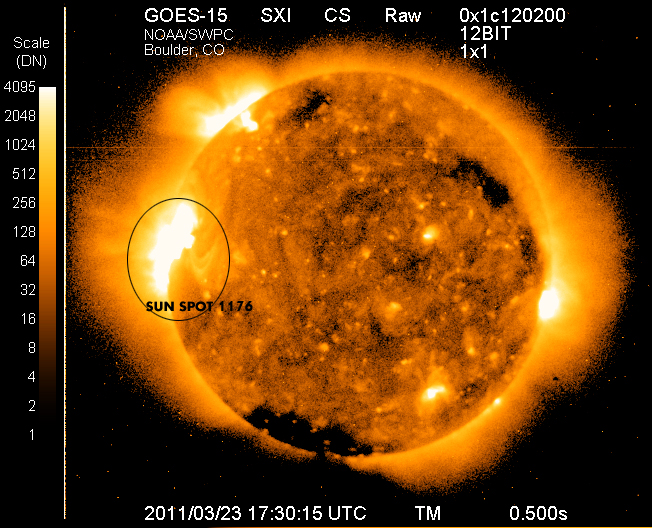
Labeled 1176, this sunspot may have been old sunspot 1165 when it was last seen in early March on the southwestern limb of the Sun.
Since then it has rotated to the far side of the Sun and it looks as if it was busy doing so. This sunspot will have the power to generate large solar flares for the next couple weeks as it crosses the Earth facing side of the Sun.
NASA’s Solar Dynamics Observatory has recorded very high levels of UV radiation from this sunspot, a clear signal to unsettled times ahead for it and the Earth should it blast a solar flare this way.
“If this puts a flare in this direction you can bet on more powerful earthquakes in the world,” TheWeatherSpace.com Senior Meteorologist Kevin Martin said. “We’ve been quiet and that is not a coincidence.”
House-Size Asteroid Zooms Close by Earth

This NASA graphic depicts the orbit (blue curve) of asteroid 2011 EB47, which will pass close by Earth within the orbit of the moon on March 16, 2011, one day after it was discovered. The asteroid poses no threat of impacting Earth.
An asteroid the size of a house zoomed by Earth Wednesday, flying within the orbit of the moon just one day after astronomers spotting the space rock in the sky, NASA says.
The small asteroid 2011 EB74 was about 47 feet across and posed no threat of hitting Earth, since it was too small to survive the trip through the planet’s atmosphere.
Instead, the asteroid passed our planet at a comfortable distance of about 203,000 miles when it made its closest approach at 5:49 p.m. EDT, NASA officials said.
For comparison, the average distance between the Earth and the moon is about Read more…
Earth’s Core Provides Climate Insights

Summary: By studying the molten core of the planet Earth, scientists have uncovered new evidence that humans play a dominant role in changing Earth's climate. The study could have important implicaitons in understanding the future of life on our planet.
The latest evidence of the dominant role humans play in changing Earth’s climate comes not from observations of Earth’s ocean, atmosphere or land surface, but from deep within its molten core.
Scientists have long known that the length of an Earth day – the time it takes for Earth to make one full rotation – fluctuates around a 24-hour average. Over the course of a year, the length of a day varies by about 1 millisecond, getting longer in the winter and shorter in the summer. These seasonal changes in Earth’s length of day are driven by exchanges of energy between the solid Earth and fluid motions of Earth’s atmosphere (blowing winds and changes in atmospheric pressure) and its ocean. Scientists can measure these small changes in Earth’s rotation using astronomical observations and very precise geodetic techniques.
But the length of an Earth day also fluctuates over much longer timescales, such as interannual (two to 10 years), decadal (approximately 10 years), or those lasting multiple decades or even longer. A dominant longer timescale mode that ranges from 65 to 80 years was observed to change the length of day by approximately 4 milliseconds at the beginning of the Read more…
Limited Nuclear War Could Deplete Ozone Layer, Increasing Radiation
By Chris Schneidmiller
 WASHINGTON — A nuclear conflict involving as few as 100 weapons could produce long-term damage to the ozone layer, enabling higher than “extreme” levels of ultraviolet radiation to reach the Earth’s surface, new research indicates (see GSN, March 16, 2010).
(Feb. 24) – A 1971 French nuclear test at Mururoa Atoll. The ozone layer could sustain lasting harm from a nuclear exchange involving as few as 100 weapons, allowing increased levels of ultraviolet radiation to reach the Earth’s surface, according to new research (Getty Images).
Increased levels of UV radiation from the sun could persist for years, possibly with a drastic impact on humans and the environment, even thousands of miles from the area of the nuclear conflict.
“A regional nuclear exchange of 100 15-kiloton weapons … would produce unprecedented low-ozone columns over populated areas in conjunction with the coldest surface temperatures experienced in the last 1,000 years, and would likely result in a global nuclear famine,” according to a presentation delivered on Friday at a major science conference in Washington.
Today, there are five recognized nuclear powers — China, France, Russia, the United Kingdom and the United States. India, Israel and Pakistan are all known or widely assumed to hold nuclear weapons, while North Korea has a Read more…


![[Most Recent Quotes from www.kitco.com]](https://i0.wp.com/www.kitconet.com/charts/metals/gold/t24_au_en_usoz_2.gif)
![[Most Recent Quotes from www.kitco.com]](https://i0.wp.com/www.kitconet.com/charts/metals/silver/t24_ag_en_usoz_2.gif)

 crisisboom
 CRISISBOOM
You must be logged in to post a comment.