Archive
Arctic climate change ‘to spark domino effect’
 The rate of Arctic climate change was now faster than ecosystems and traditional Arctic societies could adapt to.
WA-based scientists have warned of “dire consequences” to the human race after detecting the first signs of dangerous climate change in the Arctic.
The scientists, from the University of WA, claim the region is fast approaching a series of imminent “tipping points” which could trigger a domino effect of large-scale climate change across the entire planet.
In a paper published in the Royal Swedish Academy of Sciences’ journal AMBIO and Nature Climate Change, the lead author and director of UWA’s Oceans Institute, Winthrop Professor Carlos Duarte, said the Arctic region contained arguably the greatest concentration of Read more…
Nasa study solves case of Earth’s ‘missing energy’
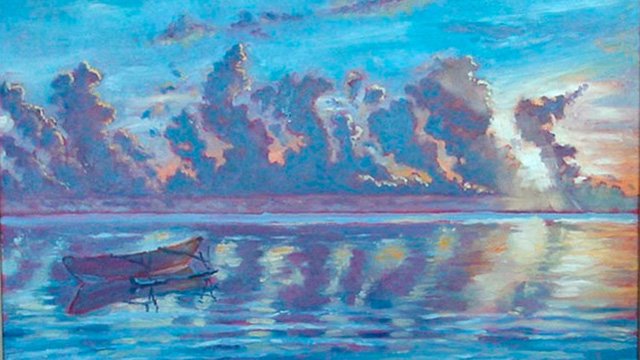
Clouds play a vital role in Earth's energy balance, cooling or warming Earth's surface depending on their type. This painting, "Cumulus Congestus," by JPL's Graeme Stephens, principal investigator of NASA's CloudSat mission, depicts cumulus clouds, which transport energy away from Earth's surface. Image credit: Graeme Stephens
(PhysOrg.com) — Two years ago, scientists at the National Center for Atmospheric Research in Boulder, Colo., released a study claiming that inconsistencies between satellite observations of Earth’s heat and measurements of ocean heating amounted to evidence of “missing energy” in the planet’s system.
Where was it going? Or, they wondered, was something wrong with the way researchers tracked energy as it was absorbed from the sun and emitted back into space?
An international team of atmospheric scientists and oceanographers, led by Norman Loeb of NASA’s Langley Research Center in Hampton, Va., and including Graeme Stephens of NASA’s Jet Propulsion Laboratory in Pasadena, Calif., set out to investigate the mystery.
They used 10 years of data — spanning 2001 to 2010 — from NASA Langley’s orbiting Clouds and the Earth’s Radiant Energy System Experiment (CERES) instruments to measure changes in the net radiation balance at the top of Earth’s atmosphere. The CERES data were then combined with estimates of the heat content of Earth’s ocean from three independent ocean-sensor sources.
Their analysis, summarized in a NASA-led study published Jan. 22 in the Read more…
Global warming: European species lag in habitat shift
 PARIS — Fast-track warming in Europe is making butterflies and birds fall behind in the move to cooler habitats and prompting a worrying turnover in alpine plant species, studies published Sunday said.
The papers, both published by the journal Nature Climate Change, are the biggest endeavour yet to pinpoint impacts on European biodiversity from accelerating global temperatures.
A team led by Vincent Devictor of France’s National Centre for Scientific Research (CNRS) found that from 1990 to 2008, average temperatures in Europe rose by one degree Celsius (1.8 degrees Fahrenheit).
This is extremely high, being around 25 percent greater than the global average for all of the last century.
In order to live at the same temperature, species would have to shift northward by 249 kilometres (155 miles), they calculated.
But during this period, butterlies moved only Read more…
Sinkhole epidemic spreads worldwide!
 All within the last several days, and all over the place.
Some may be associated with the Earthquakes, but most are not.
Allentown, Pennsylvania — [link to www.lehighvalleylive.com]
Kansas City, KS — [link to www.kansascity.com]
Cambridge, Neb — [link to www.mccookgazette.com]
Charlotte, NC — [link to www.wbtv.com]
Polk City, FL — [link to www.cfnews13.com]
Sleepy Hollow, NY — [link to www.thedailysleepyhollow.com]
El Paso, TX — [link to www.waterworld.com]
Kuala Lumpur, Malaysia — [link to www.nst.com.my]
Christchurch, New Zealand — [link to www.emirates247.com]
Earthquakes Skyrocket in 2011-2011

Click to Enlarge- Credit StanDeyo
Magma Causing Uplift in Oregon
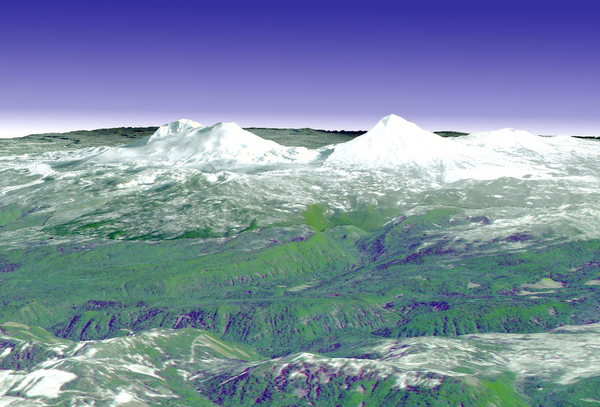
Caption: The Three Sisters area — which contains five volcanoes — is only about 170 miles (274 km) from Mount St. Helens, which erupted in 1980. Both are part of the Cascades Range, a line of 27 volcanoes stretching from British Columbia in Canada to northern California. This perspective view was created by draping a simulated natural color ASTER image over digital topography from the U.S. Geological Survey National Elevation Dataset. Credit: NASA/GSFC/MITI/ERSDAC/JAROS, and U.S./Japan ASTER Science Team
Volcanic activity is causing the earth to rise in Oregon, scientists have found.
Though whether such uplift is a sign of an imminent eruption remains uncertain.
As early as the summer of 1996, a 230-square-mile (600-square-kilometer) patch of ground in Oregon began to rise. The area lies just west of the South Sister Volcano, which with the North and Middle Sisters form the Three Sisters volcanoes, the most prominent peaks in the central Oregon stretch of the Cascade Mountains.
Although this region has not seen an eruption in at least 1,200 years, the scattered hints of volcanic activity here have been a cause of concern, leading to continuous satellite-based monitoring. Now 14 years of data is revealing just how the Earth is changing there and the likely cause of the uplift — a reservoir of magma invading the Read more…
‘Unprecedented’ ozone hole opens over Canadian Arctic

Euan Rocha / Reuters
A view of the tundra landscape in Nunavut, at the rim of the Arctic Circle.
A massive Arctic ozone hole opened up over the Northern Hemisphere for the first time this year, an international research team reported Sunday.
The hole covered two million square kilometres — about twice the size of Ontario — and allowed high levels of harmful ultraviolet radiation to hit large swaths of northern Canada, Europe and Russia this spring, the 29 scientists say.
The discovery of the “unprecedented” hole comes as the Canadian government is moving to cut its ozone monitoring network.
Environment Canada scientist David Tarasick, whose team played a key role in the Read more…
Russia: “4 Hectares of New Land Emerged, from the Shift of Tectonic Plates”
Apologies to Alexsandr, from whose Q to the Z’s on the 9/3 Q & A Chat I borrowed this. I feel this deserves a blog post. Land appearing virtually overnite from admitted plate activity. This is just more proof of Planet X’s influence, IMO.
Below a Google translation of a report, source of which, including video, here.
Amazing natural phenomenon has been documented in recent days. Huge beds of clay and stone rose by about 5 meters above the Sea of Azov in the Temryuk district of Krasnodar region, forming a peninsula.
Scientists suggest that the cause of the “new lands” have awakened mud volcanoes, and seismologists have Read more…
Greenland’s Petermann Glacier Melting at Alarming Rate
 Scientists say the disintegration of the Petermann Glacier — measuring 186 miles long and 3,280 feet high — may just be the tip of the iceberg concerning climate change’s impact in colder zones.
New photographs show the quick pace at which the massive ice sheet has shrunk over the past two years. Last year, a swath of ice measuring 77 square miles separated and a further piece twice the size of Manhattan could break off in the next year, according to Dr. Alun Hubbard of Aberystwth University, who has been monitoring the Greenland ice sheet for some years.
Oblique view of the Petermann glacier front on 24 July 2009.Related Articles
In 2009, scientists placed GPS masts on the glacier to track its movement, ahead of the major break off of ice that eventually occurred on August 3, 2010. Greenland’s glaciers have lost an Read more…
Giant Chunk of Greenland Ice Set to Break Away
 In 2010, the Manhattan-sized Petermann glacier iceberg enters the Nares Strait: Credit: European Space Agency.
An ice shelf is poised to break off from a Greenland glacier and float out to sea as an island twice the size of Manhattan, scientists say.
“I don’t know exactly when,” Jason Box, a climatologist with Ohio State Unversity’s Byrd Polar Research Center, told OurAmazingPlanet. “I wouldn’t be surprised if it happened today — or if it happened next summer.”
Just a year ago, in August 2010, the same glacier produced an even larger iceberg — a mass of ice four times the size of Manhattan, the largest in recorded Greenland history — yet researchers warn that the next spectacular break could have more-dire consequences.
Box said it’s not clear when the 62-square-mile (160 square kilometers) ice shelf, which is Read more…


![[Most Recent Quotes from www.kitco.com]](https://i0.wp.com/www.kitconet.com/charts/metals/gold/t24_au_en_usoz_2.gif)
![[Most Recent Quotes from www.kitco.com]](https://i0.wp.com/www.kitconet.com/charts/metals/silver/t24_ag_en_usoz_2.gif)

 crisisboom
 CRISISBOOM
You must be logged in to post a comment.