Archive
‘Dramatic’ solar flare could disrupt Earth communications
Handout photo released by NASA Earth Observatory on June 7, 2011 and taken from NASA’s Solar Dynamics Observatory (SDO), sunspot complex 1226-1227, shows the Sun unleashing an M-2 (medium-sized) solar flare.
WASHINGTON – An unusual solar flare observed by a NASA space observatory on Tuesday could cause some disruptions to satellite communications and power on Earth over the next day or so, officials said.
The potent blast from the Sun unleashed a firestorm of radiation on a level not witnessed since 2006, and will likely lead to moderate geomagnetic storm activity by Wednesday, according to the National Weather Service.
“This one was rather dramatic,” said Bill Murtagh, program coordinator at the NWS’s Space Weather Prediction Center, describing the M-2 (medium-sized) solar flare that peaked at 1:41 a.m. Eastern time in North America, or 0541 GMT.
“We saw the initial flare occurring and Read more…
Solar flaring warning issued

A solar wind stream flowing from the indicated coronal hole could reach Earth on or about June 4th. . Credit: SDO/AIA.
Cape Town – The Space Weather Centre has warned that the sun is undergoing some instability, which has implications for electronic communications.
“There is a very active area on the sun as rotated onto the invisible solar disc. This active area has got the potential for more flaring for the next five to six days,” space weather forecaster Kobus Olckers of the Space Weather Warning Centre at the Hermanus Magnetic Observatory told News24.
He said that communications and electronic systems might be affected.
“The internet could be a little slower for the next week or so and especially long distance communications.”
Polar routes
Scientists recognize three major Read more…
Solar Max Is Coming !
Solar storms may wreak havoc on Earth in 2013: Scientists
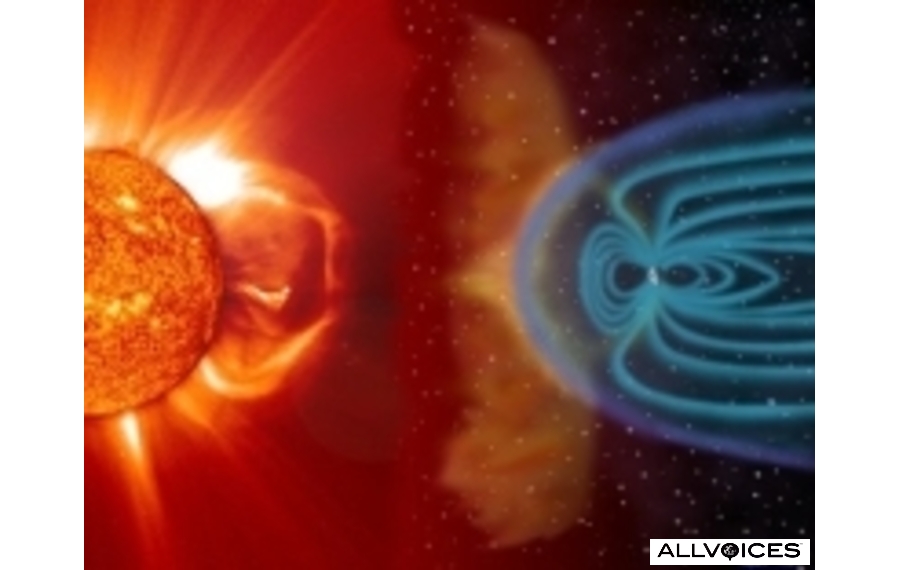 The intensity of solar storms is expected to peak in 2013 and may devastate critical infrastructure like satellite communications, navigation systems and electrical transmission equipment, a top scientist has warned. Kathryn Sullivan, assistant secretary of the US National Oceanic and Atmospheric Administration, said countries should prepare for “potentially devastating effects” from solar storms which are caused by massive explosions on the sun.
Solar storms, according to scientists, release particles that can temporarily disable or permanently destroy fragile computer circuits, the Daily Mail reported.
Dr Sullivan, a former NASA astronaut who in 1984 became the first woman to walk in space, told a UN weather conference in Geneva that “it is not a question of if, but really a matter of when a major solar event could hit our planet”. She is not the only expert to issue a warning about the threat posed by solar storms. In February, astronomers warned that mankind is now more vulnerable to such an event than at any time in history — and that the planet should prepare for a global Hurricane Katrina-style disaster.
A massive solar eruption, they said, would send waves of radiation and charged particles to Earth, damaging satellite systems used for synchronising computers, airline navigation and phone networks. If the storm is powerful enough it could even crash stock markets and cause power cuts that last weeks or months, experts told the American Association for the Advancement of Science.
The chances of a disruption from space are getting stronger because the sun is entering the most active period of its 11 to 12-year natural cycle. The world got a taster of the sun’s explosive power in February when the strongest solar eruption in five years sent a torrent of charged plasma hurtling towards the world at 580 miles per second. The storm created spectacular aurorae and disrupted radio communications.
Space storms are not new. The first major solar flare was recorded by British astronomer Richard Carrington in 1859. Other solar geomagnetic storms have been observed in recent decades. According to NASA, one huge solar flare in 1972 cut off long-distance telephone communication in the mid-western state of Illinois. Another similar flare in 1989 ‘provoked geomagnetic storms that disrupted electric power transmission’ and caused blackouts across the Canadian province of Quebec, the US space agency said.
Comet CRASHES into SUN causes Solar Flare May 11th 2011 SOHO Live FEED Capture
Explosive Solar Eruption May 10th
NASA issues warning of solar superstorm 2012: One billion could die
 Could a superstorm generated by the sun destroy civilization as we know it in 2012?
No less than NASA thinks it’s a distinct possibility. In a remarkable move the normally conservative US space agency has taken the extraordinary step of warning the world.
The headlines reverberating around the world speak volumes: ‘Leaks discovered in Earth’s magnetic field,’ Solar storms to wreak havoc,’ ‘The end of life as we know it,’ ‘Magnetic shift to cause global superstorms.’
NASA and the European Space Agency say yes.
2012 and the rising specter of doom
Among all the countries with exposure to the solar devastation, the United States is the most susceptible. Read more…
Terrifying scientific discovery: Strange emissions by sun are suddenly mutating matter…
The angry sun
This goes with another article that was posted 2 months ago.
 For months mounting fear has driven researchers to wring their hands over the approaching solar storms. Some have predicted devastating solar tsunamis that could wipe away our advanced technology, others voiced dire warnings that violent explosions on the surface of the sun could reach out to Earth, breach our magnetic field, and expose billions to high intensity X-rays and other deadly forms of cancer-causing radiation.
Now evidence has surfaced that something potentially more dangerous is happening deep within the hidden core of our life-giving star: never-before-seen particles—or some mysterious force—is being shot out from the sun and it’s hitting Earth.
Whatever it is, the evidence suggests it’s affecting all matter.
Strange and unknown
Alarmed physicists first became aware of this threat over the past several years. Initially dismissed as an anomaly, now frantic scientists are shooting e-mails back and forth to colleagues across the world attempting to grasp exactly Read more…
Solar Storms Season Heating Up

Sunspots — cooler regions fraught with intense magnetic fields — now regularly dot the surface of the sun, and the star has unleashed several powerful flares in recent months, including a Feb. 14 blast that was the most powerful outburst in more than four years. All signs suggest that the sun has shaken itself out of its slumber, researchers say. After three years in a deep solar sleep of historic proportions, the sun is starting to wake up.
In 2008, the sun plunged into its least active state in nearly a century. Sunspots all but vanished, solar flares subsided and the star was eerily quiet. Quiet spells on the sun are nothing new. They come along every 11 years or so, as part of the sun’s natural activity cycle. But this latest solar minimum lasted longer than usual, prompting some researchers to wonder if it would ever end.
This year has started off with a bang, as sunspots are crackling with activity. Earth-orbiting satellites have detected Read more…


![[Most Recent Quotes from www.kitco.com]](https://i0.wp.com/www.kitconet.com/charts/metals/gold/t24_au_en_usoz_2.gif)
![[Most Recent Quotes from www.kitco.com]](https://i0.wp.com/www.kitconet.com/charts/metals/silver/t24_ag_en_usoz_2.gif)

 crisisboom
 CRISISBOOM
You must be logged in to post a comment.