DARPA “Emergency Response” Robot Runs Faster Than Usain Bolt
Machines to be used for “defense missions”
Paul Joseph Watson
Prison Planet.com
Thursday, September 6, 2012
One of the robots under development by DARPA for the purpose of “emergency response” and humanitarian missions has beaten the human world speed record set in 2009 by athlete Usain Bolt.
“The Defense Advanced Research Project’s (DARPA) Cheetah managed to reach 28.3 mph, said the agency on Sept. 5. The speed is a little faster than the fastest human, Usain Bolt, who set the human world speed record when he reached a peak speed of 27.78 mph in 2009 during a100 meter sprint. The Cheetah robot had already attained the record as the fastest robot on earth when it clocked in 18 Mph earlier in its development,” reports Government Security News.
Cheetah’s advantage versus other robots when it comes to emergency response, humanitarian missions and “other defense missions,” is that it legs enable it to Read more…
Statisticians Calculate Probability Of Another 9/11 Attack
According to the statistics, there is a 50 per cent chance of another catastrophic terrorist attack within the next ten years

Earthquakes are seemingly random events that are hard to predict with any reasonable accuracy. And yet geologists make very specific long term forecasts that can help to dramatically reduce the number of fatalities.
For example, the death toll from earthquakes in the developed world, in places such as Japan and New Zealand, would have been vastly greater were it not for strict building regulations enforced on the back of well-founded predictions that big earthquakes were likely in future.
The problem with earthquakes is that they follow a power law distribution–small earthquakes are common and large earthquakes very rare but the difference in their power is many orders of magnitude.
Humans have a hard time dealing intuitively with these kinds of statistics. But in the last few decades statisticians have learned Read more…
Seven corporations lobbying against GMO labeling

On Nov. 6 of this year, California voters will have the opportunity to vote on Proposition 37, which would mandate the labeling of genetically-engineered foods. However, mega-corporations such as Monsanto, joined in the fight by several additional key players, are passionately battling this bid for transparency.
Those additional key players include familiar names such as:
1. Naked Juice — owned by PepsiCo — which has donated $1.7 million to Monsanto’s efforts
PepsiCo sodas rely heavily on an ingredient known as high-fructose corn syrup (HFCS), and considering the bulk of corn used in this process is GMO, PepsiCo’s interest in maintaining the status quo makes perfect sense (just imagine the blow to profits PepsiCo would suffer if every can of Pepsi came labeled with a GMO warning).
2. Honest Tea, Odwalla, and Simply Orange — owned by Coca-Cola — donated another million dollars
3. Alexia and Lightlife — owned by ConAgra — donated more than $1 million
4. Kashi, Gardenburger, and Morningstar Farms — owned by Kellogg — donated more than $600,000
When the Cornucopia Institute tested Kashi’s “Go Lean” cereal, they found that the added soy was 100 percent genetically Read more…
Drought Hits U.S. Midwest Hard
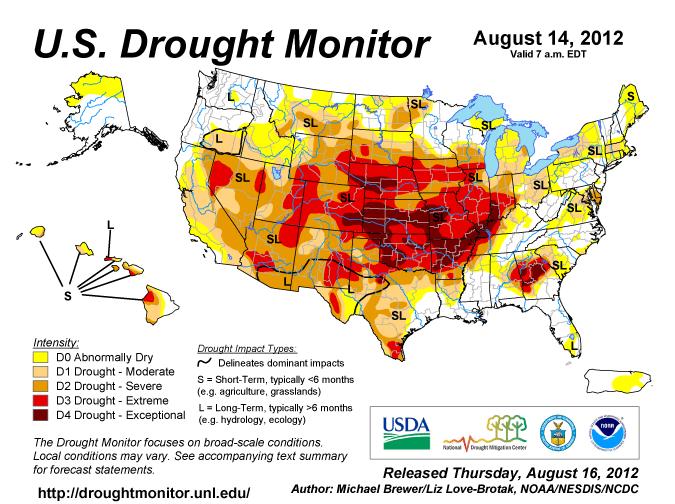 This summer, the United States experienced one of the worst droughts in history since the dustbowl. Farms went weeks on end without a drop of rain, particularly in the Midwest and, combined with high temperatures, resulted in a significant drop in harvest-ready plants. The drought affected numerous parts of the nation’s industrial sector as well as countries outside of the U.S. The United States has ample agriculture, if one part of the U.S. is experiencing drought and crop loss problems, then the whole food industry suffers as a result. While droughts are not uncommon, this summer the drought conditions were felt all over the United States, leaving almost all farms affected. As the image shows, the majority of the United States experienced at least an abnormal dryness level. The Midwest and Southwestern parts of the United States were particularly hard-hit, experiencing severe to exceptional drought conditions.
The drought conditions were persistent and occurred during the maturing and harvesting periods of the country’s most important crops- corn. The USDA estimated the drought damaged crops enough to lower corn production to by 13 percent when compared to 2011 crop numbers. Corn and its by-products, is used for wheat in food, fertilizer, ethanol, beverages, animal feed and biodegradable plastics. Director of the Agricultural Entrepreneurship Initiative at the University of Iowa and Agricultural Economist Kevin Kimle explained that “corn matures by about Labor Day, but what happens in dry conditions is it Read more…
Cutting Down Rainforests Also Cuts Down on Rainfall
As the Amazon rainforest disappears, rainfall falters over a much wider area
By Lauren Morello and ClimateWire
 RAIN MAKER: Cutting down trees in the Amazon rainforest also reduces rainfall over the region. Image: flickr/Threat to Democracy
When Amazon rainforest disappears, so does Amazon rain.
That’s the conclusion of new research that shows deforestation can significantly reduce tropical rainfall far from the area where trees have been cut down.
That’s because air passing over forests picks up moisture given off by trees and plants, fueling rains. When those trees disappear, so does some of that rain.
“What we found was this really strong impact — air that traveled over a lot of forest brought a lot more rain than air that didn’t travel over very much forest,” said lead author Dominick Spracklen of the University of Leeds.
His research, published yesterday in the journal Nature, helps reconcile a situation that has puzzled scientists.
Climate models project that Amazon deforestation would reduce rainfall regionally. But limited observations show that rainfall in deforested areas is higher than in areas where the rainforest is still intact.
(Scientists believe that when trees are cut down, the bare surfaces left behind absorb more Read more…
Mt Fuji ‘under more pressure than last eruption’
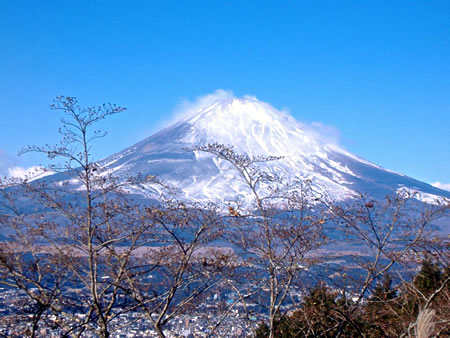 Pressure in the magma chamber of Japan’s Mount Fuji is now higher than it was the last time the volcano erupted more than 300 years ago, scientists say, according to a report Thursday.
Tectonic shifts triggered by last year’s huge 9.0 magnitude undersea quake have left the chamber under 16 times the minimum pressure at which an eruption can occur, researchers said.
Researchers at the National Research Institute for Earth Science and Disaster Prevention studied the tectonic movements caused by the tsunami-triggering quake on March 11, 2011 and a magnitude 6.4 quake that rocked central Japan four days later, Kyodo News reported.
They estimated that 1.6 megapascals of pressure, equivalent to atmospheric pressure of some 15.8 kilograms per square centimetre (226 pounds per square inch), was being exerted on the magma chamber.
Volcanic eruptions can be triggered by as little as 0.1 megapascals of pressure, and the reading of 1.6 megapascals is “not a small figure”, said senior researcher Eisuke Fujita, according to Kyodo.
Mount Fuji, an almost perfectly cone-shaped mountain that stands as one of Japan’s national symbols, last erupted in 1707, after an earthquake struck and Read more…
Disintegrating Alien Planet Has Comet-Like Tail
 A potential alien planet that is so close to its parent star that it appears to be disintegrating from the scorching heat was recently found by a team of astronomers. The planetary candidate is only slightly larger than the planet Mercury, and researchers estimate that it is shedding so much material that it could completely disintegrate within 100 million years.
Astronomers at NASA and the Massachusetts Institute of Technology (MIT) detected the tiny planet, which is located roughly 1,500 light-years away, using data from the planet-hunting Kepler mission. As the possible planet evaporates, researchers theorize that it is followed by a trail of dust and debris, similar to the tail of a comet.
The dusty planet circles its host star once every 15 hours, which indicates that the star, named KIC 12557548, likely heats the planet to blistering temperatures of about 3,600 degrees Fahrenheit (1,982 degrees Celsius). The researchers hypothesize that under these conditions, the Read more…
Climate change causing increase in extreme weather in South Pacific
An international study led by CSIRO oceanographer Dr Wenju Cai has identified that global warming is causing shifts in the rain band of the South Pacific Convergence Zone causing an increase in extreme weather across the island nation states of the South Pacific. The result of the movement causes drought and higher prevalence of forest fire in some areas while other islands experience extreme floods and increased frequency of tropical cyclones.

The South Pacific Convergence Zone is the important rainband that stretches from the equatorial western Pacific southeastward toward French Polynesia. When the rainband moves northward, extreme climate events are induced. “Here we show that greenhouse warming Read more…
Minority Report: Fiction Has Become Reality
“The Internet is watching us now. If they want to. They can see what sites you visit. In the future, television will be watching us, and customizing itself to what it knows about us. The thrilling thing is, that will make us feel we’re part of the medium. The scary thing is, we’ll lose our right to privacy. An ad will appear in the air around us, talking directly to us.”—Steven Spielberg
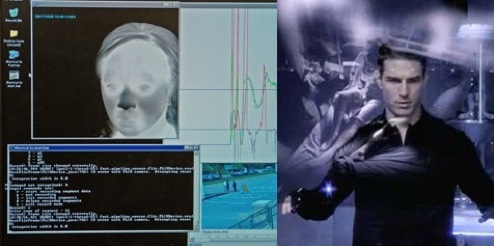 It was a mere ten years ago that Steven Spielberg’s action film Minority Report, based on a short story by Philip K. Dick, offered movie audiences a special effect-laden techno-vision of a futuristic world in which the government is all-seeing, all-knowing and all-powerful. And if you dare to step out of line, dark-clad police SWAT teams will bring you under control.
The year is 2054. The place is Washington, DC. Working in a city in which there has been no murder committed in six years—due in large part to his efforts combining widespread surveillance with behavior prediction technologies—John Anderton (played by Tom Cruise), Chief of the Department of Pre-Crime in Washington, DC, uses precognitive technology to capture would-be criminals before they can do any damage—that is, to prevent crimes before they happen. Unfortunately for Anderton, the technology, which proves to be fallible, identifies him as the next would-be criminal, and he flees. In the ensuing chase, Anderton finds himself not only attempting to prove his innocence but forced to take drastic measures in order to avoid capture in a surveillance state that uses biometric data and sophisticated computer networks to track its citizens.
Seemingly taking its cue from science fiction, technology has moved so Read more…
Op-Ed: Should schools monitor students with ‘spychips’ in student IDs?
 Schools have been tracking student attendance for some time, but the methods of how students are tracked has significantly evolved over the decades. Currently, using “spychips” in schools appears to be an issue that keeps emerging its controversial head.
Technology is available as an easy solution, but is this really the direction society wants to go?
Schools look to “spychips” for student ID cards
The issue of using RFID technology to track students has emerged many times over the past several years. Recently, Digital Journal reported a story where parents and students protestedin San Antonio, Texas after the Northside ISD school district decided to test pilot RFID student ID cards in two of its schools.
The student tracking ID card issue in Read more…


![[Most Recent Quotes from www.kitco.com]](https://i0.wp.com/www.kitconet.com/charts/metals/gold/t24_au_en_usoz_2.gif)
![[Most Recent Quotes from www.kitco.com]](https://i0.wp.com/www.kitconet.com/charts/metals/silver/t24_ag_en_usoz_2.gif)

 crisisboom
 CRISISBOOM
You must be logged in to post a comment.