Archive
Tectonic plates rattle- more turbulence at the South Pole

June 21, 2011 – ANTARCTICA – A 5.5 magnitude earthquake struck the South Sandwich Islands region, situated around 750km south east of South Georgia, in the South Atlantic early Sunday. It was the latest in a series of quakes to hit the Antarctic Region during the past 24 hours. The moderate quake struck at 9.37am GMT at a depth of 137km and was centered 69 km (42 miles) NNW of Visokoi Island and 330 km (205 miles) NNW of Bristol Island. The last significant earthquake to be recorded in the South Sandwich Islands region occurred on Read more…
World’s Oceans In ‘Shocking’ Decline
 The oceans are in a worse state than previously suspected, according to an expert panel of scientists.
In a new report, they warn that ocean life is “at high risk of entering a phase of extinction of marine species unprecedented in human history”.
They conclude that issues such as over-fishing, pollution and climate change are acting together in ways that have not previously been recognised.
The impacts, they say, are already affecting humanity.
The panel was convened by the International Programme on the State of the Ocean (IPSO), and brought together experts from different disciplines, including coral reef ecologists, toxicologists, and fisheries scientists.
Its report will be formally released later this week.
“The findings are shocking,” said Alex Rogers, IPSO’s scientific director and professor of conservation biology at Oxford University.
“As we considered the cumulative effect of what humankind does to the oceans, the implications became far worse than we had individually realised.
“We’ve sat in one forum and spoken to Read more…
Antarctica Mysteries
By J. P. Skipper
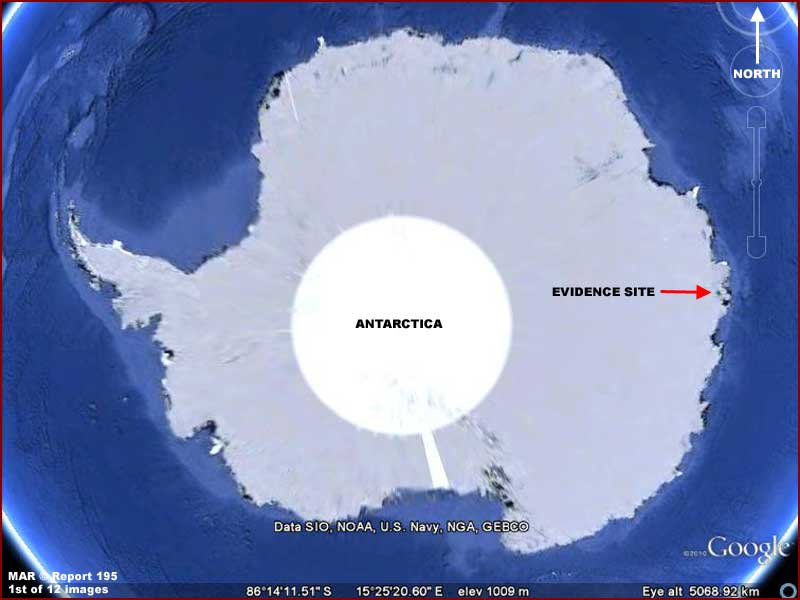 For any who wish to track behind me, the above 1st image is included here to help locate the evidence site on the coastal area of Antarctica at the Southern Sea but inland from the coast. When zooming in on this site in Google Earth, one will encounter a narrow pale blue strip at this location within which the evidence reported on here resides. That pale blue strip is a corridor of high resolution surrounded by an extensive sea of smudge obfuscation and that narrow higher resolution strip is the sole reason why we Read more…
Beneath The Ice of East Antarctica: Dramatic Discoveries Mapped by Radar
nanopatentsandinnovations.blogspot
Scientists from the U.S., U.K. and Australia have used ice-penetrating radar to create the first high- resolution topographic map of one of the last uncharted regions of Earth, the Aurora Subglacial Basin, an immense ice-buried lowland in East Antarctica larger than Texas.
This new topographic map of a portion of the East Antarctic Ice Sheet revealed several giant fjords carved by the advancing and reatreating ice sheet between 34 and 14 million years ago.

Credit: University of Texas
The map reveals some of the largest fjords or ice cut channels on Earth, Read more…
Walking on thin ice
 Antarctica
Icebergs break away as the melting Antarctica landscape yields to glabal warming. Photo: Angela Wylie
Every now and then the magnificent, mute marble coast of Antarctica will suddenly find a voice and let out a shattering exclamation – like a gunshot. The noise travels far and wide, thundering uninterrupted across crystal space until sheer distance exhausts it.
It is the sound of an ice cliff collapsing into the ocean. Or maybe of a new iceberg cleaving itself away from the continent and setting sail. It is part of the natural soundtrack of planet history, though it is only rarely, and recently – in geological timescales – heard by humans.
In little remote scientific communities like the Australian Antarctic Division’s Casey Station, on the East Antarctic coast, a roar from the ice might briefly interrupt the labour or conversation of the scientists and tradesfolk who are resident there, working on some aspect of deciphering the climate story. For those lucky enough to be among them, to hear it, it sends a shiver of humility through your bones. You are, after all, at the mercy of this grumbling giant. The cryosphere Read more…
Mystery of cosmic ray source bombarding the southern pole of Earth intensifies
 May 6, 2011 – ANTARCTICA – Cosmic rays crashing into the Earth over the South Pole appear to be coming from particular locations, rather than being distributed uniformly across the sky. Similar cosmic ray “hotspots” have been seen in the northern skies too, yet we know of no source close enough to produce this pattern. “We don’t know where they are coming from,” says Stefan Westerhoff of the University of Wisconsin-Madison. It’s a mystery because the hotspots must be produced within about 0.03 light years of Earth. Further out, galactic magnetic fields should deflect the particles so much that the hotspots would be smeared out across the sky. But no such sources are known to exist. One of the hotspots seen by IceCube points in the direction of the Vela supernova remnant, a possible source of cosmic rays, but it’s almost 1000 light years away. Cosmic rays coming from such large distances should be constantly buffeted and deflected by galactic magnetic fields on route, and should thus have lost all directionality by the time they reach Earth. In other words, such long-distance cosmic rays should appear to come from all parts of the sky. That’s not what has been observed. (Source article below) Read more…
Ozone hole linked to southern rain increases
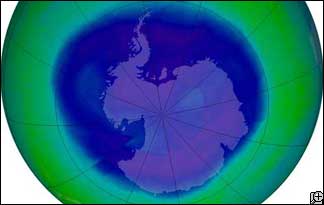 WASHINGTON — The hole in the ozone layer over Antarctica is a significant driver of climate change and rain increases in the southern hemisphere over the past 50 years, US scientists said Thursday.
The findings by a team at Columbia University’s School of Engineering and Applied Science are the first to link ozone depletion in the polar region to climate change all the way to the equator.
Researchers said the analysis should lead policy-makers to consider the ozone layer along with other environmental factors such as Arctic ice melt and greenhouse gas emissions when considering how to tackle climate change.
“It’s really amazing that the ozone hole, located so high up in the atmosphere over Antarctica, can have an impact all the way to the tropics and affect rainfall there,” said Sarah Kang, lead author of the study in the journal Science. Read more…
New Mineral (Wassonite)Found in Antarctic Meteorite
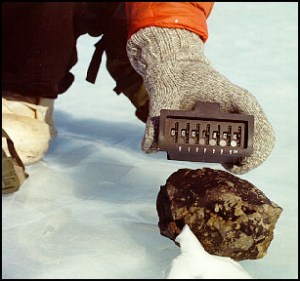 A meteorite discovered in Antarctica in 1969 has just divulged a modern secret: a new mineral, now called Wassonite.
The new mineral found in the 4.5-billion-year-old meteorite was tiny — less than one-hundredth as wide as a human hair. Still, that was enough to excite the researchers who announced the discovery Tuesday (April 5).
“Wassonite is a mineral formed from only two elements, sulfur and titanium, yet it possesses a unique crystal structure that has not been previously observed in nature,” NASA space scientist Keiko Nakamura-Messenger said in a statement.
The mineral’s name, approved by the International Mineralogical Association, honors John T. Wasson, a UCLA professor known for his achievements across a broad swath of meteorite and impact research.
Grains of Wassonite were analyzed from the meteorite that has been officially designated Yamato 691 enstatite chondrite. Chondrites are primitive meteorites that scientists think Read more…
Ozone layer damaged by unusually harsh winter

An image of total ozone column profile around the North Pole on March 30, 2011, developed by the Finnish Meteorological Institute using satellite and ground-based data, is seen in this handout, April 5, 2011. Satellite measurement of total ozone from OMI (Ozone Monitoring Instrument) shows a region of low ozone (blue region) above the Arctic regions. As of late March the ozone-poor region is shifted away from the pole and covers Greenland and Scandinavia. — WMO via Reuters
The stratospheric ozone layer, which shields the Earth from the Sun’s harmful ultraviolet rays, has been damaged to its greatest-ever extent over the Arctic this winter.
The protective layer of gas, which can be destroyed by reactions with industrial chemicals, has suffered a loss of about 40 per cent from the start of winter until late March, exceeding the previous seasonal loss of about 30 per cent, according to the World Meteorological Organisation (WMO).
The phenomenon is annual in the Antarctic, where after its discovery in the 1980s it came to be known as the “ozone hole“. Although CFC levels are now dropping, they remain in the atmosphere for so long that they will still be causing ozone depletion for decades in certain conditions, particularly the intense cold of the stratosphere.
Arctic ozone conditions vary more and the temperatures are always warmer than over Antarctica, where the ozone hole forms high in the stratosphere near the South Pole each winter and spring. Because of changing weather and temperatures, some Arctic winters experience almost no ozone loss – but others with exceptionally cold stratospheric conditions can occasionally lead to substantial ozone depletion.
This is what has happened over the Arctic this winter; for while at ground level the Arctic region was unusually warm, temperatures 15-20km above the Earth’s surface plummeted. WMO officials say the latest losses, which are unprecedented, were detected in Read more…


![[Most Recent Quotes from www.kitco.com]](https://i0.wp.com/www.kitconet.com/charts/metals/gold/t24_au_en_usoz_2.gif)
![[Most Recent Quotes from www.kitco.com]](https://i0.wp.com/www.kitconet.com/charts/metals/silver/t24_ag_en_usoz_2.gif)

 crisisboom
 CRISISBOOM
You must be logged in to post a comment.