
Russian amateur astronomer discovers new comet
NASA’s Interstellar Boundary Explorer, the centerpiece of a $169 million mission mapping the frontier of the sun’s influence, has detected atoms from interstellar space streaming by Earth, that are different from the chemical make-up of the solar system, scientists announced Tuesday.
The IBEX satellite observed hydrogen, oxygen, neon and helium atoms that originated in interstellar space, the vacuous medium between stars in the Milky Way galaxy and found 74 oxygen atoms for every 20 neon atoms in the interstellar material, compared with 111 oxygen atoms for every 20 neon atoms inside the solar system. Most of the interstellar medium is made up of hydrogen and helium. Heavier elements, such as oxygen and neon, are spread by exploding supernovae at the end of a star’s life cycle, according to NASA.
“We’ve directly measured four separate types of atoms from interstellar space and the composition just doesn’t match up with what we see in the solar system,” said Eric Christian, IBEX mission scientist at NASA’s Goddard Space Flight Center in Greenbelt, Md. “IBEX’s observations shed a whole new light on the mysterious Read more…
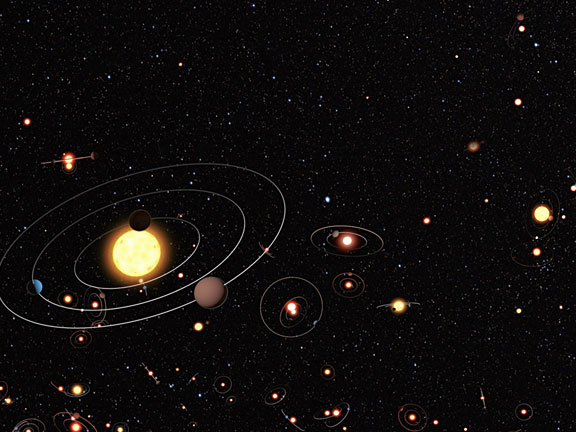 Our Milky Way galaxy contains a minimum of 100 billion planets according to a detailed statistical study based on the detection of three extrasolar planets by an observational technique called microlensing.
Kailash Sahu, of the Space Telescope Science Institute in Baltimore, Md., is part of an international team reporting today that our galaxy contains a minimum of one planet for every star on average. This means that there should be a minimum of 1,500 planets within just 50 light-years of Earth.
The results are based on observations taken over six years by the PLANET (Probing Lensing Anomalies NETwork) collaboration, which Sahu co-founded in 1995. The study concludes that there are far more Earth-sized planets than bloated Jupiter- sized worlds. This is based on calibrating a planetary mass function that shows the number of planets increases for lower mass worlds. A rough estimate from this survey would point to Read more…
Please view this video full screen so that you can see what I am pointing out. Here is visual proof that there is something in front of our sun between us and it. Everyday it is getting closer and now you can actually see there is seven or more objects orbiting the larger dwarf star.
If you can recall as many mainstream news articles have reported about it, Venus has been unusually bright during that time span…
view this on the SECCHI-B HI-1: what looks like a large impact on the planet Venus. Just as comet Lovejoy passes nearby. The SECCHI website was “out of service” for the past several days — now I think I may understand why.
A possibly large planetary collision occurred.
search the dates starting on 12/24/2011 – through today 1/6/2012 (several recent days not yet available).
here is the link to the blog post on this with screenshots and the direct link to SECCHI:
http://sincedutch.wordpress.com/2012/01/06/162012-planet-venus-has-been-hit-b… Read more…
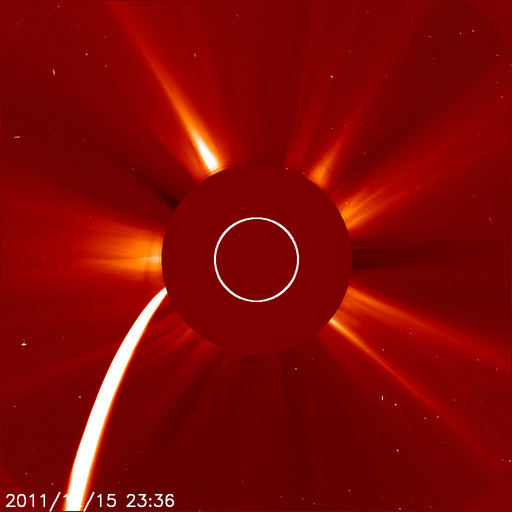
Comet Lovejoy hurtled towards the sun on December 15, 2011, as seen by the SOHO spacecraft. CREDIT: SOHO
Comet Lovejoy plunged through the sun’s corona at about 7 p.m. EST today (midnight GMT on Dec. 16), coming within 87,000 miles (140,000 kilometers) of our star’s surface. Temperatures in the corona can reach 2 million degrees Fahrenheit (1.1 million degrees Celsius), so most researchers expected the icy wanderer to be completely destroyed.But Lovejoy proved to be made of tough stuff. A video taken by NASA’s Solar Dynamics Observatory (SDO) spacecraft showed the icy object emerging from behind the sun and zipping back off into space.
“Breaking News! Lovejoy lives! The comet Lovejoy has survived its journey around the sun to reemerge on the other side,” SDO researchers tweeted today.
SDO is one of many instruments that scientists — eager to record and study the comet’s presumed demise — trained on Lovejoy as it streaked toward the sun.
“We have here an exceptionally rare opportunity to observe the complete vaporization of a relatively large comet, and we have approximately 18 instruments on five different Read more…
 CNN says;
“There is a huge hidden heavenly body right here in our solar system.”
This information does co-inside with our sources except for the distance — according to Read more…
Russian amateur astronomer Artyom Novichonok, a student of Petrozavodsk University, made a discovery of a new comet, Russian astronomy website Astronet said on Sunday.
The comet is the first comet discovered from Russian territory since 1989.
Novichonok’s discovery was confirmed by the International Astronomical Union, the comet being designated P/2011 R3 (Novichonok), the Ka-Dar Observatory, where Novichonok made his discovery, said on its website.
Novichonok discovered the comet on six images taken in September using a 0.4-m Jigit telescope.

Astronomers say they have discovered a planet that orbits around a pair of stars. It is the first time a so-called circumbinary system has been detected.
Movie fans might be familiar with the score of “Star Wars, Episode IV, A New Hope,” the blockbuster movie from 1977. Luke Skywalker stands on his stark home planet Tatooine. As he gazes pensively into the distance toward a pinkish sky, an orange sun descends toward the horizon, with a smaller white sun following close behind.
Well, move over, Tatooine, says John Knoll of Industrial Light and Magic, which Read more…
 Harvard scientists have discovered what they have dubbed an “invisible planet.”
While the planet is not actually invisible, scientists inferred its existence from “the influence it’s exerting on another planet,” bypassing more traditional methods of detecting planets that rely on visible evidence, lead researcher Sarah A. Ballard said.
Ballard, who is a graduate student in astronomy, found the planet—dubbed Kepler-19c and located 650 light-years from Earth in the constellation Lyra—during a routine examination of data collected from Read more…
 Recently, there has been quite a bit of talk about a comet or celestial body named Elenin (or C/2010x) that has entered our solar system and will be making a close pass of the Earth soon. At first, I assumed it was simply the talk of fanciful amateur astronomers and that, at most, it might offer an interesting night-sight for Earth’s inhabitants, much like Haley’s Comet and many others.
But as I continued hearing more and more about this “Elenin object,” I started to realize this was no mere comet. And perhaps, just maybe, it could have something to do with the famed Planet-X first reported about back in 1983 by the Washington Post. Unfortunately, it seemed as though most of what I could find was wild speculation and fanatical rantings about the end of the world. I had discovered only a handful of articles that Read more…


![[Most Recent Quotes from www.kitco.com]](https://i0.wp.com/www.kitconet.com/charts/metals/gold/t24_au_en_usoz_2.gif)
![[Most Recent Quotes from www.kitco.com]](https://i0.wp.com/www.kitconet.com/charts/metals/silver/t24_ag_en_usoz_2.gif)

 crisisboom
 CRISISBOOM
You must be logged in to post a comment.