Archive
Are Jellyfish Increasing in World’s Oceans?

Giant jellyfish clog fishing nets in Japan. (Photo Credit: Shin-ichi Uye)
A global study has questioned claims that jellyfish are increasing worldwide.
Blooms, or proliferation, of jellyfish have shown a substantial, visible impact on coastal populations — clogged nets for fishermen, stinging waters for tourists, even choked intake lines for power plants — and recent media reports have created a perception that the world’s oceans are experiencing increases in jellyfish due to human activities such as global warming and overharvesting of fish. Now, a new global and collaborative study questions claims that jellyfish are increasing worldwide and suggests claims are not supported with any hard evidence or scientific analyses to date.
Dr Cathy Lucas, a marine biologist at the University of Southampton, who is based at the National Oceanography Centre, Southampton was involved in the study, which appears in the latest issue of BioScience. Her co-authors are composed of experts from the Global Jellyfish Group, a consortium of approximately 30 experts on gelatinous organisms, climatology, oceanography and socioeconomics from around the globe, that Read more…
Arctic climate change ‘to spark domino effect’
 The rate of Arctic climate change was now faster than ecosystems and traditional Arctic societies could adapt to.
WA-based scientists have warned of “dire consequences” to the human race after detecting the first signs of dangerous climate change in the Arctic.
The scientists, from the University of WA, claim the region is fast approaching a series of imminent “tipping points” which could trigger a domino effect of large-scale climate change across the entire planet.
In a paper published in the Royal Swedish Academy of Sciences’ journal AMBIO and Nature Climate Change, the lead author and director of UWA’s Oceans Institute, Winthrop Professor Carlos Duarte, said the Arctic region contained arguably the greatest concentration of Read more…
1/26/2012 — USDA confirms WARM LATITUDES move north = New PLANTS will grow = Russia North Pole
FINALLY ! It all ties together.
Strange animal deaths starting last year…. global uptick in earthquakes…. weather patterns shifting / changing noticeably …. compasses showing variances …. airports changing their runway alignment …. sun rising early in Greenland …. record snow over Russia/Alaska …. north pole shifting …. gravity and moon anomalies…
And now this latest story — the USDA confirms that Read more…
UM study links climate change, decline in songbird populations

University of Montana biology professor John Maron, left, and Thomas Martin, UM biology professor and U.S. Geological Survey scientist, explain the reduction of songbird populations in Arizona due to changing climate conditions.
JOHN CREPEAU/Missoulian University of MISSOULA — A decline in snow at high elevations has led to shrinking songbird populations in the mountains of northern Arizona, a new study by two University of Montana scientists found.
Some of the same bird species inhabit Montana.
U.S. Geological Survey senior scientist and UM professor Thomas Martin, along with UM biology professor John Maron, recently published the findings of their six-year study on indirect effects of climate change on ecosystems.
The abundance of deciduous trees and songbird populations have declined over the past 22 years because of decreasing snowpack above 8,000 feet in northern Arizona. Because of less snow, elk remain at higher elevations for longer periods of time, browsing on plants that provide cover and nesting places for birds.
The study is available now online, Martin said, while a hard copy of the journal Nature Climate Change is due out next month.
“The indirect effects of climate on plant communities may be Read more…
Water supplies may run out by 2030 in India: Study
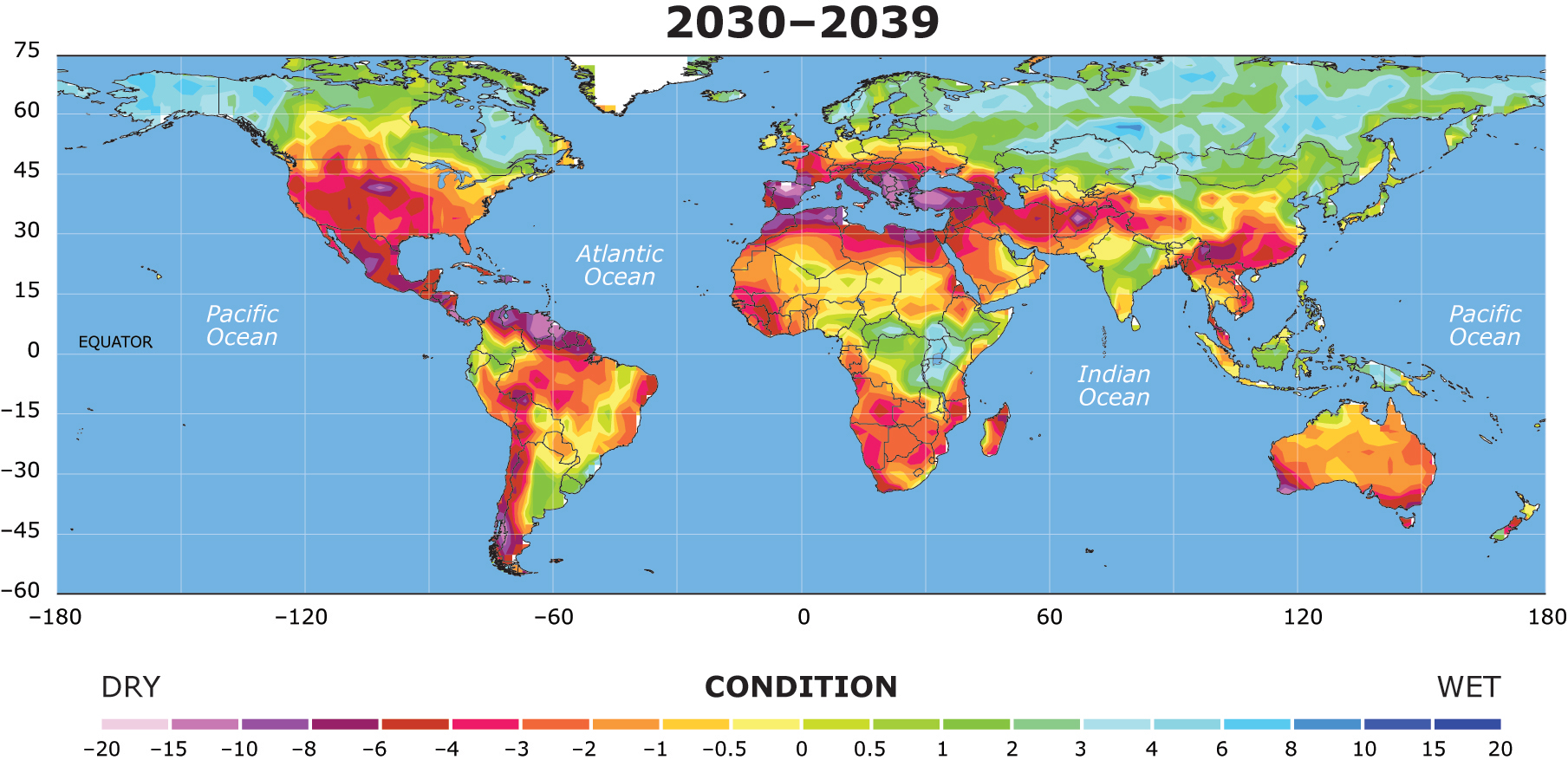
Palmer Drought Severity Index, which assigns positive numbers when conditions are unusually wet for a particular region, and negative numbers when conditions are unusually dry. A reading of -4 or below is considered extreme drought. Regions that are blue or green will likely be at lower risk of drought, while those in the red and purple spectrum could face more unusually extreme drought conditions. (Courtesy Wiley Interdisciplinary Reviews, redrawn by UCAR. This image is freely available for media use.
Water supplies will begin running out in critical regions where they support cities, industries and food production — including in India, China and the Middle East — by 2030 due to over-extraction of groundwater, a scientist has warned.
“The world has experienced a boom in groundwater use, more than doubling the rate of extraction between 1960 and 2000 — with usage continuing to soar up to the present,” says Craig Simmons, director of the National Centre for Groundwater Research and Training (NCGRT).
A recent satellite study has revealed falling groundwater tables in the US, India, China, Middle East and North Africa, where expanding agriculture and cities have increased water demand.
“Groundwater currently makes up about Read more…
Global warming: European species lag in habitat shift
 PARIS — Fast-track warming in Europe is making butterflies and birds fall behind in the move to cooler habitats and prompting a worrying turnover in alpine plant species, studies published Sunday said.
The papers, both published by the journal Nature Climate Change, are the biggest endeavour yet to pinpoint impacts on European biodiversity from accelerating global temperatures.
A team led by Vincent Devictor of France’s National Centre for Scientific Research (CNRS) found that from 1990 to 2008, average temperatures in Europe rose by one degree Celsius (1.8 degrees Fahrenheit).
This is extremely high, being around 25 percent greater than the global average for all of the last century.
In order to live at the same temperature, species would have to shift northward by 249 kilometres (155 miles), they calculated.
But during this period, butterlies moved only Read more…
Major threats foreseen due to Europe’s changing marine environments

This map shows coastal areas most vulnerable to erosion. Credit: Project CLAMER and European Environment Agency (EEA), based on EU Eurosion project data
Europeans face greater risk of illness, property damage and job losses because of the impacts of climate change on the seas around them.
Worried citizens, whose biggest related top-of-mind concerns are sea level rise and coastal erosion, are taking personal actions to reduce carbon emissions. However, they largely blame climate change on other groups of people or nations and assign governments and Read more…
Greenland’s Petermann Glacier Melting at Alarming Rate
 Scientists say the disintegration of the Petermann Glacier — measuring 186 miles long and 3,280 feet high — may just be the tip of the iceberg concerning climate change’s impact in colder zones.
New photographs show the quick pace at which the massive ice sheet has shrunk over the past two years. Last year, a swath of ice measuring 77 square miles separated and a further piece twice the size of Manhattan could break off in the next year, according to Dr. Alun Hubbard of Aberystwth University, who has been monitoring the Greenland ice sheet for some years.
Oblique view of the Petermann glacier front on 24 July 2009.Related Articles
In 2009, scientists placed GPS masts on the glacier to track its movement, ahead of the major break off of ice that eventually occurred on August 3, 2010. Greenland’s glaciers have lost an Read more…
Hurricane Irene Demonstrates Threats to Coasts As Climate Changes
 Every hurricane season, climate scientists are asked how climate change is impacting hurricanes.
The short answer is that global warming makes the ocean warmer and increases sea surface temperatures, which can make hurricanes stronger. But several factors, including differences in wind speed and direction, can break up hurricanes. Many future projections show a decrease in the frequency of all hurricanes globally, but a higher chance of intense hurricanes forming when they do occur. The changing nature of hurricanes in a warmer world remains an active area of research.
In any case, focusing on climate change and hurricanes can obscure the consequences of less sensational climate-related threats to America’s coasts, including sea-level rise and more intense precipitation. Further, extreme Read more…
Climate change to worsen childhood asthma
“Our study shows that these assessment models are Read more…


![[Most Recent Quotes from www.kitco.com]](https://i0.wp.com/www.kitconet.com/charts/metals/gold/t24_au_en_usoz_2.gif)
![[Most Recent Quotes from www.kitco.com]](https://i0.wp.com/www.kitconet.com/charts/metals/silver/t24_ag_en_usoz_2.gif)

 crisisboom
 CRISISBOOM

You must be logged in to post a comment.