Archive
Powers That Be preparing for lockdown as Earth Changes increase? UN security council to consider ‘climate change peacekeeping force’
 Special meeting to discuss ‘green helmets’ force to intervene in conflicts caused by rising seas levels and shrinking resources
A special meeting of the United Nations security council is due to consider whether to expand its mission to keep the peace in an era of climate change.
Small island states, which could disappear beneath rising seas, are pushing the security council to intervene to combat the threat to their existence.
There has been talk, meanwhile, of a new environmental peacekeeping force – green helmets – which could step into conflicts caused by shrinking resources.
The UN secretary general, Ban Ki-Moon, is expected to address the meeting on Wednesday.
But Germany, which called the meeting, has warned it is premature to expect the council to take the plunge into green peacemaking or even adopt climate change as one of its key areas of concern.
“It is too early to seriously think about council action on climate change. This is clearly not Read more…
Drought and wildfire threaten America’s cattle capital

* A mother and her calf idle in dead grassland on the Swenson Ranch outside Stamford, Texas, in this photo from May 21. Severe drought and millions of acres of wildfires have delivered a potent one-two punch this year, forcing tough decisions on ranchers across cattle country. Elliott Blackburn / Reuters /. File
Chicago-As if the heartland hasn’t faced enough this summer, with wildfires, droughts, and punishing heat, cattle ranchers are now facing a hay shortage.
The triple-digit temperatures, expected to result in the worst drought north-central Texas has ever experienced, follows spring wildfires, which scorched millions of acres that traditionally nourish the nation’s largest steer population – five million head of cattle.
Most Texas pasture and range lands – 86 percent – are currently “poor” or “very poor,” according to the US Department of Agriculture’s National Agricultural Statistics Service. The same rating applied to 69 percent of Oklahoma and 40 percent of Kansas.
The hardships this year “don’t compare to any in recent years,” says Jason Miller, a county agriculture agent for the Texas AgriLife Extension Service (TALES). “The ranchers are just holding on.”
July temperatures have topped 110 degrees in the heart of cattle country, from Texas to Kansas. Ranchers complain that Read more…
Record heat, drought, and flooding sweeps US; food supply to take a hit
 The year 2011 is shaping up to be one of the most treacherous years in recent history, at least as far as the nation’s weather patterns are concerned. While much of the Midwestern US continues to get drenched by record rainfall and torrential flooding, the Southern US is experiencing tremendous heat and drought conditions that, combined with flood conditions to the north, will have devastating effects on the nation’s food supply.
Extreme heat threatens US agriculture
For several weeks now, extreme heat conditions have afflicted much of the Southern and Midwestern US. According to the National Weather Service, Heat Advisories and Excessive Heat Warnings have been issued in 17 different states, with temperatures soaring over 100 degrees Fahrenheit (F) in many areas, and heat indexes topping 115 degrees F (http://www.examiner.com/weather-in-…).
The 17 states under heat advisories or warnings include Mississippi, Arkansas, Louisiana, Missouri, Oklahoma, Texas, South Carolina, Georgia, Alabama, Illinois, Kansas, Nebraska, Iowa, Indiana, Ohio, Kentucky, and Tennessee. And cities that have reached record highs include Oklahoma City, Okla., at 105 degrees F, Tulsa, Okla., at 107 degrees F, Medicine Lodge, Kan., at 111 degrees F, and Columbus, Miss., at a Read more…
Supersize Dust Storms Could Become Southwest Norm
 The massive dust storm that engulfed Phoenix last week was unusual for the 20th century, but could become more common in the 21st.
The storm resulted from thunderstorm-cooled air plummeting into the ground like mist pouring from an open freezer, only exponentially more powerful. Combine those winds with extremely dry conditions, and the result was a wall of dust 100 miles wide and 5,000 feet high.
Dust storms are common in the U.S. southwest, but not storms this big. No formal records are kept, but meteorologists said it was the largest such storm in at least 30 years. It was on par with storms seen in China’s Gobi desert and Australia. Some commentators invoked the apocalyptic storms of the 1930’s Dust Bowl.
As dry as it’s been in the southwest this year, with precipitation 50 percent below mid-20th century levels, there’s reason to think that extra-dry conditions will Read more…
Climate factor involved in wars, crises
 Christian Parenti is a contributing editor at the Nation and a visiting scholar at the Center for Place, Culture and Politics, at the Cuny university of New York’s Grand Center.
He has reported extensively on Afghanistan, Iraq, and various parts of Africa, Asia, and Latin America. His work has been published among others at the Fortune, the Washington Post, the New York Times, and Mother Jones. He holds a PHD in Sociology from the London School of Economics.
Press TV has interviewed Parenti on his latest book, Tropic of Chaos: Climate Change and the New Geography of Violence.
The following is a rough transcription of the interview.
Press TV: Christian Parenti, thank you so much for joining us on the Autograph. While we often address the issue of climate change solely as an environmental challenge, in Read more…
Africa battles worst drought in 60 years, aid agencies warn
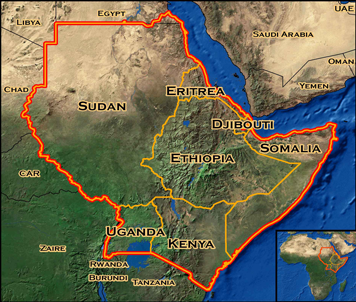 With the UN warning that both East and the Horn of Africa have been hit by the worst drought in 60 years, international aid agencies have warned of an alarming gap in the food pipeline to reach those most in need.
More than 10 million people are thought to be affected across the East African region. The UN says that large swathes of central Kenya and Somalia are now in the “emergency” category, one phase before what is officially classified as famine.
The crisis is most acute in Somalia, Ethiopia and; central and northern Kenya. Refugees are now arriving at the Somali camps in northern Kenya, at a rate of 1,200 every day.
Aid agencies told the UK-based Independent on Sunday, of the terrible plight of Read more…
Africa drought leaves 10 million facing famine and disease
The worst drought for 60 years is threatening more than ten million people with starvation and disease in eastern Africa, aid workers are warning.
 Refugees at a food distribution point in Dadaab – the world’s largest refugee camp (Pic: AFP/Getty)
A severe dry spell and wrecked harvests in parts of Kenya, Somalia, Ethiopia, Djibouti and Uganda have caused what charities described as ‘the worst food crisis of the 21st century’, prompting multimillion-pound aid demands.
Save The Children is launching a £40million emergency appeal to help thousands of malnourished children, while Oxfam is calling for £50million.
The lack of water and supplies has pushed food prices up by 240 per cent, worsening conditions for those struggling to survive. More than half of those needing Read more…
Experts warn epic weather ravaging US could worsen

CHICAGO — Epic floods, massive wildfires, drought and the deadliest tornado season in 60 years are ravaging the United States, with scientists warning that climate change will bring even more extreme weather.
The human and economic toll over just the past few months has been staggering: hundreds of people have died, and thousands of homes and millions of acres have been lost at a cost estimated at more than $20 billion.
And the United States has not even entered peak hurricane season.
“This spring was one of the most extreme springs that we’ve seen in the last century since we’ve had good records,” said Deke Arndt, chief of climate monitoring for the National Oceanic and Atmospheric Administration (NOAA).
While it’s not possible to tie a specific weather event or pattern to climate change, Arndt said this spring’s extreme weather is in line with what is forecast for the future.
“In general, but not everywhere, it is expected that the wetter places will get wetter and the drier places will tend to see more prolonged dry periods,” he told AFP.
“We are seeing an increase in the amount (of rain and snow) that comes at once, and the ramifications are that it’s a lot more water to deal with at a Read more…
2010 – 2011: Earth’s most extreme weather since 1816?
 Every year extraordinary weather events rock the Earth. Records that have stood centuries are broken. Great floods, droughts, and storms affect millions of people, and truly exceptional weather events unprecedented in human history may occur. But the wild roller-coaster ride of incredible weather events during 2010, in my mind, makes that year the planet’s most extraordinary year for extreme weather since reliable global upper-air data began in the late 1940s. Never in my 30 years as a meteorologist have I witnessed a year like 2010–the astonishing number of weather disasters and unprecedented wild swings in Earth’s atmospheric circulation were like nothing I’ve seen. The pace of incredible extreme weather events in the U.S. over the past few months have kept me so busy that I’ve been unable to write-up a retrospective look at the weather events of 2010. But I’ve finally managed to finish, so fasten Read more…
Drought conditions taking toll on Texas lakes
 The boat ramps at Lake Medina just seem to go on and on. What used to be only a few feet to the water are now hundreds of feet and getting further every day. While Medina is by far the lowest of the area lakes, it isn’t alone in its shrinking shoreline.
Medina Lake is down almost 30 feet, Canyon Lake is down 5 feet, Lake Buchanan is down 14 feet; even Lake Travis is down 34 feet.
The summer drought has depleted these reservoirs one by one, with areas of shoreline exposed for the sun for the first time in two years.
Across the state, the combined totals of Texas’s reservoirs are down to 71.8 percent, a decline of almost five percent since May 22, with lake levels dropping a combine 2,700,000 feet. Read more…


![[Most Recent Quotes from www.kitco.com]](https://i0.wp.com/www.kitconet.com/charts/metals/gold/t24_au_en_usoz_2.gif)
![[Most Recent Quotes from www.kitco.com]](https://i0.wp.com/www.kitconet.com/charts/metals/silver/t24_ag_en_usoz_2.gif)

 crisisboom
 CRISISBOOM
You must be logged in to post a comment.