Archive
Scientists plan to drill all the way down to the Earth’s mantle

Credit: World Book illustration by Raymond Perlman and Steven Brayfield, Artisan-Chicago
(PhysOrg.com) — In what can only be described as a mammoth undertaking, scientists, led by British co-chiefs, Dr Damon Teagle of the National Oceanography Centre in Southampton, England and Dr Benoit Ildefonse from Montpellier University in France, have announced jointly in an article in Nature that they intend to drill a hole through the Earth’s crust and into the mantle; a feat never before accomplished, much less seriously attempted.
The Earth’s mantle is the part of the planet that lies between the crust and the iron ball at its center, and to reach it, would require drilling down from a position in the ocean, because the crust is much thinner there. Even still, it would mean drilling through five Read more…
Powerful sunspot emerges, extreme UV radiation detected
(TheWeatherSpace.com) — A sunspot is emerging around the southeastern limb of the Sun and it is a powerful one at that.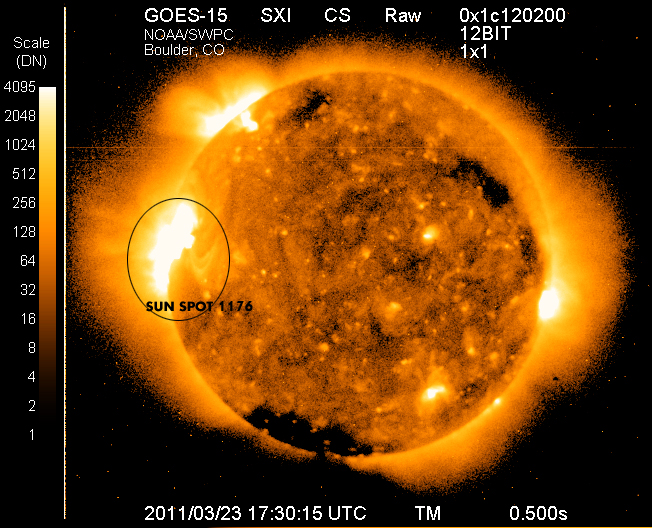
Labeled 1176, this sunspot may have been old sunspot 1165 when it was last seen in early March on the southwestern limb of the Sun.
Since then it has rotated to the far side of the Sun and it looks as if it was busy doing so. This sunspot will have the power to generate large solar flares for the next couple weeks as it crosses the Earth facing side of the Sun.
NASA’s Solar Dynamics Observatory has recorded very high levels of UV radiation from this sunspot, a clear signal to unsettled times ahead for it and the Earth should it blast a solar flare this way.
“If this puts a flare in this direction you can bet on more powerful earthquakes in the world,” TheWeatherSpace.com Senior Meteorologist Kevin Martin said. “We’ve been quiet and that is not a coincidence.”
House-Size Asteroid Zooms Close by Earth

This NASA graphic depicts the orbit (blue curve) of asteroid 2011 EB47, which will pass close by Earth within the orbit of the moon on March 16, 2011, one day after it was discovered. The asteroid poses no threat of impacting Earth.
An asteroid the size of a house zoomed by Earth Wednesday, flying within the orbit of the moon just one day after astronomers spotting the space rock in the sky, NASA says.
The small asteroid 2011 EB74 was about 47 feet across and posed no threat of hitting Earth, since it was too small to survive the trip through the planet’s atmosphere.
Instead, the asteroid passed our planet at a comfortable distance of about 203,000 miles when it made its closest approach at 5:49 p.m. EDT, NASA officials said.
For comparison, the average distance between the Earth and the moon is about Read more…
Earth’s Core Provides Climate Insights

Summary: By studying the molten core of the planet Earth, scientists have uncovered new evidence that humans play a dominant role in changing Earth's climate. The study could have important implicaitons in understanding the future of life on our planet.
The latest evidence of the dominant role humans play in changing Earth’s climate comes not from observations of Earth’s ocean, atmosphere or land surface, but from deep within its molten core.
Scientists have long known that the length of an Earth day – the time it takes for Earth to make one full rotation – fluctuates around a 24-hour average. Over the course of a year, the length of a day varies by about 1 millisecond, getting longer in the winter and shorter in the summer. These seasonal changes in Earth’s length of day are driven by exchanges of energy between the solid Earth and fluid motions of Earth’s atmosphere (blowing winds and changes in atmospheric pressure) and its ocean. Scientists can measure these small changes in Earth’s rotation using astronomical observations and very precise geodetic techniques.
But the length of an Earth day also fluctuates over much longer timescales, such as interannual (two to 10 years), decadal (approximately 10 years), or those lasting multiple decades or even longer. A dominant longer timescale mode that ranges from 65 to 80 years was observed to change the length of day by approximately 4 milliseconds at the beginning of the Read more…
Moon at Maximum Traction During Latest Earthquake Clusters
The moon’s gravitational impact on the earth, especially between February and April this year, coincides with the latest cluster of major earthquakes.
 (13th March 2011) Many astronomers and climate scientists studying the relationship of the moon with the orbits of the earth and sun, have noted that lunar perigree can coincide with major tectonic activity.
Lunar perigree is when the moon’s orbit is closest to the earth, as on 19th March 2011, but a proxigean cycle is even stronger.
This occurs when the moon is closest in orbit to the Earth, (this year between March 18th and 21st), and also in its new or full Moon phase.
Present proxigean cycle has maximum effect
This proxigean cycle is when the moon Read more…
The Power of the Supermoon?
As I have mentioned here, on ABCnews.com (see the story by clicking here) and to people I had talked with about the supermoon, I was neutral, not a believer or non-believer in the power of the supermoon. Notice I say Read more…
Impact of space weather threat examined
 Professor Hapgood examines the linkage between the science of space weather and its impact on technological systems, potential impact of Solar weather on orbital and ground based systems including power, energy and communications – as well as atmospheric physics.
Space weather is concerned with disturbances in Earth’s upper atmosphere and in near-Earth space that can disrupt the advanced technologies on which our society now relies. A proper understanding of space weather requires us to bring together a range of scientific, engineering and economic expertise, emphasizing the role of the electromagnetic force in many of the physical processes that cause space weather.
One example is the crucial role of plasma physics within the sources of space weather on the Sun, in the transmission of energy from the Sun to the Earth via the solar wind and Earth’s magnetosphere.
Another is the role of the electric currents that naturally flow with Read more…
Global warming means more snowstorms: scientists
Climate change is not only making the planet warmer, it is also making snowstorms stronger and more frequent, US scientists said on Tuesday.
 Workers remove snow from a runway at O’Hare International Airport on February 3, in Chicago, Illinois. Climate change is not only making the planet warmer, it is also making snowstorms stronger and more frequent, US scientists said on Tuesday.
“Heavy snowstorms are not inconsistent with a warming planet,” said scientist Jeff Masters, as part of a conference call with reporters and colleagues convened by the Union of Concern Scientists.
“In fact, as the Earth gets warmer and more moisture gets absorbed into the atmosphere, we are steadily loading the dice in favor of more extreme storms in all seasons, capable of causing greater impacts on society.”
Masters said that the northeastern United States has been coated in heavy snowfall from Read more…
Two planets found sharing one orbit
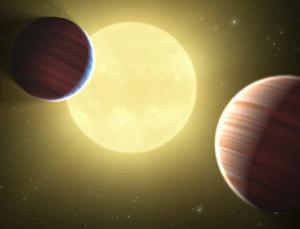 Buried in the flood of data from the Kepler telescope is a planetary system unlike any seen before. Two of its apparent planets share the same orbit around their star. If the discovery is confirmed, it would bolster a theory that Earth once shared its orbit with a Mars-sized body that later crashed into it, resulting in the moon’s formation.
The two planets are part of a four-planet system dubbed KOI-730. They circle their sun-like parent star every 9.8 days at exactly the same orbital distance, one permanently about 60 degrees ahead of the other. In the night sky of one planet, the other world must appear as a constant, blazing light, never fading or brightening.
Gravitational “sweet spots” make this possible. When one Read more…
Large crack opens in the earth in southern Peru
Puno: The Earth Is Opening In Southern Peru
 |
| The mysterious crack measures 100 meters wide and three kilometers long. (Photo: El Comercio) |
The sudden appearance early in the morning of an enormous crack, measuring 100 meters wide and three kilometers long, caused confusion among residents of the Huacullani district in the Chucuito province, department of Puno.
The exact cause of the crack in the earth still unknown. Peru’s geophysical institute ruled out the occurrence of an earthquake in the region, but what is clear is that the ground opened up and large blocks of earth can be observed scattered throughout the area.
The event, recorded Wednesday morning, caused the collapse of one house located in the rural community of Llorohoco. Four people managed to escape, but the youngest in the family, five-year-old Jean Carlos Vilcanqui Acero, is missing.
Geological engineers from the regional committee for civil defense have Read more…


![[Most Recent Quotes from www.kitco.com]](https://i0.wp.com/www.kitconet.com/charts/metals/gold/t24_au_en_usoz_2.gif)
![[Most Recent Quotes from www.kitco.com]](https://i0.wp.com/www.kitconet.com/charts/metals/silver/t24_ag_en_usoz_2.gif)

 crisisboom
 CRISISBOOM
You must be logged in to post a comment.