Archive
New study: Nations requiring the most vaccines tend to have the worst infant mortality rates
 (NaturalNews) A new study, published in Human and Experimental Toxicology (http://het.sagepub.com/content/earl…), a peer-reviewed journal indexed by the National Library of Medicine, found that nations with higher (worse) infant mortality rates tend to give their infants more vaccine doses. For example, the United States requires infants to receive 26 vaccines — the most in the world — yet more than six U.S. infants die per every 1000 live births. In contrast, Sweden and Japan administer 12 vaccines to infants, the least amount, and report less than three deaths per 1000 live births.
The authors of the study, Neil Z. Miller and Dr. Gary Goldman, conducted a literature review to determine the immunization schedules for the United States and all 33 nations with better infant mortality rates than the United States. The total number of vaccine doses specified for infants aged less than one year was then determined for each country. The 34 nations were then organized into data pairs consisting of total number of vaccine doses specified for their infants and infant mortality rates. A scatter plot of the data pairs provided evidence of a positive correlation: infant mortality rates and vaccine doses tend to increase together.
Nations were also grouped into five different vaccine dose ranges. The mean infant mortality rates of all nations within each Read more…
Bad News from NASA: Proof That Comet Elenin Is Affecting Earth
 |
| Dees Illustration |
Dr. Mark Sircus, Contributing Writer
Activist Post
This is going to be the most extraordinary communication so fasten your seatbelts; we are in for a rough ride. I have known in my heart for months that I would have to make a communication like this but had no idea it would be this soon. Back in January, while investigating the underground city that is alleged to have been built under the new Denver Airport, reported on by the former governor Jesse Ventura, I put the puzzle together and came to the conclusion that a planetary event was in store for us in 2012.
Today I am presenting rock solid information; it does not get any better when NASA is your source. What you are about to read and see is happening. Last night, looking at a NASA mathematical model of comet Elenin, I found out that a large celestial body has already penetrated the solar system and is on course for a near and possibly horrific encounter with the earth in the fall of 2011. What we do not know is the size and mass of comet Elenin though I have no doubt that it is known by Read more…
Can’t seal Fukushima like Chernobyl – it all goes into sea
Cesium 137 Threat Grows While Corporate Media Remains Mute
Kurt Nimmo
Prison Planet.com
Wednesday, April 20, 2011
The hereditary communist dictatorship in North Korea reports on the spread of radiation from the Fukushima nuclear plant, but it has all but fallen off the corporate media radar screen here. Monitoring stations across North Korea from April 11 to 17 detected iodine-131 and cesium-137 in the air above Wonsan in the southeast and Chongjin in the southeast, according to the country’s state-run media.
Here is a recent map showing the spread of cesium-137. Note the increased concentration over the United States.

Is this the age of megaquakes?
 Kyodo / Reuters
Buildings tossed together by the tsunami is seen in Miyagi Prefecture, northeastern Japan March 12, 2011. Scientists are asking if another megaquake will strike in the next six years.
By John Roach
First there was the earthquake and tsunami in Sumatra in 2004. Chile was shaken and lashed violently a year ago. Japan is still reeling from the twin disasters on March 11. It seems as if the Earth has woken from a long slumber and is violently re-jiggering its plates. Is there any truth to the notion?
The question of megaquake clustering, which I explored in the days following the 9.0 earthquake and tsunami in Japan, was a hot topic of conversation Thursday at the Seismological Society of America’s annual meeting in Memphis, Tenn., according to various media reports.
There, Charles Bufe, a seismologist retired from the U.S. Geological Survey in Denver, said the spate of recent megaquakes is very similar to a string of seven magnitude 8.5 or greater quakes that struck between 1950 and 1965. The intervening decades, he noted, were quiet.
Bufe and USGS colleague David Perkins analyzed the clustering and concluded that Read more…
Secret Weapons Program Inside Fukushima Nuclear Plant?
Confused and often conflicting reports out of Fukushima 1 nuclear plant cannot be solely the result of tsunami-caused breakdowns, bungling or miscommunication. Inexplicable delays and half-baked explanations from Tokyo Electric Power Company (TEPCO) and the Ministry of Economy, Trade and Industry (METI) seem to be driven by some unspoken factor.
The smoke and mirrors at Fukushima 1 seem to obscure a steady purpose, an iron will and a grim task unknown to outsiders. The most logical explanation: The nuclear industry and government agencies are scrambling to prevent the discovery of atomic-bomb research facilities hidden inside Japan’s civilian nuclear power plants.
A secret nuclear weapons program is a ghost in the machine, detectable only when the system of information control momentarily lapses or breaks down. A close look must be taken at the gap between the official account and unexpected events.
Conflicting Reports
TEPCO, Japan’s nuclear power operator, initially reported three reactors were operating at the time of the March 11 Tohoku earthquake and tsunami. Then a hydrogen explosion ripped Unit 3, run on plutonium-uranium mixed oxide (or MOX). Unit 6 immediately disappeared from the list of operational reactors, as highly lethal particles of plutonium billowed out of Unit 3. Plutonium is the stuff of smaller, more easily delivered warheads.

A fire ignited inside the damaged housing of the Unit 4 reactor, reportedly due to overheating of spent uranium fuel rods in a Read more…
March 9.0 Japanese quake set off tremors around the world

The earthquake that launched a series of disasters in Japan in March triggered micro-quakes and tremors around the world, scientists find.
The catastrophic magnitude 9.0 earthquake that struck off the coast of the Tohoku region of Japan March 11 set off tremors mostly in places of past seismic activity, including southwest Japan, Taiwan, the Aleutians and mainland Alaska, Vancouver Island in Canada, Washington state, Oregon, central California and the central United States. It was unlikely that any of these events exceeded magnitude 3.
Researchers noted, however, that temblors also were detected in Cuba. “Seismologists had never seen tremor in Cuba, so this is an exciting new observation,” Justin Rubinstein, a seismologist with the U.S. Geological Survey at Menlo Park, Calif., told OurAmazingPlanet.
Part of the excitement of the find is the insight it could add into the inner workings of earthquakes.
“Studying long-range triggering may help us to better understand the underlying physics of how earthquakes start,” explained seismologist Zhigang Peng at the Georgia Institute of Technology in Atlanta.
Quakes where normally quiet
Most of these micro-earthquakes and tremors occurred in places that already had high background levels of seismic activity, including California’s Geysers Geothermal Field and the San Andreas Fault. Some of the quakes occurred in low-activity areas, such as central Nebraska, central Arkansas and near Beijing.
“Seismologists generally think of the central U.S. as relatively Read more…
Disasters to slash Australian growth by 1 pct
 SYDNEY — The hit to exports from Japan’s quake and tsunami, devastating floods in its own northeast and a rallying dollar has shaved 1.0 percent off Australia’s growth forecasts, according to a report.
Accompanied by a slump in consumer spending, the disasters have led the Treasury to downgrade growth from the 3.25 percent flagged in November’s budget update to 2.25 percent, said The Age newspaper on Saturday, citing an internal memo.
The devastation and nuclear crisis in key trading partner Japan wiped 0.25 percent from economic growth, according to the memo, with Australia’s Read more…
Gas prices surge toward $4, threaten economic recovery
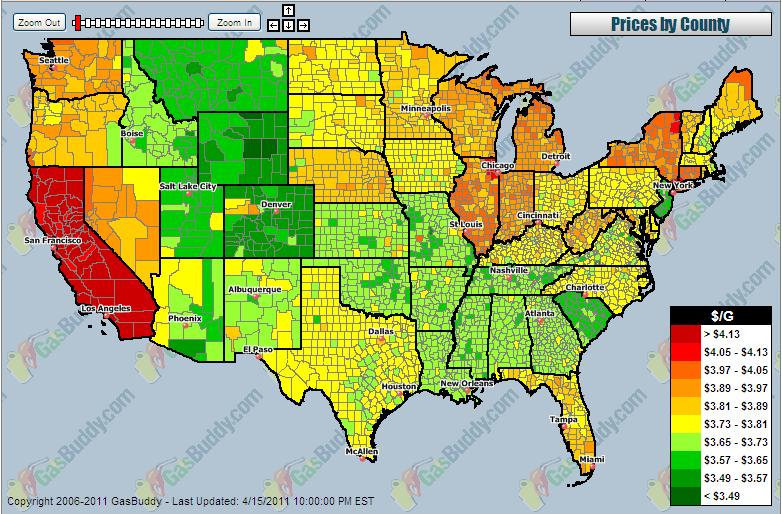
Click Map to enlarge
Gas prices continued to gallop toward $4 a gallon early this week, both in the area and across the state, as prices in Minocqua and Rhinelander hit $3.99 on Tuesday, even as prices for crude oil eased, at least temporarily.
Across the nation, according to GasBuddy.com on Wednesday morning, the national average price for a gallon of regular gasoline stood at $3.79; in Wisconsin, the average was $3.87. Four states, including Illinois, have seen prices already surpass $4.
Crude oil prices moved downward Tuesday from $113 a barrel – the highest price since September 2008 – to $106, a Read more…
Japan Mulls to Move Capital over Disaster Worries

A handout picture taken and released by Tokyo Electric Power Co (TEPCO) 13 April 2011 shows a fire in the facilities takling seawater samples at Fukushima nuclear power plant in Okuma, Fukushima Prefecture. Photo by EPA/BGNES
As powerful earthquakes continue to jolt Japan and radiation levels near Tokyo are rising, the Asian country’s authorities are considering moving the capital to another city.
The most probable location for a new capital are Osaka and Nagoya, according to ITAR-TASS. Both cities are located near international airports.
The main conditions the new capital has to provide are a population over 50 000 and a sufficient capacity to accommodate the parliament, the government, the Emperor’s residency and the foreign diplomatic missions.
According to experts, should a 7.2 magnitude earthquake shake Tokyo, the casualties will be around 11 000, some 210 000 will be injured and the material damage will be worth about USD 1 B


![[Most Recent Quotes from www.kitco.com]](https://i0.wp.com/www.kitconet.com/charts/metals/gold/t24_au_en_usoz_2.gif)
![[Most Recent Quotes from www.kitco.com]](https://i0.wp.com/www.kitconet.com/charts/metals/silver/t24_ag_en_usoz_2.gif)

 crisisboom
 CRISISBOOM
You must be logged in to post a comment.