Archive
Drought In Amazon Could Lead To Accelerated Global Warming
A new study reveals a drought last year in the Amazon basin caused the forest to lose significant levels of vegetation, which in turn could accelerate the pace of global warming.
The study, conducted by an international team of scientists and funded by NASA, uses specific satellite imaging data provided by the agency to draw its conclusions. The Moderate Resolution Imaging Spectroradiometer (MODIS) and Tropical Rainfall Measuring Mission (TRMM) satellites provided more than a decade’s worth of data for scientists who studied the de-vegetation of the Amazon rainforest.
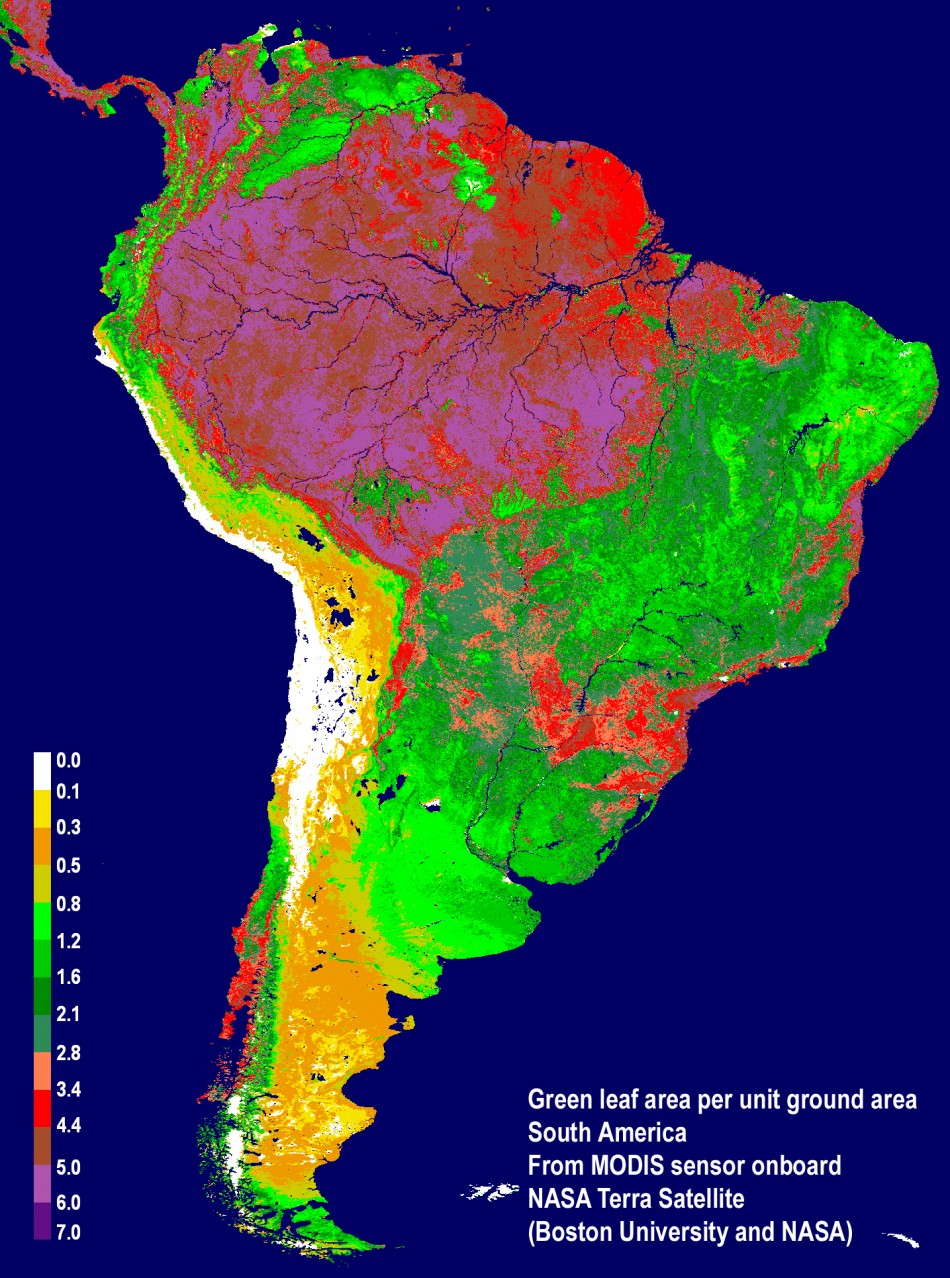
(Photo: NASA/BU) NASA satellite sensors, such as MODIS, showed an average pattern of greenness of vegetation on South America: Amazon forests which have very high leaf area are shown in red and purple colors, the adjacent cerrado (savannas) which have lower leaf area are shown in shades of green, and the coastal deserts are shown in yellow colors.


The scientists say changing climates with warmer temperatures and altered rainfall could lead to the rainforests turning into grasslands or woody savannas. This causes carbon stored in the rotting wood to be released into the atmosphere, which would add to the greenhouse gases present.
“The greenness levels of Amazonian vegetation — a measure of its health — decreased dramatically over an area more than three and one-half times the size of Texas and did not recover to normal levels, even after the drought ended in late October 2010,” Liang Xu, the study’s lead author from Boston University, said in a statement.
“The MODIS vegetation greenness data suggest a more widespread, severe and long-lasting impact to Amazonian vegetation than Read more…
NASA’s buzz about comet Elenin

IMAGE: NASA JPL
NASA posted a video on their website Buzzroom last week, bringing attention to a recently discovered comet in our solar system. The comet was discovered by Russian astronomer Leonid Elenin in December last year. Comet Elenin, as it is called, is of particular interest to NASA because of the close proximity to Earth that its orbit will reach during its turn around the sun on its way back out through the solar system later this year.
Most orbits of planets are not circles; they are ellipses. The elongated ends of elliptical orbits are called aphelions and perihelions; the aphelion being the end farthest away from the stationary object being orbited, and perihelion being the end closest to the stationary object. In Elenin’s case, its trip around our sun represents the comet’s perihelion.
So little is known about this comet because of its relatively recent-discovery status, therefore, Read more…
Powerful sunspot emerges, extreme UV radiation detected
(TheWeatherSpace.com) — A sunspot is emerging around the southeastern limb of the Sun and it is a powerful one at that.
Labeled 1176, this sunspot may have been old sunspot 1165 when it was last seen in early March on the southwestern limb of the Sun.
Since then it has rotated to the far side of the Sun and it looks as if it was busy doing so. This sunspot will have the power to generate large solar flares for the next couple weeks as it crosses the Earth facing side of the Sun.
NASA’s Solar Dynamics Observatory has recorded very high levels of UV radiation from this sunspot, a clear signal to unsettled times ahead for it and the Earth should it blast a solar flare this way.
“If this puts a flare in this direction you can bet on more powerful earthquakes in the world,” TheWeatherSpace.com Senior Meteorologist Kevin Martin said. “We’ve been quiet and that is not a coincidence.”
House-Size Asteroid Zooms Close by Earth

This NASA graphic depicts the orbit (blue curve) of asteroid 2011 EB47, which will pass close by Earth within the orbit of the moon on March 16, 2011, one day after it was discovered. The asteroid poses no threat of impacting Earth.
An asteroid the size of a house zoomed by Earth Wednesday, flying within the orbit of the moon just one day after astronomers spotting the space rock in the sky, NASA says.
The small asteroid 2011 EB74 was about 47 feet across and posed no threat of hitting Earth, since it was too small to survive the trip through the planet’s atmosphere.
Instead, the asteroid passed our planet at a comfortable distance of about 203,000 miles when it made its closest approach at 5:49 p.m. EDT, NASA officials said.
For comparison, the average distance between the Earth and the moon is about Read more…
Earth’s Core Provides Climate Insights

Summary: By studying the molten core of the planet Earth, scientists have uncovered new evidence that humans play a dominant role in changing Earth's climate. The study could have important implicaitons in understanding the future of life on our planet.
The latest evidence of the dominant role humans play in changing Earth’s climate comes not from observations of Earth’s ocean, atmosphere or land surface, but from deep within its molten core.
Scientists have long known that the length of an Earth day – the time it takes for Earth to make one full rotation – fluctuates around a 24-hour average. Over the course of a year, the length of a day varies by about 1 millisecond, getting longer in the winter and shorter in the summer. These seasonal changes in Earth’s length of day are driven by exchanges of energy between the solid Earth and fluid motions of Earth’s atmosphere (blowing winds and changes in atmospheric pressure) and its ocean. Scientists can measure these small changes in Earth’s rotation using astronomical observations and very precise geodetic techniques.
But the length of an Earth day also fluctuates over much longer timescales, such as interannual (two to 10 years), decadal (approximately 10 years), or those lasting multiple decades or even longer. A dominant longer timescale mode that ranges from 65 to 80 years was observed to change the length of day by approximately 4 milliseconds at the beginning of the Read more…
Japan Quake Shifts Earth Axis: Though Slight, Days Will Be Shortened In Centuries

The Montreal Gazette
By Carmen Chai, Postmedia News
Initial results out of Italy’s National Institute of Geophysics and Volcanology show that the 8.9-magnitude earthquake that rattled Japan Friday shifted the earth’s rotation axis by about 25 centimetres.
INGV’s report, which came hours after the devastating incident, is equivalent to “very, very tiny” changes that won’t be seen for centuries, though, Canadian geologists say.
Only after centuries would a second be lost as each day is shortened by a millionth of a second, according to University of Toronto geology professor Andrew Miall.
“Ten inches sounds like Read more…
Pace of polar ice melt ‘accelerating rapidly’: study
(AFP)
 WASHINGTON — The pace at which the Greenland and Antarctic ice sheets are melting is “accelerating rapidly” and raising the global sea level, according to findings of a study financed by NASA and published Tuesday.
The findings suggest that the ice sheets — more so than ice loss from Earth’s mountain glaciers and ice caps — have become “the dominant contributor to global sea level rise, much sooner than model forecasts have predicted.”
This study, the longest to date examining changes to polar ice sheet mass, combined two decades of monthly satellite measurements with regional atmospheric climate model data to study changes in mass.
“That ice sheets will dominate future sea level rise is not surprising — they hold a lot more ice mass than mountain glaciers,” said lead author Eric Rignot, jointly of NASA’s Jet Propulsion Laboratory and the University of California, Irvine.
“What is surprising is this increased contribution by the ice sheets is already happening,” he said.
Under the current trends, he said, sea level is likely to be “significantly higher” than levels projected by Read more…
Secretive X-37B Space Plane Launches on New Mystery Mission
| space.com
|
| The Air Force’s second X-37B robot space plane blasts off from Cape Canaveral Air Force Station in Florida on March 5, 2011 to begin its secret Orbital Test Vehicle 2 mission. CREDIT: United Launch Alliance |

After being delayed a day by bad weather, the U.S. Air Force’s second X-37B robotic space plane blasted off from Florida this afternoon (March 5) on a mystery mission shrouded in secrecy.
The unmanned X-37B mini-shuttle — known as Orbital Test Vehicle 2 (OTV-2) — took to the skies from Cape Canaveral at 5:46 p.m. EST (2246 GMT) today, tucked away in the nose cone atop a huge Atlas 5 rocket.
“Liftoff of the Atlas 5 rocket and the second experimental X-37B, America’s miniature military space shuttle,” the Air Force Space Command wrote in a Twitter post as the Atlas 5 streaked into the Florida skies.
The space plane was originally scheduled to launch yesterday, but cloudy, windy conditions scrubbed two attempts. And a technical glitch caused the X-37B to miss a launch window earlier this afternoon; a faulty valve had to be replaced in a last-minute repair.
The X-37B’s mission is classified, but Air Force officials have said the vehicle will be used to test out new spacecraft technologies. Shortly after launch, the mission went into a scheduled media blackout, with no further public updates.
Today’s launch marks the start of the X-37B program’s second space mission. The Air Force’s other X-37B plane, known as OTV-1, returned to Earth in December 2010 after a similarly mysterious seven-month maiden mission. [Photos: First Flight of the X-37B Space Plane]

CREDIT: USAF
Mysterious mini-shuttle
The X-37B spacecraft looks a bit like NASA’s space shuttles, only much smaller. The vehicle is about 29 feet long by 15 feet wide (8.8 by 4.5 meters), with a payload bay about the size of a pickup truck bed. By comparison, two entire X-37Bs could fit inside the payload bay of a space shuttle.
The space plane, built by Boeing for the U.S. military, can fly long, extended missions because of its solar array power system, which allows it to stay in orbit for up to nine months, Air Force officials have said. [Infographic: The X-37B Space Plane]
What exactly the vehicle does while circling the Earth for so long is a mystery, since the craft’s payloads and missions are classified. Partly as a result of the secrecy, some concern has been raised — particularly by Russia and China — that the X-37B is a space weapon of some sort.
But the Air Force has repeatedly denied that charge, claiming that the X-37B’s chief task is testing out new hardware for future satellites — instruments like sensors and guidance, control and navigation systems. And that’s likely to be the case, experts say.
“It gives the Air Force the ability to test-fly some of this hardware,” said Brian Weeden, a former Air Force orbital analyst who works as a technical adviser for the nonprofit Secure World Foundation.
Weeden suspects the X-37B is testing gear for the National Reconnaissance Office, the intelligence agency that builds and operates the U.S.’s spy satellites. That would explain all the secrecy, he said.

Second mission for the X-37B
The Air Force’s other X-37B, known as OTV-1, launched last April and returned in December after spending 224 days in space. While its mission was also classified, technology-testing was OTV-1’s primary job, too, Air Force officials have said.

CREDIT: United Launch Alliance
And things presumably went well, experts say, or the Air Force wouldn’t be launching the craft’s twin a few short months later.
While the X-37B is likely trying out new hardware, the vehicle itself is experimental — hence the “X” designation — so these flights should also help the Air Force assess the space plane as well as its payload.
“Part of its mission is to test out reusable technologies and to see how quickly they can turn around these vehicles and launch them again,” Weeden said.
Boeing’s Space and Intelligence Systems division builds the X-37B for the Air Force. Originally, NASA used the space plane as an experimental test bed until funding for the project ran out in 2004.
The vehicle then passed to the Defense Advanced Research Projects Agency and was ultimately turned over to the Air Force in 2006.
NASA scientist finds evidence of alien life

Aliens exist, and we have proof.
That astonishingly awesome claim comes from Dr. Richard B. Hoover, an astrobiologist at NASA’s Marshall Space Flight Center, who says he has found conclusive evidence of alien life — fossils of bacteria found in an extremely rare class of meteorite called CI1 carbonaceous chondrites. (There are only nine such meteorites on planet Earth.) Hoover’s findings were published late Friday night in the Journal of Cosmology, a peer-reviewed scientific journal.
“I interpret it as indicating that life is more broadly distributed than restricted strictly to the planet earth,” Hoover, who has spent more than 10 years studying meteorites around the world, told FoxNews.com in an interview. “This field of study has just barely been touched — because quite frankly, a great many scientist [sic] would say that this is impossible.”
Hoover discovered the fossils by breaking apart the CI1 meteorite, and analyzing the exposed rock with a Read more…
Two planets found sharing one orbit
 Buried in the flood of data from the Kepler telescope is a planetary system unlike any seen before. Two of its apparent planets share the same orbit around their star. If the discovery is confirmed, it would bolster a theory that Earth once shared its orbit with a Mars-sized body that later crashed into it, resulting in the moon’s formation.
The two planets are part of a four-planet system dubbed KOI-730. They circle their sun-like parent star every 9.8 days at exactly the same orbital distance, one permanently about 60 degrees ahead of the other. In the night sky of one planet, the other world must appear as a constant, blazing light, never fading or brightening.
Gravitational “sweet spots” make this possible. When one Read more…


![[Most Recent Quotes from www.kitco.com]](https://i0.wp.com/www.kitconet.com/charts/metals/gold/t24_au_en_usoz_2.gif)
![[Most Recent Quotes from www.kitco.com]](https://i0.wp.com/www.kitconet.com/charts/metals/silver/t24_ag_en_usoz_2.gif)

 crisisboom
 CRISISBOOM

You must be logged in to post a comment.