Archive
Over 50,000 TONS Of Deadly Radioactive Fukushima Water
Work to dispose of highly radioactive water at the crippled Fukushima Daiichi nuclear power plant is not proceeding smoothly as more time is needed for preparations. Read more…
California Seizing Property from Safety Deposit Boxes
As reported by ABC News, what started out as a program to hold unclaimed property, such as the contents of safety deposit boxes owned by people who have moved away without a forwarding address, has gone wildly out of control. The program is now using the flimsiest of excuses to drill safe deposit boxes and sell the contents.
In a case reminiscent of the Monty Python organ donor skit (or perhaps the movie Repo Men), a San Francisco woman’s jewelry appraised at over $80,000 was sold even though she lived a few blocks from her bank, had not moved, and was current on all of her box rental feeds. In another case, a man’s retirement savings consisting of $4 million of stock certificates were sold; and “A Sacramento family lost out on railroad land rights their ancestors had owned for generations”.
The program began life as a place to hold unclaimed property for up to 5 years while the state made attempts to locate the owner. Both the holding period and the efforts to locate the owner have diminished over time. ABC news indicates that there have been internal debates within the state on these changes, with an internal memo objecting to efforts to to find the owners on the grounds that “It could well result in additional claims of monies that would otherwise flow into the general fund.”
What surprises me about these seizures is the scale and how under-reported it is. This is the first article that I have seen on this topic, compared to dozens of pieces and several books on civil asset forfeiture. This phenomenon is probably at least as large as CAF — Jarret Wollstein cites a number in the low single-digit billions for asset forfeiture (which may be an annual number) compared to the $32 billion (which may be a multi-year aggregate) cited by ABC news. In comparison, looting of safe deposit boxes requires even less due process than asset forfeiture, which at least requires that the property be accused of a crime, and can be fought in court.
Salt Lake City goes wallet-free with Isis
Trial run for national rollout
 Operator consortium Isis has selected Salt Lake City as its flagship deployment to show the rest of the USA what NFC can do for them.
The plan will see Salt Lake City’s public transport system accepting pay-by-wave from a mobile phone by the middle of next year. Retailers have also been encouraged to adopt Near Field Communications technology at the point of sale, as Salt Lake City strives to become The Place You Can Leave Your Wallet At Home.
Isis was set up less than six months ago: a consortium of US network operators including AT&T, T-Mobile and Verizon. The consortium is dedicated to ensuring that electronic payments based on NFC keep their secure element in the SIM – under the control of the network operator, not the handset manufacturer or bank-card supplier – by promoting the technology and business models associated with it.
In Salt Lake City, that involves working with the Utah Transit Authority to convert all the buses and trains to accept NFC payments, as well as flooding the area with NFC handsets and SIM chips.
“I would like to express our excitement that the Salt Lake City area has been chosen to lead the roll-out of Isis mobile payments,” said Mayor Ralph Becker’s canned statement, though looking a little closer it becomes obvious why Salt Lake was chosen to lead the US into contactless payments.
The Utah Transit Authority already uses proximity payment cards, deployed in 2009, so adding NFC functionality to public transport is a matter of software not hardware, and while the City might be the capital of Utah it has a population somewhat smaller than Northampton, so presents a nicely sized area for experimentation rather than a sprawling metropolis where deployment would be more challenging.
But the transition to electronic payments isn’t going to happen overnight, and it’s good to see Isis doing something practical, and with a reasonably aggressive timetable. It will be interesting to see how the locals take to paying by wave.
China Buys 47% of the World’s Gold
 China is panicking.
Rampant inflation is driving Chinese consumers to buy gold on a massive scale…
In fact China is already set to buy almost half of all the gold that’ll be mined this year.
You read that right: The Chinese may buy nearly 50% of total world gold production in 2011.
This incredible demand will no doubt put significant strain on global supplies.
Today I want to talk about how this soaring demand may be the catalyst that pushes gold prices over the $1,500 level in as little as a few weeks.
Over 1.3 billion inflation-nervous Chinese eye gold
In January 2010, China recorded an inflation rate of 1.5%. But just 12 months later, the rate of Chinese inflation has climbed to 4.9%.
Rising inflation has sent food and property prices in China skyrocketing.
The price of food in China, for instance, has increased 10.3% on an annual basis; grain saw an increase of 15.1% and fruit is up 34.8% since January of last year:

China’s rising inflation stems from the $585 billion economic stimulus package its leaders pushed through in the depths of the financial crisis two years ago.
In dollar terms, China’s stimulus was much smaller than the $800 billion package the U.S. created. But it was much larger as a percentage of the Read more…
New Mineral (Wassonite)Found in Antarctic Meteorite
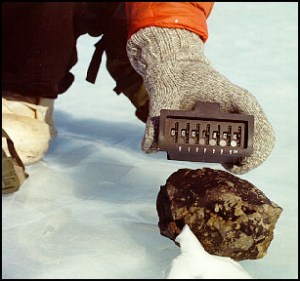 A meteorite discovered in Antarctica in 1969 has just divulged a modern secret: a new mineral, now called Wassonite.
The new mineral found in the 4.5-billion-year-old meteorite was tiny — less than one-hundredth as wide as a human hair. Still, that was enough to excite the researchers who announced the discovery Tuesday (April 5).
“Wassonite is a mineral formed from only two elements, sulfur and titanium, yet it possesses a unique crystal structure that has not been previously observed in nature,” NASA space scientist Keiko Nakamura-Messenger said in a statement.
The mineral’s name, approved by the International Mineralogical Association, honors John T. Wasson, a UCLA professor known for his achievements across a broad swath of meteorite and impact research.
Grains of Wassonite were analyzed from the meteorite that has been officially designated Yamato 691 enstatite chondrite. Chondrites are primitive meteorites that scientists think Read more…
G2-Geomagnetic Storm / Solar Watch April 8th 2011
Forecasters expect 5 big hurricanes
 At least five major hurricanes with winds of more than 111 miles per hour are expected to develop in the Atlantic during the 2011 storm season, Colorado State University forecasters said yesterday.
Overall, some 16 named storms are likely, with nine of them reaching hurricane status — an above-average season, said the forecasters led by William Gray and Phil Klotzbach. The forecast reduces by one the group’s preliminary December outlook for 17 named storms.
There is a 72 percent chance that one of the major storms will strike the US coast, above the 52 percent average for the past century, they said, and a 47 percent chance of a Gulf Coast hit. The East Coast’s odds are 48 percent.
“We reduced the number of storms but our statistical models are still calling for an active Read more…
Scientists Work on New Nerve Agent Treatment
Researchers in Ohio are developing a new treatment that would counteract the effects of exposure to deadly organophosphorus nerve agents, according to a Tuesday release from Ohio State University (see GSN, July 25, 2007).
Nerve agents can cause uncontrollable muscle spasms and other physical effects that can prove lethal in a matter of minutes.
Existing treatments counteract the material by inserting oxime compounds that adhere to the nerve agent’s phosphorous atoms and block their effects on a key enzyme from which constant activation messages would otherwise produce the spasms through transmission to muscles, organs and glands in the body. Complete recovery from exposure, though, is not always guaranteed as some nerve agent molecules can be remain attached to enzymes.
Ohio State chemistry professor Christopher Hadad and a team of scientists are using the Ohio Supercomputer Center in studying potential compounds that would allow the body to Read more…
India objects to ‘smuggling’ superbug samples out to UK
 NEW DELHI: India on Thursday seriously objected to biological samples in the form of “swabs of seepage water and tap water” being carried out of the country “on the sly” by British scientists to test the presence of the multi-drug resistant superbug.
India said it was a signatory to World Health Organization’s International Materiel Transfer Agreement as per which permission is required to carry out any biological material from the country.
“The way scientists carried out samples from India to be tested in UK does not point to a good scientific motive. It is illegal,” said Dr V M Katoch, director general of Indian Council for Medical Research. “Some people want to keep the heat on India,” he added.
According to him, such multi-drug resistant bacteria — like what is being called a superbug caused by the NDM1 gene — exists in environment across the world. “To keep on pressing India as a hotbed of such superbugs is unfair, and its motive is questionable,” Dr Katoch added.
The scientists had collected 171 swabs of seepage water and 50 public tap water samples Read more…


![[Most Recent Quotes from www.kitco.com]](https://i0.wp.com/www.kitconet.com/charts/metals/gold/t24_au_en_usoz_2.gif)
![[Most Recent Quotes from www.kitco.com]](https://i0.wp.com/www.kitconet.com/charts/metals/silver/t24_ag_en_usoz_2.gif)

 crisisboom
 CRISISBOOM
You must be logged in to post a comment.