Archive
NASA’s buzz about comet Elenin

IMAGE: NASA JPL
NASA posted a video on their website Buzzroom last week, bringing attention to a recently discovered comet in our solar system. The comet was discovered by Russian astronomer Leonid Elenin in December last year. Comet Elenin, as it is called, is of particular interest to NASA because of the close proximity to Earth that its orbit will reach during its turn around the sun on its way back out through the solar system later this year.
Most orbits of planets are not circles; they are ellipses. The elongated ends of elliptical orbits are called aphelions and perihelions; the aphelion being the end farthest away from the stationary object being orbited, and perihelion being the end closest to the stationary object. In Elenin’s case, its trip around our sun represents the comet’s perihelion.
So little is known about this comet because of its relatively recent-discovery status, therefore, Read more…
Upcomming days of interest for possible Seismic Activity
- Keep in mind of sunspot 1176’s possible activity
House-Size Asteroid Zooms Close by Earth

This NASA graphic depicts the orbit (blue curve) of asteroid 2011 EB47, which will pass close by Earth within the orbit of the moon on March 16, 2011, one day after it was discovered. The asteroid poses no threat of impacting Earth.
An asteroid the size of a house zoomed by Earth Wednesday, flying within the orbit of the moon just one day after astronomers spotting the space rock in the sky, NASA says.
The small asteroid 2011 EB74 was about 47 feet across and posed no threat of hitting Earth, since it was too small to survive the trip through the planet’s atmosphere.
Instead, the asteroid passed our planet at a comfortable distance of about 203,000 miles when it made its closest approach at 5:49 p.m. EDT, NASA officials said.
For comparison, the average distance between the Earth and the moon is about Read more…
Woman Predicted 03/11 Earthquake on 03/08
MARCH 11-23 EVENT?! Signs and Evidence
Sun Emitting Solar Flare
Look at the size of that solar flare! Lots of activity on the way folks.

Planet “X” Revealed by Cornell University
Headlines from recent Cornell University web pages.:
Persistent Evidence of a Jovian Mass Solar Companion in the Oort Cloud
search.arxiv.org:8081/paper.jsp?r=1004.4584&qid=null&qs=nemesis&byDate=1
We present an updated dynamical and statistical analysis of outer Oort cloud cometary evidence suggesting the sun has a wide-binary Jovian mass companion. The results support a conjecture that there exists a companion of mass ~ 1-4 M_Jup orbiting in the innermost region of the outer Oort cloud. Our most restrictive prediction is that the orientation angles of the orbit normal in galactic coordinates are centered on the galactic longitude of the ascending node Omega = 319 degree and the galactic inclination i = 103 degree (or the opposite direction) with an uncertainty in the normal direction subtending ~ 2% of the sky. A Bayesian statistical analysis suggests that the probability of the companion hypothesis is comparable to or greater than the probability of the null hypothesis of a statistical fluke. Read more…
Two planets found sharing one orbit
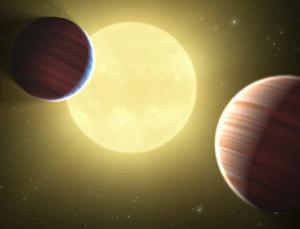 Buried in the flood of data from the Kepler telescope is a planetary system unlike any seen before. Two of its apparent planets share the same orbit around their star. If the discovery is confirmed, it would bolster a theory that Earth once shared its orbit with a Mars-sized body that later crashed into it, resulting in the moon’s formation.
The two planets are part of a four-planet system dubbed KOI-730. They circle their sun-like parent star every 9.8 days at exactly the same orbital distance, one permanently about 60 degrees ahead of the other. In the night sky of one planet, the other world must appear as a constant, blazing light, never fading or brightening.
Gravitational “sweet spots” make this possible. When one Read more…
Get ready for a ‘global Katrina’: Biggest ever solar storm could cause power cuts which last for MONTHS

- Earth is overdue a solar storm as the sun enters its most active period.
The world is overdue a ferocious ‘space storm’ that could knock out communications satellites, ground aircraft and trigger blackouts – causing hundreds of billions of pounds of damage, scientists say.
Astronomers today warned that mankind is now more vulnerable to a major solar storm than at any time in history – and that the planet should prepare for a global Katrina-style disaster.
A massive eruption of the sun would save waves of radiation and charged particles to Earth, damaging the satellite systems used for synchronizing computers, airline navigation and phone networks.
NIBIRU,PLANET X Admitted by Scientists – NASA shuts down Space Telescope ‘WISE’!!
You know how you sometimes can sense that something is present even though you can’t see it? Well, astronomers are getting that feeling about a giant, hidden object in space.
And when we say giant, we mean GIANT.

They’ve found the largest planet ‘IN OUR SOLAR SYSTEM’!. It orbits our Sun in a far elliptical orbit, and is said to be 4x’s the size of Jupiter! It has a helium and hydrogen atmosphere. It’s most likely to have moons! This planet fits the exact description of Planet X!
So, one must ask, why are they suddenly telling us now? Scientists have known about this planet since 1983 ( Read article below) and they’ve been using WISE and IRAS to monitor it. Does this mean it will be visible this year? I’m thinking so. They have no choice but to tell us as it will viewable to everyone w/o a telescope this year. And why are they not calling this planet by its real name? Nibiru? Planet X? Well, that would mean that all of Read more…
Modern Society Threatened by Solar Storms

NASA/SDO/AIA
The Earth just dodged a solar bullet. But it won’t be the last. Experts say a geomagnetic storm, sparked by a massive solar eruption similar to the one that flared toward the Earth on Tuesday, is bound to strike again, and the next one could wreak more havoc than the world has ever seen.
Modern society is increasingly vulnerable to space weather because of our dependence on satellite systems for synchronizing computers, navigational systems, telecommunications networks and other electronic devices.
A potent solar storm could disrupt these technologies, scorch satellites, crash stock markets and cause months-long power outages, experts said Saturday at the Read more…


![[Most Recent Quotes from www.kitco.com]](https://i0.wp.com/www.kitconet.com/charts/metals/gold/t24_au_en_usoz_2.gif)
![[Most Recent Quotes from www.kitco.com]](https://i0.wp.com/www.kitconet.com/charts/metals/silver/t24_ag_en_usoz_2.gif)

 crisisboom
 CRISISBOOM
You must be logged in to post a comment.