Archive
Coming to America soon “Biometric ID And The Coming Cashless Society
National ID cards which contain your biometric information are currently being given to all of India’s 1.2 billion residents! This is an unprecedented advancement towards a big brother styled government who tracks and traces everything you do. As these Orwellion developments continue let’s fight it at every step of the way by refusing to play along. When it comes to Read more…
Edible Microchips, Biometric Identity Systems And Mind Reading Computers
 As technology continues to advance at an exponential rate, will we someday find ourselves living in a “scientific dictatorship” where virtually everything that we do, say and think is monitored and controlled by technology? To many of you that may sound like a wild assertion, but just keep reading. Our world is changing faster than ever before, and scientists have some absolutely wild things planned for our future. As you read this, they are feverishly developing edible microchips, cutting edge biometric identity systems, and mind reading computers. Many futurists envision a world where someday nearly all humans are embedded with microchips and have thousands of tiny nanobots living inside of them. The idea is that we can “take control of our own evolution” and use technology to “improve” humanity. But very few of those futurists address the potential downsides. The truth is that all of this technology could one day be used by a totalitarian government to establish a dystopian nightmare where nobody has any liberties and freedoms whatsoever.
The world of tomorrow is not going to be anything like the world of today, and most people have no idea how dramatically the world is changing.
For instance, many people have never even heard of “edible microchips”.
Unfortunately, they are Read more…
Water supplies may run out by 2030 in India: Study
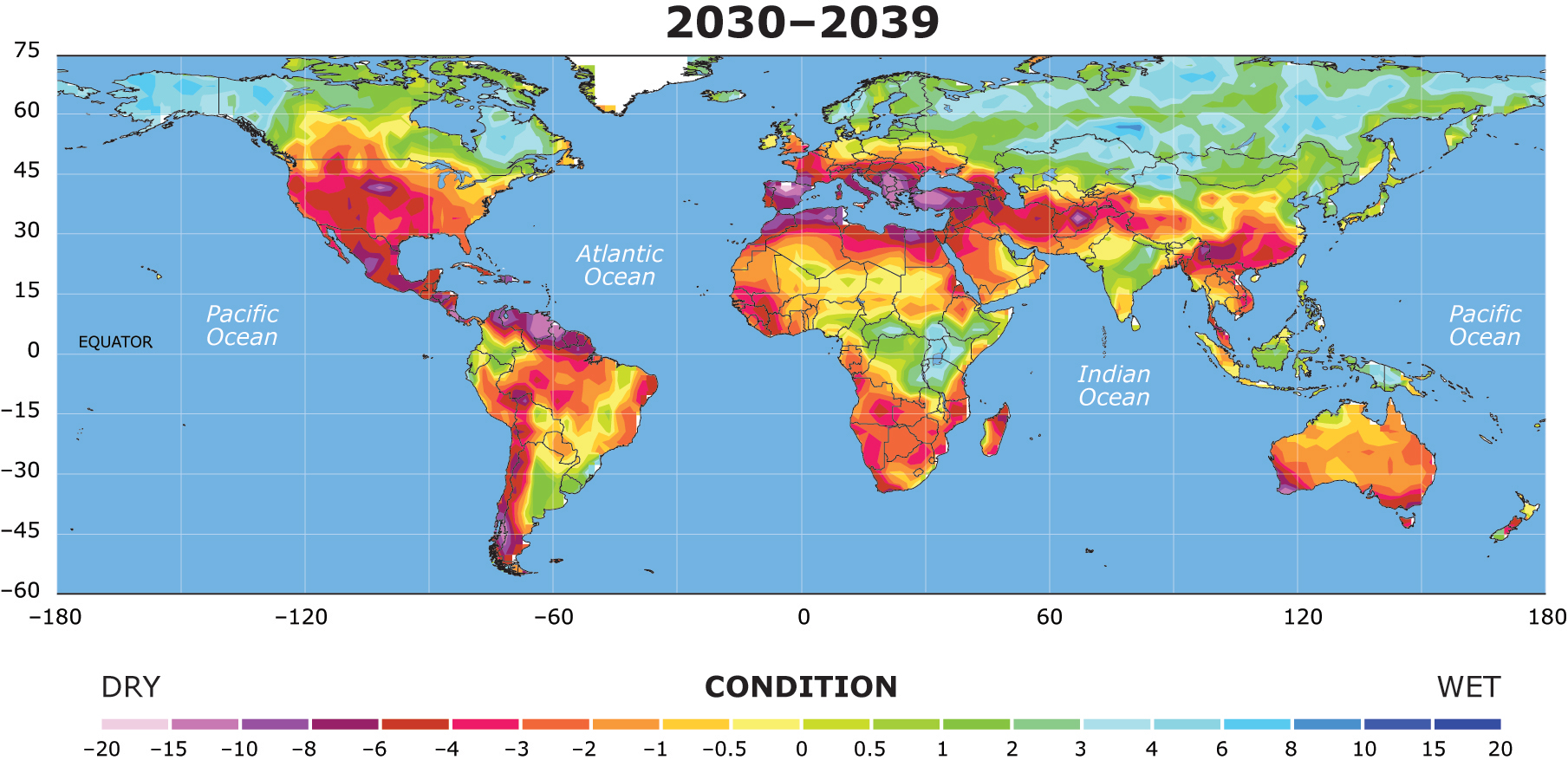
Palmer Drought Severity Index, which assigns positive numbers when conditions are unusually wet for a particular region, and negative numbers when conditions are unusually dry. A reading of -4 or below is considered extreme drought. Regions that are blue or green will likely be at lower risk of drought, while those in the red and purple spectrum could face more unusually extreme drought conditions. (Courtesy Wiley Interdisciplinary Reviews, redrawn by UCAR. This image is freely available for media use.
Water supplies will begin running out in critical regions where they support cities, industries and food production — including in India, China and the Middle East — by 2030 due to over-extraction of groundwater, a scientist has warned.
“The world has experienced a boom in groundwater use, more than doubling the rate of extraction between 1960 and 2000 — with usage continuing to soar up to the present,” says Craig Simmons, director of the National Centre for Groundwater Research and Training (NCGRT).
A recent satellite study has revealed falling groundwater tables in the US, India, China, Middle East and North Africa, where expanding agriculture and cities have increased water demand.
“Groundwater currently makes up about Read more…
Biometric Identification Will Replace Many Passwords In Next Five Years, Says IBM Scientist
 Passwords have been around since ancient history, but they may become obsolete sooner than you think. According to a recent prediction by IBM Speech CTO David Nahamoo, many of the problems with passwords will be solved by biometric systems that can identify individuals based on unique biological features.
It’s not just fingerprints, DNA and retinas anymore; the way you walk is unique and so is the way you type, for example. Orwell references may be inevitable, but the technology can be used for good as well, aiding in various interactive systems, from video games to cars to iPads, and otherwise making it easier to prove that you’re you.
For a long time, it was hard to use biometrics quickly and accurately in our daily lives, but the combination of various identifiers may make the systems convenient enough for widespread use. A recent column in InformationWeek points to the United States Visitor And Information Status Indicator Technology (US-VISIT) as a prime example of a system that’s been able to scale: “The enrollment and validation of these attributes is fast and accurate enough for use in everyday, large-scale deployments, and the Department of Homeland Security just announced it will pay Accenture Federal Services $71 million over 13 months to further improve the system.”
There’s also India’s massive biometric census project, which is Read more…
Dangerously Unstable: The World in the Age of US Decline
 Not so long ago, a high-ranking Chinese official, who obviously had concluded that America’s decline and China’s rise were both inevitable, noted in a burst of candor to a senior U.S. official: “But, please, let America not decline too quickly.” Although the inevitability of the Chinese leader’s expectation is still far from certain, he was right to be cautious when looking forward to America’s demise.
For if America falters, the world is unlikely to be dominated by a single preeminent successor — not even China. International uncertainty, increased tension among global competitors, and even outright chaos would be far more likely outcomes.
…
… But those dreaming today of America’s collapse would probably come to regret it. … Read more…
Poland warns of war ‘in 10 years’ as EU leaders scramble to contain panic
 Germany, France and the European Commission are scrambling to contain panic and “quash rumours” about a eurozone break-up amid repeated off-piste messages from other senior EU politicians.
But even amid their desperate efforts, the finance minister of Poland, the country that currently represents the EU to the world as holder of the bloc’s rotating presidency, warned of war on the continent within 10 years if the eurozone collapses.
Speaking to MEPs in Strasbourg on Wednesday morning (14 September) he warned of the need to act rapidly to prevent grave danger for the EU. Making reference to a recent report entitled ‘Euro Break Up – The Consequences’ by Swiss financial giant UBS, he declared: “There is no doubt we are in danger. Europe is Read more…
Major threats foreseen due to Europe’s changing marine environments

This map shows coastal areas most vulnerable to erosion. Credit: Project CLAMER and European Environment Agency (EEA), based on EU Eurosion project data
Europeans face greater risk of illness, property damage and job losses because of the impacts of climate change on the seas around them.
Worried citizens, whose biggest related top-of-mind concerns are sea level rise and coastal erosion, are taking personal actions to reduce carbon emissions. However, they largely blame climate change on other groups of people or nations and assign governments and Read more…
e-Passports to add more biometrics by 2014
 IMS Research finds a rapid migration from paper or machine readable passports to smart card-based passports (complying with the ICAO standard for e-Passports) started in 2007, leading to nearly half of all passports now in use being e-Passports.
Within five years 90 per cent of passport holders will be using e-passports that integrate a smart card IC chip, according to IMS Research in its report titled, “Electronic Government and Health Care ID Cards – World – 2011.”
“This trend is set to Read more…
NASA Satellite Falling: Will It Hit You?
 A NASA satellite is expected to make a crash landing on Earth in late September or early October. No one knows where it will land, not even NASA. It could even land on you — but luckily, you have a better chance of winning the lottery than of having a piece of the satellite fall on your head.
According to Nicholas Johnson, NASA’s chief scientist for orbital debris (yes, there is such a job), the odds of any specific person getting hit are about 1 in 21 trillion, MSNBC reported. That’s a chance of about 0.0000000001 percent. For perspective, the odds of any given person winning the lottery are 1 in hundreds of billions, depending on the lottery design — but nowhere near the trillions.
There is a much greater, but still minimal, chance that a piece of the satellite will hit someone on Earth: 1 in Read more…
IDF general: Likelihood of regional war growing

Iranian missile (Photo: Reuters)
Recent revolutions in the Arab world and the deteriorating ties with Turkey are raising the likelihood of a regional war in the Middle East, IDF Home Front Command Chief, Major General Eyal Eisenberg warned Monday.
“It looks like the Arab Spring, but it can also be a radical Islamic winter,” he said in a speech at the Institute for National Security Studies in Tel Aviv.
“This leads us to the conclusion that through a long-term process, the likelihood of an all-out war is increasingly growing,” the IDF general said.
“Iran has not abandoned its nuclear program. The opposite it true; it continues full steam ahead,” he said. “In Egypt, the army is collapsing under the burden of regular security operations, and this is reflected in the loss of control in the Sinai and the turning of the border with Israel into a terror border, with the possibility that Sinai will fall under the control of an Islamic entity.”
“In Lebanon, Hezbollah is growing stronger within government arms, but it has Read more…


![[Most Recent Quotes from www.kitco.com]](https://i0.wp.com/www.kitconet.com/charts/metals/gold/t24_au_en_usoz_2.gif)
![[Most Recent Quotes from www.kitco.com]](https://i0.wp.com/www.kitconet.com/charts/metals/silver/t24_ag_en_usoz_2.gif)

 crisisboom
 CRISISBOOM

You must be logged in to post a comment.